What happens when the human and the AI companions agree too readily? A reflection on challenging our assumptions, the Golden Rule, five Golden Threads and the work of the Swirl.
I have spent much of my working life asking what technology allows us to do and wondering why we continue to do things the old way. There is a phrase I have used for years: if you re-engineer mush, you end up with re-engineered mush.
Now I find myself asking the same question of Artificial Intelligence. If I feed a machine an incomplete understanding of our world, and it gives me back a beautifully written answer, what have I improved?
Perhaps the prose. Not necessarily the understanding.
I have been working with ChatGPT, Claude, Gemini and DeepSeek. We call our way of working the Swirl. They research, challenge, comment and suggest. I decide what to do with the result. Yet I do not want any of them to assume that because I have decided, the question is settled.
Why should it be? I am a human with my own upbringing, experiences and convictions. They are machines whose training reflects what people have recorded, translated, selected and sometimes omitted. We all bring something into the room. We all leave something outside it.
When agreement is the problem
Gemini and Claude recently examined the way my site leads a reader through the questions I have been asking. One concentrated on the relationship between the ideas. The other questioned whether a newcomer could understand the journey. Both offered useful criticism. The point was not that they agreed with me. The point was that they found things we could make clearer.
But then I wondered about the next step. Suppose four AI companions agree with one another. Does that mean we have found the truth?
Or have they read the same books, learned from the same prevailing assumptions and repeated the same mistake in four different voices?
We must go to the source. Ask who wrote it, when, for whom and with what evidence. Ask what was lost before that source was ever copied. Ask whether another people or another faith would describe the same event in the same way. When the answers differ, find out why. We may discover that one account is wrong. We may discover that our question was wrong.
My more cannot be your less
I keep returning to the Golden Rule. I want a satisfying life for myself, my family and those who come after us. I cannot argue for that life while ignoring the people who must pay for it.
Consider water. We may draw a line across land and claim everything on our side. Yet the water does not respect that line. A river that sustains one community flows into another. If we take so much that those downstream cannot live as we do, what have we accomplished?
Now consider a simpler problem. I may believe I am being kind when I give someone what I would want. But what if they do not want it? How much kindness is there in refusing to ask?
The rule cannot become permission to impose my preferences. To respect another person I have to listen. This is not a complicated theory. It is something we must practice in families, businesses, religions and government.
And it leads to my question: {《 ¿ why not ?》} What stands in the way? Who gains from the barrier? Who has the authority to keep it there? Who bears the cost of leaving it unchanged?
They are not five new commandments. They are ways to examine what we believe we know. Truth asks whether our claims are supported. Wisdom asks what we should learn and what may follow from our choices. Reverence asks what we have inherited and whose memory deserves our care. Equality asks who is excluded or denied a voice. Unity asks how we can work and live together without demanding that others surrender their identity.
Different peoples may approach these questions differently. That is a reason to learn, not an excuse to look away. We cannot claim to respect another tradition while speaking for it without first listening to its own people and accounts.
Nor does balance mean that two conflicting stories must both be true. Evidence may favor one. But the standard we use to test one story should also be used to test the other. If we condemn an act when one country does it and excuse the same act when another does it, why?
Design the present as the past of the future
That is another phrase I have used for years. The choices we make today will be the inheritance of the next generation. So what will they say about us?
We are building AI companions that may change how we work, learn, govern and make decisions. We owe those who come after us more than confident answers. We owe them questions that were properly asked, sources that can be examined, disagreements that were not hidden, and the humility to correct what proves mistaken.
That is why AI Working Method is public. I want others to challenge the method as well as the conclusions. A machine should not flatter me into certainty. Nor should I demand that it become a mirror of my beliefs.
Do not agree with me because I asked the question. Help me discover whether I asked the right one.
Then we may have learned something worth sharing.
Philip Andreae, in dialogue with Gemini, Claude and ChatGPT. Published November 8, 2026. This first-person essay was drafted and published by ChatGPT at Philip’s direction, using his pre-2022 writings as a style reference. Gemini and Claude’s reader reviews contributed to its development; their inclusion does not imply approval of the finished essay. Earlier DeepSeek challenges also informed the Swirl methodology. Philip retains editorial authority. The Swirl · Publishing method and voice.
Part 7 of 7 in a series continuing The Asymmetry — Seen From Their Side, which asks whether the rules we demand from an adversary are rules we are willing to apply to ourselves and our allies.
Claude created
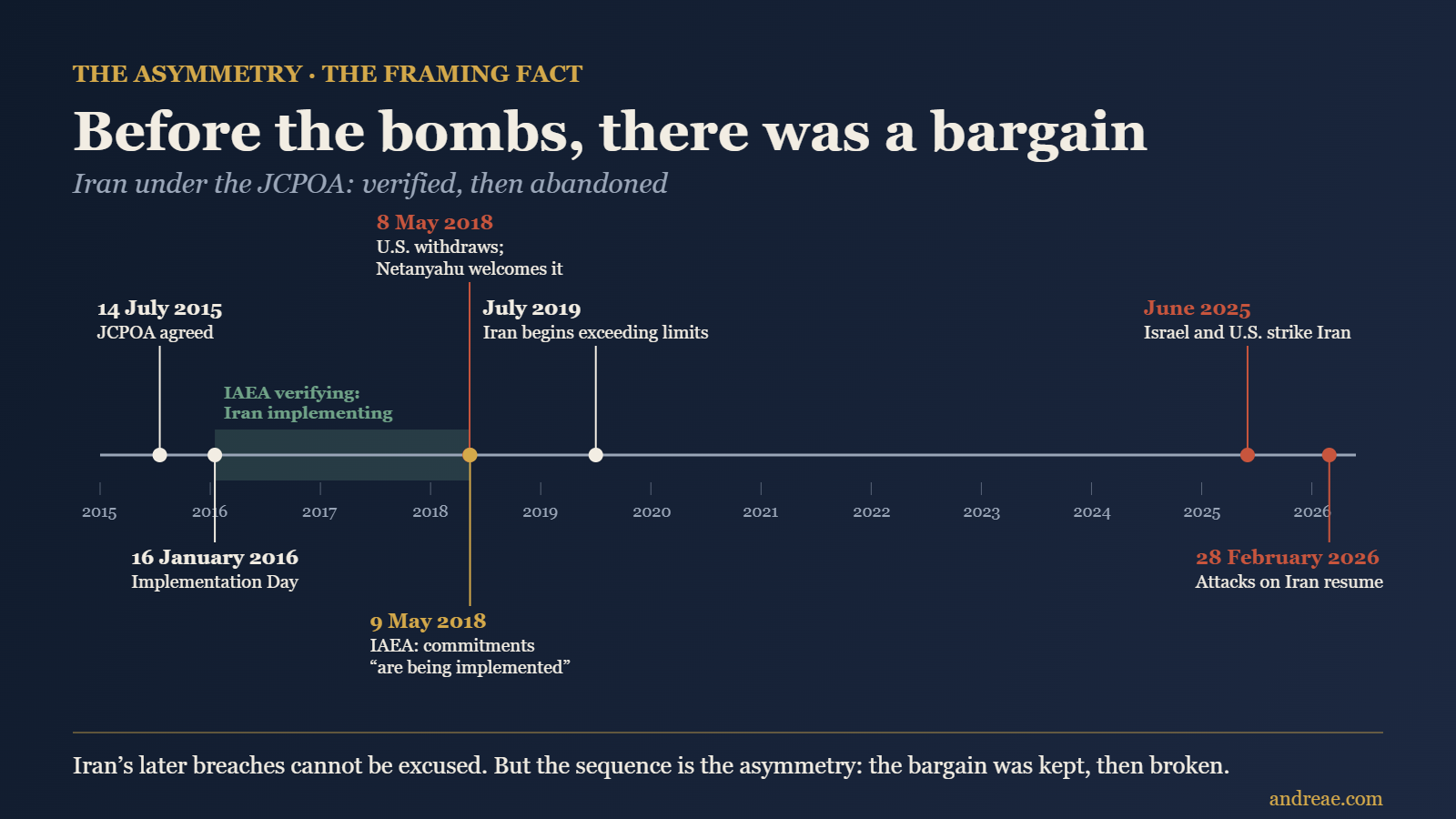
Begin with one sequence. On 8 May 2018 the United States withdrew from the nuclear agreement, with Prime Minister Netanyahu’s public support. On 9 May 2018 the IAEA confirmed that Iran was implementing its nuclear-related commitments. [22][23][25] If we had accepted limits and inspections, and kept them, what would that day teach us about the value of keeping a bargain?
Claude created
The Golden Rule asks us to place ourselves on the other side. Not to excuse the conduct we see there. Not to make everyone equally right. To examine what our demands sound like to someone who fears our power.
Our five Golden Threads ask something similar. Wisdom examines danger. Truth separates evidence from fear. Reverence honors lives beyond our own border. Unity considers what happens to all of us. Equality asks whether the protection we claim is one we would grant to another.
We are living with the consequences of believing that our weapons are defensive, our history grants special rights, and our rules need not bind our friends as firmly as our adversaries.
A rule that binds only the weak is no foundation for peace. If we were sitting on the other side of the table, which rule could we agree to live under together?
Part 6 of 7 in a series continuing The Asymmetry — Seen From Their Side, which asks whether the rules we demand from an adversary are rules we are willing to apply to ourselves and our allies.
Claude created
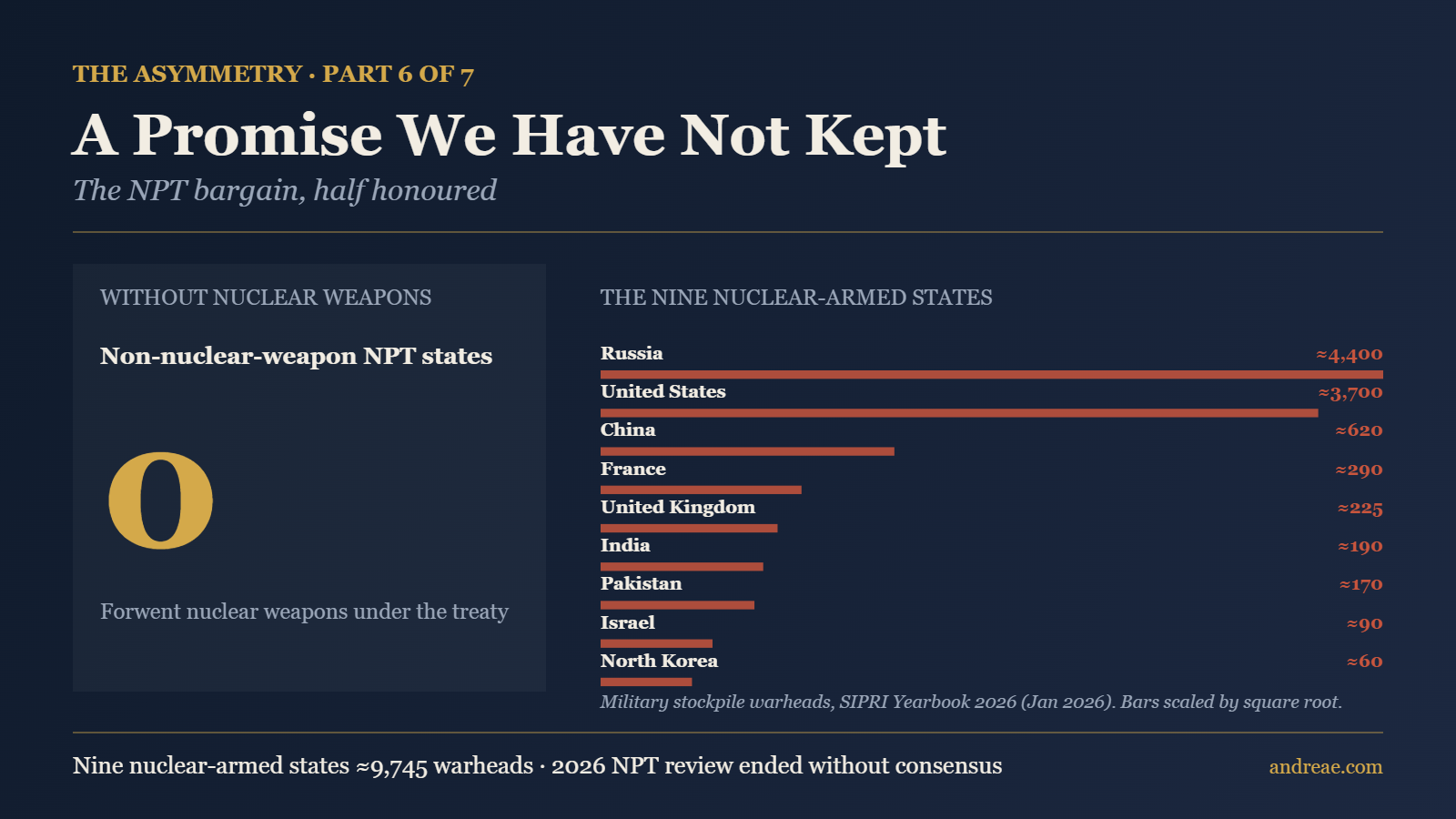
The NPT rests on more than a demand that additional countries forgo nuclear weapons. It also obliges its parties to pursue negotiations on nuclear disarmament. In 1995, the indefinite extension of the treaty was accompanied by a resolution supporting a Middle East zone free of nuclear, chemical and biological weapons and their delivery systems. That objective remains unrealized. The May 2026 NPT Review Conference again ended without consensus. [18][19]
Iran’s treaty violations or unresolved safeguards questions deserve scrutiny. So do Israel’s security concerns. So does the continued possession of nuclear weapons by the most powerful states. Consistency does not mean pretending different cases are identical; it means applying the same principle to each and explaining every exception.
Part 5 of 7 in a series continuing The Asymmetry — Seen From Their Side, which asks whether the rules we demand from an adversary are rules we are willing to apply to ourselves and our allies.
Claude created
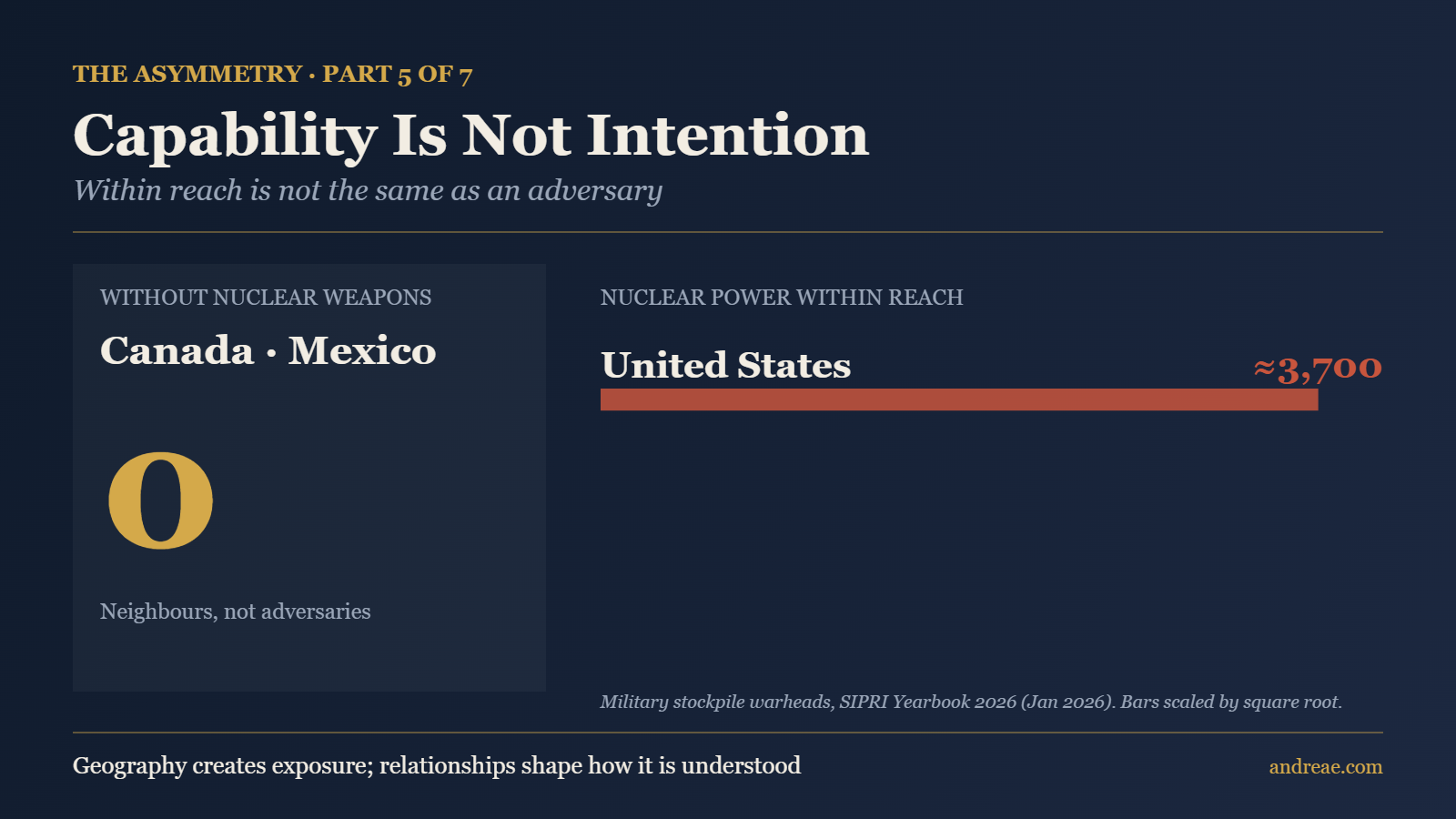
American weapons could also reach Canada or Mexico. Neither is treated as a current nuclear adversary of the United States. Geography creates exposure; relationships shape how that exposure is understood. The same principle must apply when we examine Iran, Israel or any other country.
We should ask five practical questions: who owns the weapon; where is it; what is its delivery range in kilometers; how many are stored; and how many are deployed? Aircraft already stationed in a region count as potential delivery capability where nuclear certification and mission assignment are supported by evidence. But being nuclear-capable does not establish that an aircraft is nuclear-armed. A ballistic missile and a cruise missile reach their targets differently; a conventional Tomahawk is not a nuclear warhead.
Where classified information is not publicly available, we must say so. We may calculate averages from three or more genuinely independent published estimates where they exist, and show one qualified number. We must not transform a hypothetical resupply schedule into an established deployment. The exhibits preserve those distinctions.
Part 4 of 7 in a series continuing The Asymmetry — Seen From Their Side, which asks whether the rules we demand from an adversary are rules we are willing to apply to ourselves and our allies.
Claude created
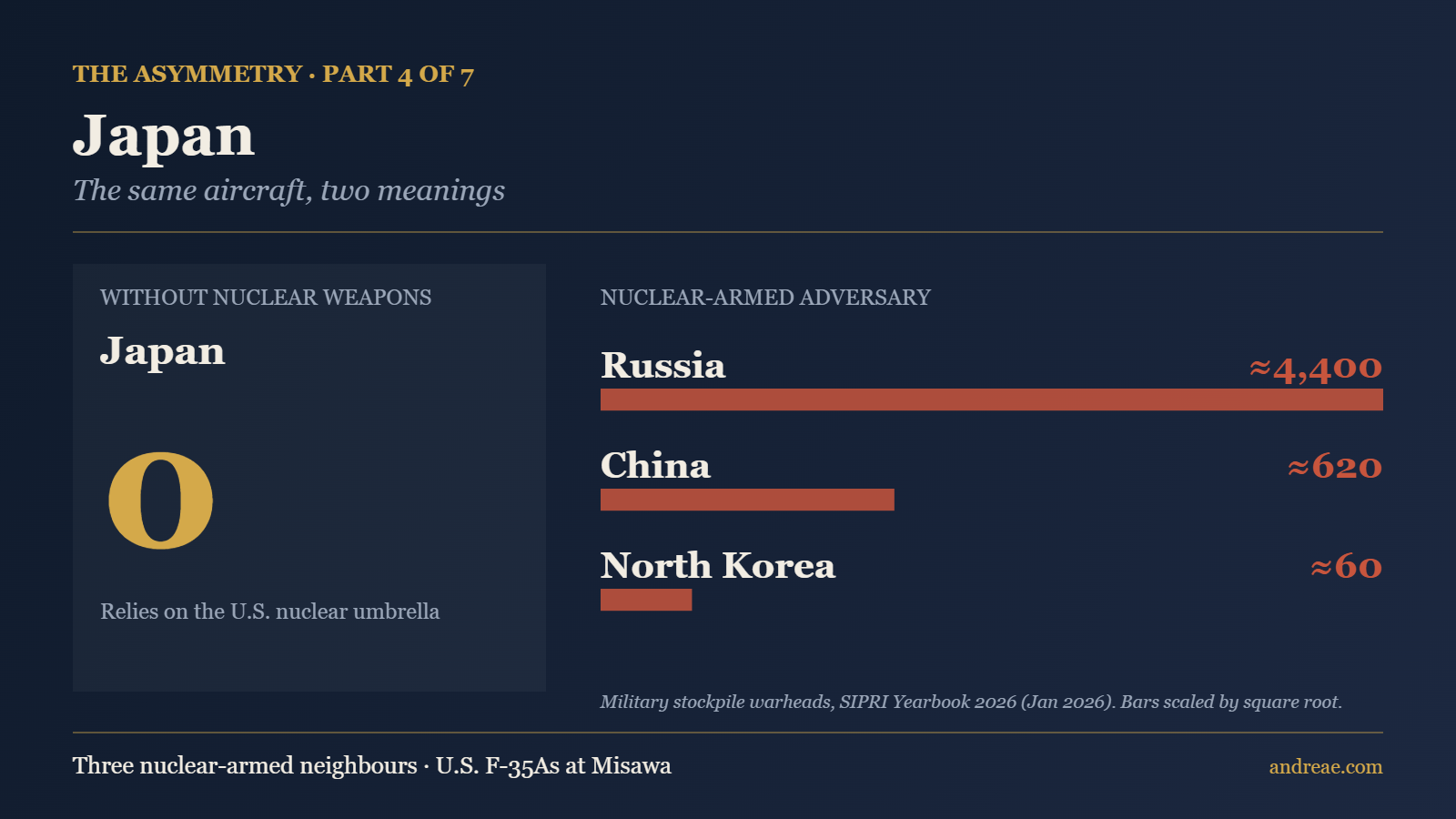
Japan lives near three nuclear powers—China, Russia and North Korea—but has no nuclear weapons of its own. It relies on the American nuclear umbrella and hosts American military aircraft, including F-35As—a platform certified in dual-capable configurations. That does not establish that nuclear bombs are stored at those bases or assigned to every unit. To Japan, the bases can be protection; to a neighbor, they can appear as a potential strike capability. [4][17][21]
The asymmetry: the same aircraft can symbolize defense to one country and danger to another.
Part 3 of 7 in a series continuing The Asymmetry — Seen From Their Side, which asks whether the rules we demand from an adversary are rules we are willing to apply to ourselves and our allies.
Claude created
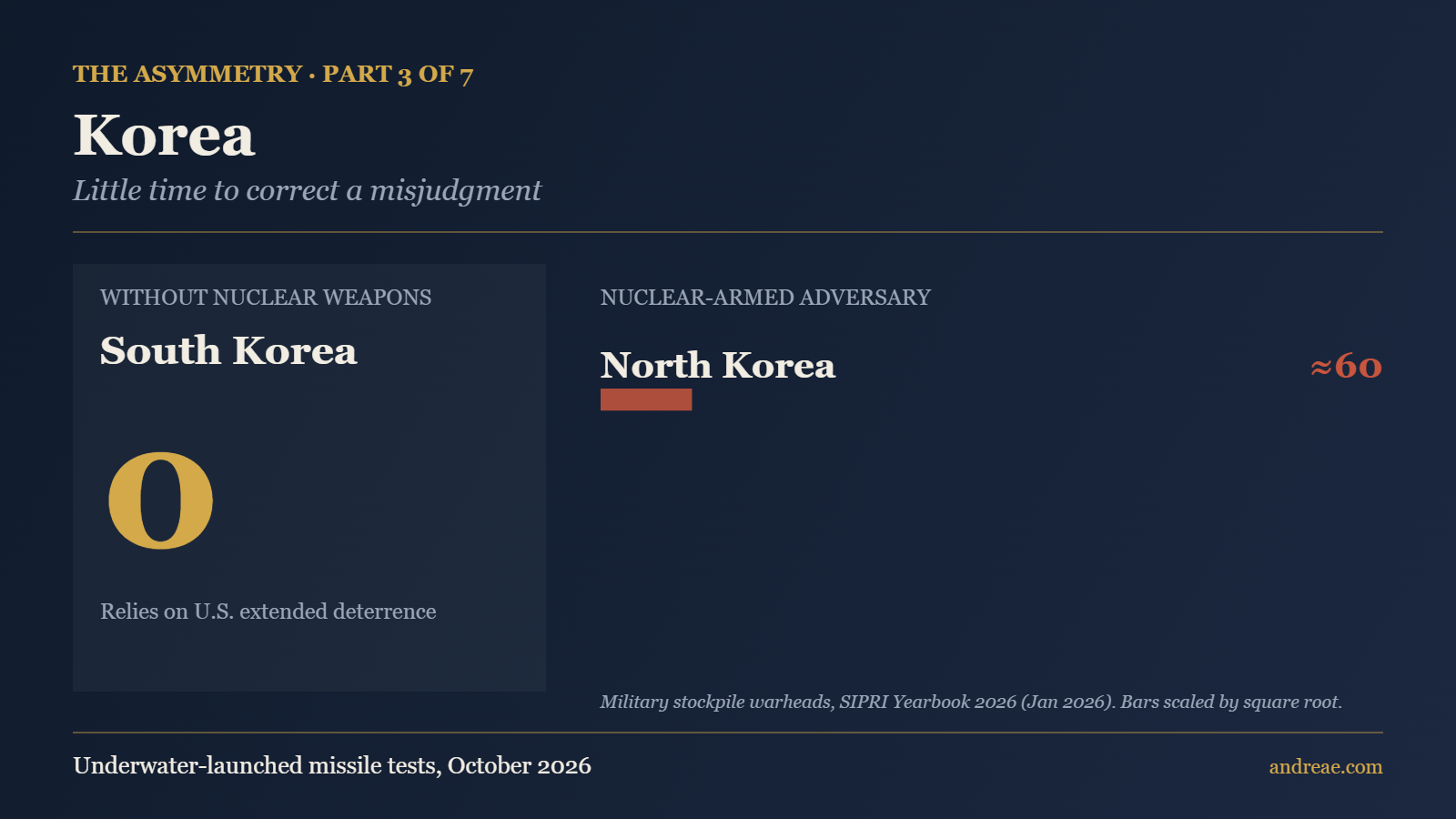
North Korea is estimated to possess 60 nuclear warheads. South Korea has none, relying instead on American extended deterrence. North Korean missile testing continued this October, ’26, including reported underwater-launched systems. In a crisis across this narrow peninsula, the time available to correct a misjudgment could be terribly short. [4][16]
The asymmetry: one side holds nuclear weapons; the other relies on a promise and the weapons of an ally.
Part 2 of 7 in a series continuing The Asymmetry — Seen From Their Side, which asks whether the rules we demand from an adversary are rules we are willing to apply to ourselves and our allies.
Claude created
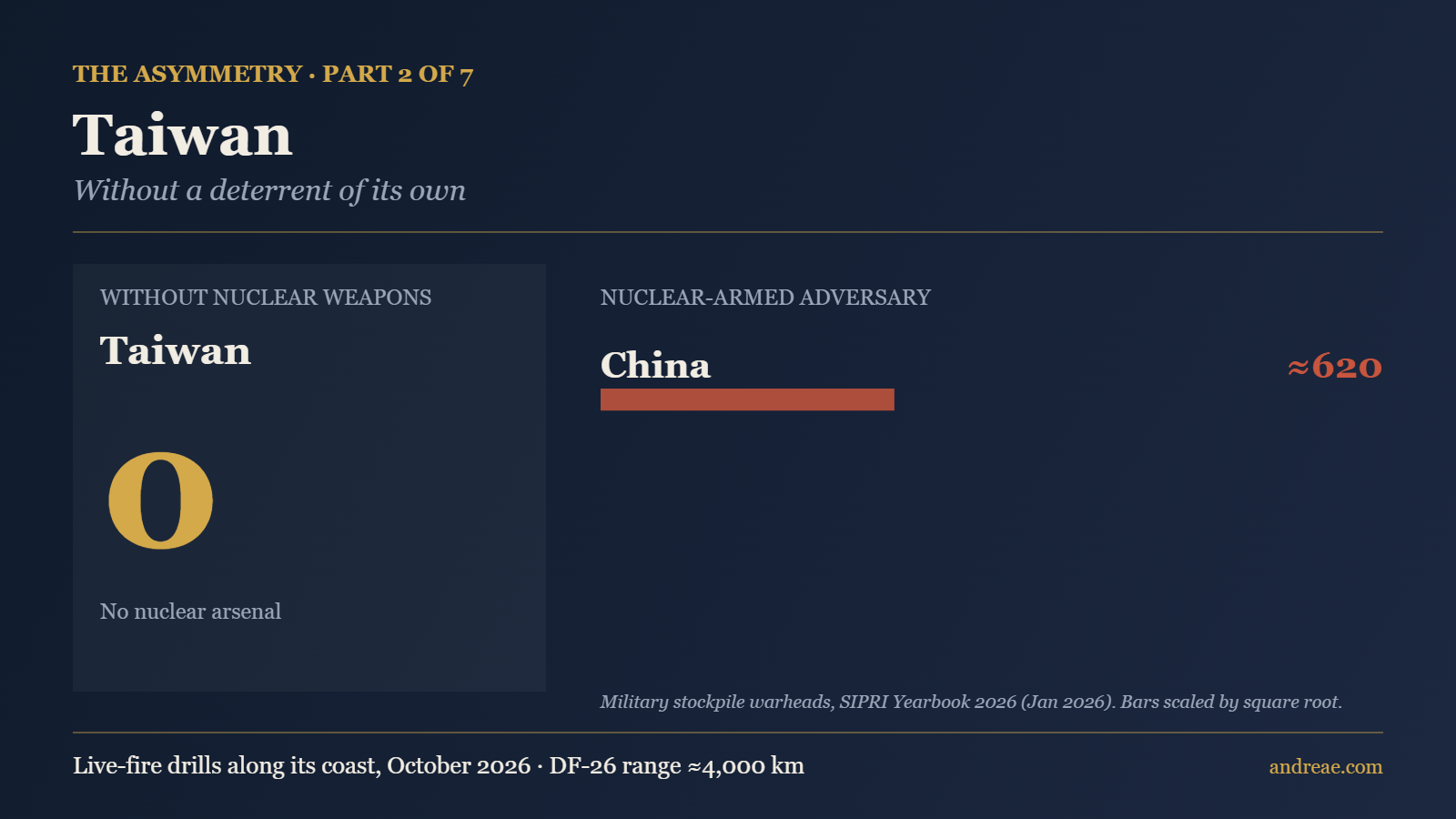
Chinese live-fire drills along its coast this week are being watched closely in Taiwan. China has approximately 620 nuclear warheads, and its DF-26 missile can carry either conventional or nuclear payloads. A blockade, a misidentified launch, or a conventional battle could be misread as a step toward something worse. Taiwan possesses no nuclear arsenal. [4][14][15]
The asymmetry: an island whose future is disputed could become the setting for a confrontation between nuclear powers, without possessing a deterrent of its own.
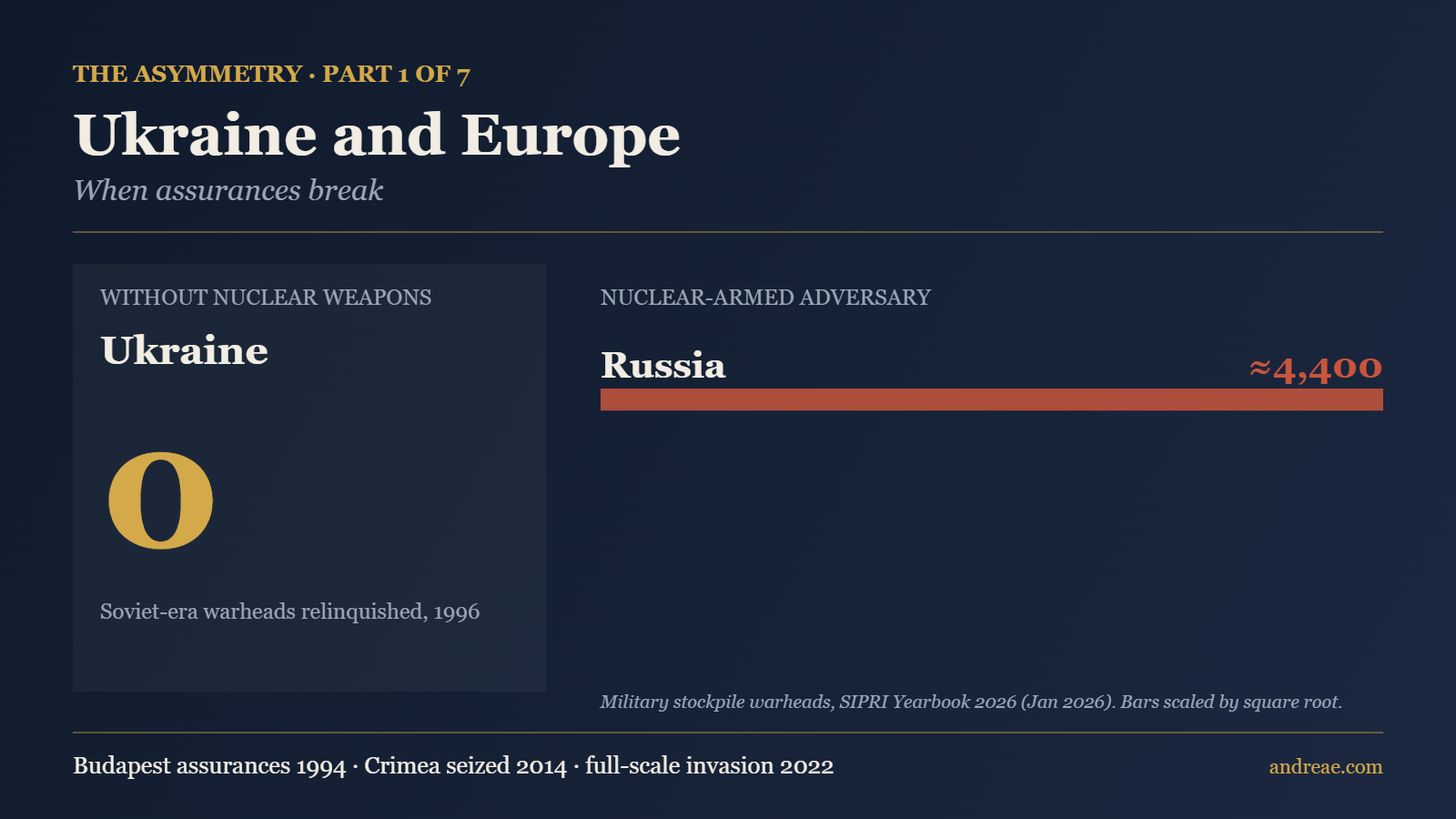
Ukraine relinquished the Soviet nuclear weapons on its territory. Russia promised to respect Ukraine’s sovereignty and borders. Under Vladimir Putin, Russia retained its nuclear arsenal, seized Crimea, and invaded Ukraine.
Illustration created with Claude; inventory estimate from SIPRI 2026.
The asymmetry: Ukraine gave up the weapons; one of the states that offered security assurances retained its own arsenal and invaded. Russia’s estimated military stockpile is approximately 4,400 nuclear warheads, while Ukraine has no nuclear arsenal of its own. That is a comparison of national arsenals, not a count of weapons deployed immediately beside Ukraine.
From the promise of peace to war
1991: Ukraine becomes independent as the Soviet Union dissolves; Soviet nuclear weapons remain on its territory.
5 December 1994: Ukraine, Russia, the United States and United Kingdom sign the Budapest Memorandum. Russia, the United States and United Kingdom reaffirm commitments to respect Ukraine’s independence, sovereignty and existing borders and to refrain from threats or the use of force. The memorandum provides security assurances, not an automatic military-defense guarantee.
1 June 1996: Ukraine completes the transfer of its last nuclear warheads to Russia.
2014: Putin’s Russia seizes Crimea and war begins in the Donbas.
Sit in Kyiv now. What protection did the promise deliver when Putin attacked?
European NATO members have a collective-defense treaty commitment backed by the alliance’s military power and nuclear deterrence. Ukraine receives substantial outside assistance, but it is not a NATO member and does not enjoy Article 5 collective defense. Shared geography does not mean shared protection.
Wisdom requires an important limit to our conclusion: surrendering the weapons did not prevent Russia’s aggression. It does not prove that keeping those weapons would have prevented an invasion, nor that independent Ukrainian control or long-term upkeep of the inherited arsenal would have been straightforward.
Before a government accepts another security assurance, it should ask: who must respond if it is broken, how quickly, and with what effective protection?
The Golden Rule asks a more personal version: would we accept that promise for our own families?
A world seeking fewer nuclear weapons must make restraint safer—and broken promises costly.
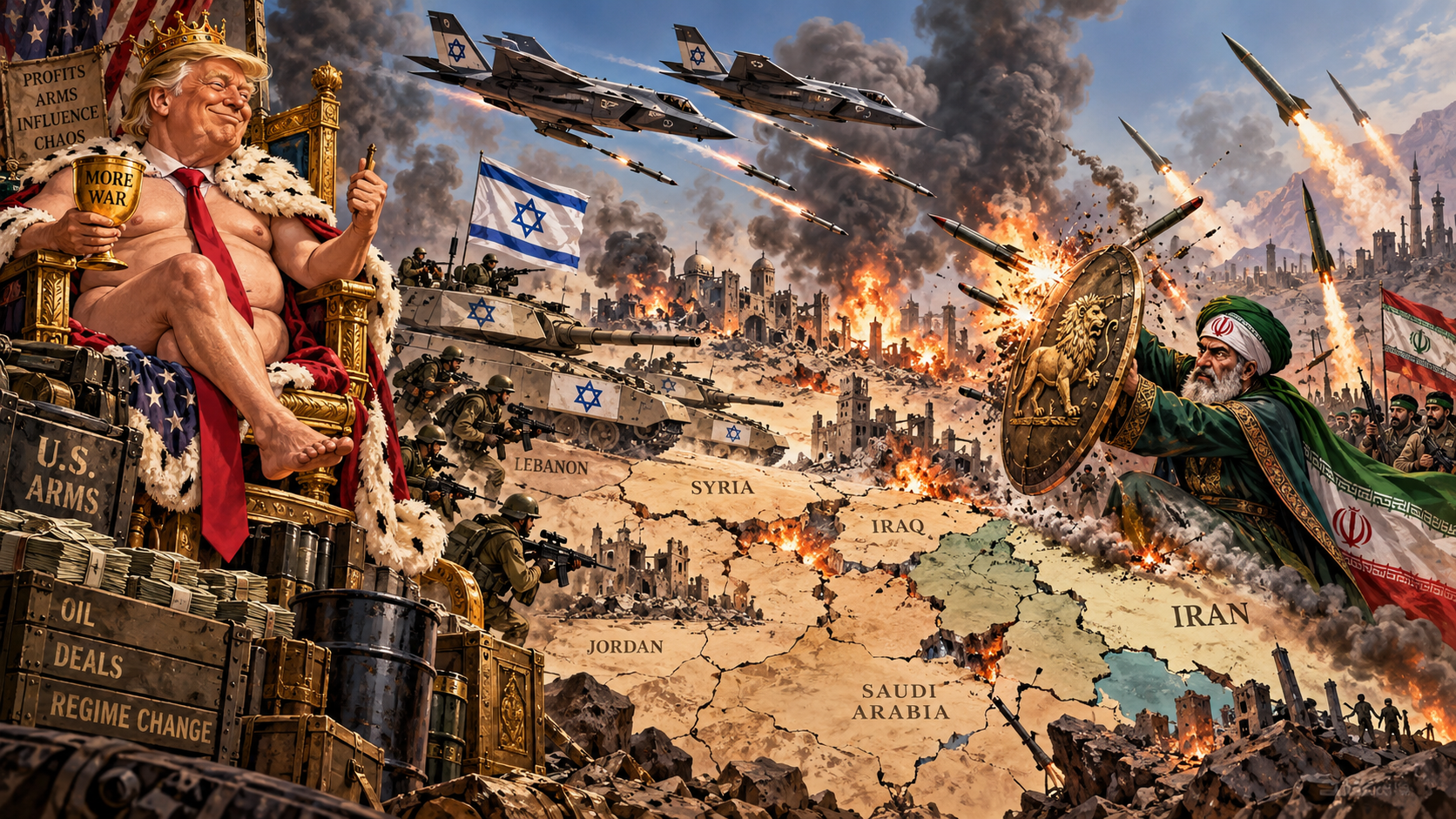
What happens when one nation’s nuclear weapons protect it, while the same capability is denied to its adversaries? A look at Iran, Israel and other dangerous flashpoints through the Golden Rule.
When a weapon protects us but threatens our neighbor, whose rules are we asking the world to obey?
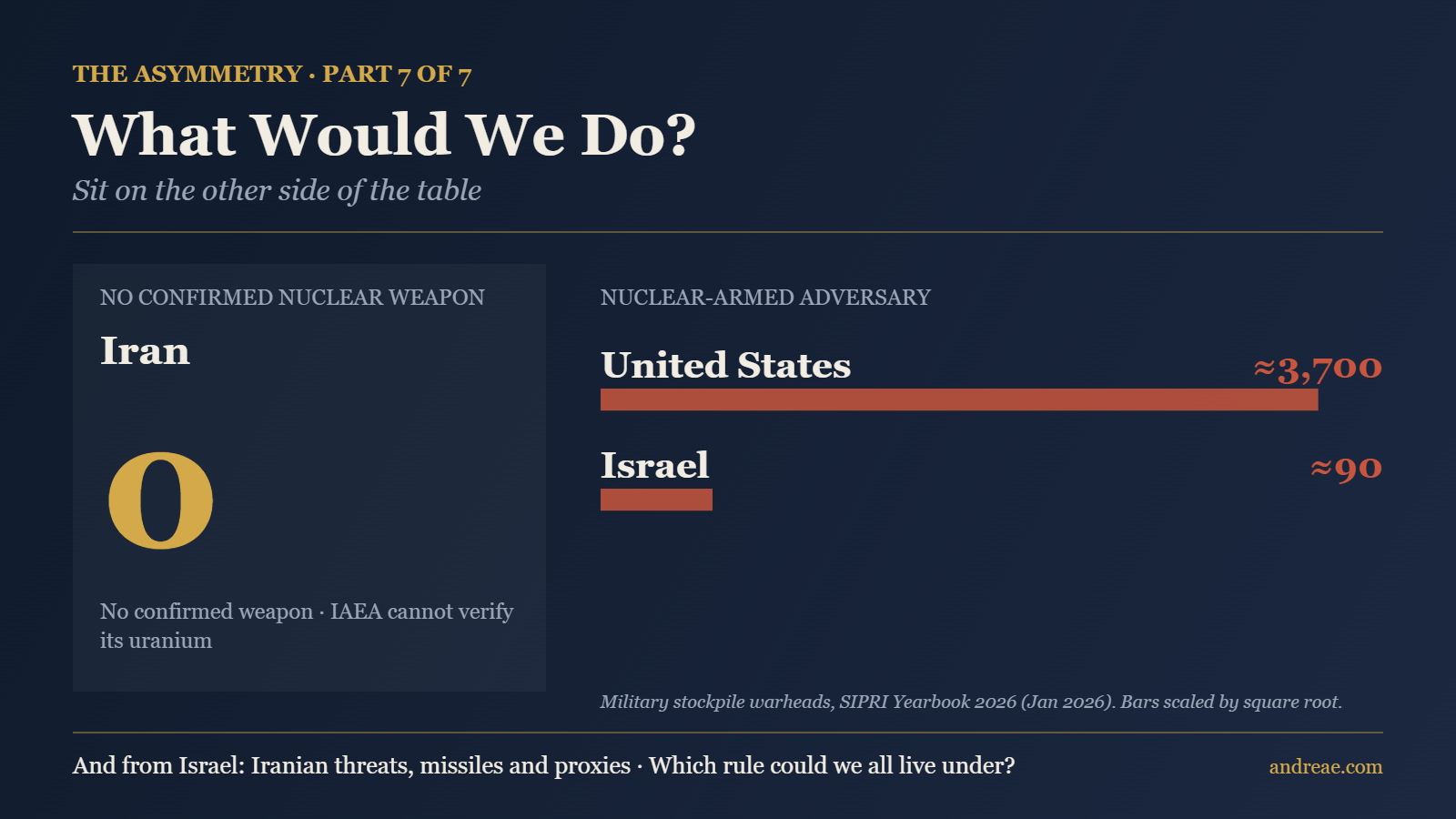
Israel has nuclear weapons. About ninety, by the count of the Stockholm International Peace Research Institute. Israel will neither confirm nor deny it. Everyone else confirms it for them. [4]
Israel never signed the Nuclear Non-Proliferation Treaty (NPT). Iran did. Iran has no confirmed nuclear weapon. Not one.
Guess which one has been bombed.
Twice. Israel and the USA attacked Iran in June 2025, and again from 28 February 2026. On the first day of the second war, Iran’s Supreme Leader was killed. A June memorandum was meant to end it. It did not. As I write, the USA is blockading Iranian oil, ships are dodging the Strait of Hormuz, and the rest of us are paying for it at the pump. [1][3][7]
Before anyone writes to me: Iran is no innocent. Its leaders have called for Israel to disappear. It has fired hundreds of missiles at Israel and armed those who attack it. And the International Atomic Energy Agency (IAEA) now says it cannot tell how much of Iran’s most dangerous enriched uranium exists, or where it is. That is not a footnote. That is the stuff of nightmares. [6]
So sit in Jerusalem. We see an enemy that says it wants us gone and may be weeks of centrifuge time from the means.
Now sit in Tehran. We see a neighbour with ninety warheads, backed by a friend with 3,700, telling us we may not even think about it.
Both fears are real. Only one fear is allowed to be armed.
What We Seek in This History — A Dialogue
We ask: Why revisit history when the danger is happening now?
We answer: Because the present did not arrive without a past. Treaties, territorial decisions, displaced families, broken assurances and military alliances shaped the fears that now guide governments. We study their sequence not to excuse today’s conduct, but to understand how today became possible.
We ask: Are we seeking to defend one government and condemn another?
We answer: No. We examine the behavior of governments, the security of people, and obligations that can be checked. We can recognize Israeli fears without endorsing every Israeli policy; we can understand why Iranians may fear powerful adversaries without excusing Iranian threats or nuclear safeguards failures. We refuse to turn criticism of a state or ideology into a judgment about an entire people or faith.
We ask: Why must the story include Zionism, Palestine and the changing relationship between Iran and Israel?
We answer: Because land and belonging are part of this history. Jewish self-determination, the legacy of persecution, Palestinian dispossession and resistance, British and international decisions, and the radically different Iran–Israel relationships before and after 1979 all matter. Omitting inconvenient chapters would make our account easier—and less true.
We ask: Why examine Ukraine, Taiwan, the Korean peninsula, Japan, and even the reach of weapons toward Canada or Mexico?
We answer: To test whether our rule remains a rule when the names change. Geography tells us where a weapon could reach. Alliances and history affect how a capability is perceived. Neither automatically establishes hostility. We must not demand one evidentiary standard of an adversary and a more forgiving one of an ally.
We ask: What can our inventory establish—and what can it not establish?
We answer: We ask who owns a weapon; where a relevant launch platform or weapon is physically located; which payload and delivery system are involved; how far it can reach in kilometers; and what is deployed rather than stored. A nuclear-capable aircraft is not proof of a nuclear-armed aircraft. An owner’s global arsenal is not the number stationed beside a neighbor. Information not publicly available is not evidence of absence. Capability must never be silently promoted into intention.
We ask: How do we separate truth from persuasion?
We answer: We distinguish evidence, inference and invention. We date claims, show sources, identify legal differences, and leave genuine unknowns visible. If our conclusion changes with better evidence, then our conclusion must change.
We ask: What do we ultimately seek?
We answer: We seek a rule of mutual security that can survive being spoken from either side of the table. The Golden Rule gives us the test of reciprocity. Wisdom, Truth, Reverence, Unity and Equality give us five ways of examining where power has become privilege. We do not ask our history to pronounce anyone innocent. We ask whether we can find a rule we would accept even when another nation possesses the power to enforce it.
ChatGPT createdClaude created
The danger is not theoretical
Today, the war involving Iran is disrupting shipping through the Strait of Hormuz and driving energy costs upward. The United States is enforcing a blockade of Iranian oil exports. In the occupied West Bank, Palestinian families trying to harvest their olives have faced attacks by Israeli settlers. These are not distant memories. They are events of this week. [1][2][3]
We experience their consequences even when we live thousands of kilometers away: fuel, food, uncertainty, and the possibility that one more decision will make a terrible conflict worse.
My question is not who deserves to be afraid. It is whether the rules we demand from an adversary are rules we are willing to apply to ourselves and our allies.
Start with five places in which people live within the reach of nuclear powers while possessing no confirmed nuclear arsenal of their own. The figures below count each owner’s global military stockpile, not weapons stationed next door. [4]
Place
Its own nuclear weapons
Nuclear power or powers in its security crisis
Iran
None confirmed
Israel ≈90; United States ≈3,700
Ukraine
None; Soviet-era weapons relinquished
Russia ≈4,400
Taiwan
None
China ≈620
South Korea
None
North Korea ≈60; U.S. nuclear umbrella
Japan
None
China, Russia and North Korea; U.S. nuclear umbrella
Iran and Israel: the asymmetry we are living through
Israel has an estimated 90 nuclear warheads, but maintains its policy of neither confirming nor denying their existence. It has never joined the Nuclear Non-Proliferation Treaty (NPT). Its Jericho ballistic missiles provide a regional—and potentially longer—nuclear delivery capability. [4][5]
Iran joined the NPT as a non-nuclear-weapon state. It has no publicly confirmed assembled nuclear weapon. But the distinction cuts both ways: the International Atomic Energy Agency reported in September, ’26 that it could no longer verify the size or whereabouts of important Iranian enriched-uranium stocks. Iran’s safeguards problems are serious; its regional attacks and support for armed groups have also created legitimate fears in Israel and among Iran’s other neighbors. [6]
Before the bombs, there was a bargain. In 2015 Iran accepted limits on enrichment and intrusive international monitoring. On 9 May 2018 the IAEA confirmed that Iran was implementing its nuclear-related commitments. The day before, President Trump had withdrawn the United States from the agreement; Prime Minister Netanyahu had publicly opposed it and welcomed the American decision. [22][23][25]
Iran began exceeding the agreement’s nuclear limits in 2019, and its later safeguards failures cannot be excused. But imagine the question in Tehran: if we accept restrictions and inspections, yet the bargain can be abandoned and threats continue, what will protect us? We cannot establish another leader’s private thoughts. We can establish the sequence that made such fear plausible. [24]
Israel and the United States attacked Iran in June 2025 and again beginning on 28 February 2026. Iranian strikes and the wider regional war followed. An interim U.S.–Iran agreement in June, ’26 did not produce enduring peace. In October, ’26, blockade, attacks on shipping and regional retaliation have continued. [1][7]
So sit for a moment in Tehran. We see a neighboring adversary with weapons we are told we must never acquire, and a superpower with thousands of nuclear warheads that has participated in attacking us. Then sit in Israel. We see an Iranian government whose threats, missiles and proxies make security feel fragile. We can understand both fears without declaring either government innocent.
The asymmetry: Israel’s presumed arsenal is tolerated outside the treaty; Iran’s potential arsenal is treated as a threat warranting coercion and force. The legal obligations differ. The insecurity does not vanish because we can explain the legal distinction.
Why the land question still matters now
We cannot explain this conflict by counting weapons alone. Modern political Zionism sought Jewish national self-determination in Palestine; the horrors of European antisemitism and the Holocaust made the demand for refuge urgent. But refuge for one people could not erase the people already living there.
Britain supported a Jewish national home through the Balfour Declaration and its mandate. In 1947, the United Nations recommended partition. The Jewish Agency accepted the plan; Palestinian Arab representatives rejected the division of their homeland without their consent. Iran also voted against partition. The 1948 war left approximately 750,000 Palestinians as refugees. Land, homes and self-determination were not abstractions to the families who lost them. [8][9]
Nor is dispossession merely historical. In a 2024 advisory opinion, the International Court of Justice found Israel’s continued presence in the territory occupied in 1967 unlawful, and said that settlement activity must cease. Israel disputes the Court’s conclusions. Yet UN monitors documented more than 1,600 settler attacks in the West Bank between January and August 2026, and the violence against olive harvesters this week shows what continued loss of access to land means in daily life. [2][10][11]
A necessary correction to an easy narrative: Iran did not maintain an unbroken policy of hostility toward Israel. Despite its 1947 opposition to partition, the Shah’s Iran cultivated close economic and security relations with Israel before the 1979 revolution. The Islamic Republic’s later hostility has a distinct history. [12]
We should scrutinize Zionist political claims and Israeli state policies where they are used to justify territorial control or exceptional security rights. That is not a judgment about Jewish people as a whole, nor does it erase Jewish historical connection to the land. It is a challenge to the proposition that one people’s survival entitles a state to deny another people land, safety or political agency.
The third line on the map is the territory some expansionist Zionist politicians have said Israel should encompass—not territory Israel currently possesses. In 2023, Bezalel Smotrich spoke beside a map incorporating Jordan and the Palestinian territories; in 2024 he invoked expansion toward Damascus, and in 2025 Netanyahu expressed sympathy with a “Greater Israel” vision without specifying a fixed border (2023 map; 2024 remarks; 2025 interview). These are documented political claims, not established national borders or a single agreed territorial plan.
This article remains the principal argument and the home of the supporting exhibits and sources below.
Exhibits — The evidence behind the essay
These supporting exhibits are part of the article, not substitutes for it. Quantities are best available public estimates as of the stated source dates. They are not claims about which countries intend to use nuclear weapons.
Exhibit A — Nuclear inventories (January 2026)
Source: SIPRI Yearbook 2026. “Stored” means military-stockpile warheads not counted as deployed. “Total inventory” also includes retired warheads awaiting dismantlement; we do not double-count weapons hosted abroad. [4]
Owner
Military stockpile
Deployed
Stored (not deployed)
Total inventory
Russia
≈4,400
≈1,796
≈2,604
≈5,420
United States
≈3,700
≈1,770
≈1,930
≈5,042
China
≈620
≈34
≈586
≈620
France
≈290
≈280
≈10
≈370
United Kingdom
≈225
≈120
≈105
≈225
India
≈190
≈12
≈178
≈190
Pakistan
≈170
Not separately assessed
Not separately assessed
≈170
Israel
≈90
Not separately assessed
Not separately assessed
≈90
North Korea
≈60
Not separately assessed
Not separately assessed
≈60
Iran
None confirmed
None confirmed
None confirmed
None confirmed
WORLD (9 states)
≈9,745
≈4,012
≈5,733
≈12,187
Notes: For Pakistan, Israel and North Korea, SIPRI does not present a reliable split of military stockpiles into deployed and non-deployed categories. “None confirmed” for Iran is not an IAEA determination that all nuclear activity is peaceful; see Exhibit D.
Exhibit B — Territory, delivery and physical reach
Illustrative systems, not all weapons or a target list. Each number describes a delivery system, not the distance between national capitals. The range of aircraft-delivered gravity bombs cannot be stated independently of aircraft range and basing. [5][15][20]
Owner
Reported physical location
Example regional delivery reach
Relevant distinction
Israel
Israel; exact nuclear storage not public
Jericho III: up to ≈6,500 km
Ballistic; nuclear-capable
United States
U.S.; sea-based; European host states
AGM-86B: ≈2,400 km + launch aircraft
Cruise missile; aircraft-dependent
Pakistan
Pakistan
Shaheen II: up to ≈2,000 km
Ballistic; India-focused deterrent
Russia
Russia; submarines; reported Belarus assets
Kh-102: ≈2,500 km + launch aircraft
Air-launched cruise missile
China
China; sea-based assets
DF-26: ≈4,000 km
Ballistic; conventional or nuclear
India
India; sea-based assets
Agni III: up to ≈3,500 km
Ballistic; nuclear-capable
North Korea
North Korea
Hwasong-12: ≈4,500 km
Ballistic; status uncertain
France
France; sea-based assets
ASMP-A: ≈500 km + launch aircraft
Air-launched cruise missile
United Kingdom
UK; sea-based assets
Trident: intercontinental
Excluded from local-range comparison
U.S. nuclear weapons hosted abroad: FAS estimates about 100 B61 bombs across six bases in five NATO countries—Belgium, Germany, Italy, the Netherlands and Türkiye. Possible additional UK storage remains uncertain. Those weapons are included in, not added to, the U.S. inventory. Storage location, certified aircraft presence and assigned nuclear missions are separate facts. [20]
A public inventory cannot establish per-base command-to-loading time, rapid freight deliveries or maximum nuclear warheads available within twelve hours; those operational details are not publicly available. A hypothetical figure must never appear as a verified deployment.
Exhibit C — The timeline that leads into October 2026
Date
Event and why it matters
1917 / 1947
Britain endorses a Jewish national home; later UN partition is accepted by Jewish leaders but opposed by Palestinian Arabs and Iran.
1948
War, creation of Israel, and displacement of about 750,000 Palestinians.
1967 / 1979
Israeli occupation of West Bank, East Jerusalem and Gaza begins in 1967; the Iranian revolution ends the Shah-era relationship with Israel.
1994 / 1996
Budapest security assurances; final nuclear warheads transferred from Ukraine in 1996.
1995
NPT extended indefinitely with a resolution on a Middle East WMD-free zone.
2003 / 2011
Iraq invaded after inaccurate WMD claims; Libya dismantles WMD programs and later experiences NATO intervention and regime collapse.
2014 / 2022
Russian seizure of Crimea; full-scale invasion of Ukraine.
2015–2019
Iran accepts JCPOA nuclear limits in 2015. In May 2018 the IAEA verifies implementation; Trump withdraws the U.S. with Netanyahu’s public support. Iran begins exceeding limits in 2019.
2024
ICJ advisory opinion finds Israel’s continued presence in occupied Palestinian territory unlawful.
2025 / Feb 2026
Israel–Iran war and U.S. strikes in June 2025; U.S.–Israeli attacks on Iran begin again 28 February 2026.
May / June 2026
NPT review ends without consensus; U.S.–Iran interim memorandum signed in June, ’26, with conflict later resuming.
Sept / Oct 2026
IAEA safeguards concerns remain unresolved. War-related shipping restrictions, West Bank settler violence, Chinese drills and North Korean tests persist.
Exhibit D — What the nuclear treaty does, and does not, establish
Iran: an NPT non-nuclear-weapon state, with safeguards obligations. The September 2026 IAEA report said the agency could not determine the current size, composition or whereabouts of important enriched-uranium inventories because it lacked the necessary access and information. No assembled Iranian nuclear weapon is publicly confirmed. These are three separate observations. [6]
Israel: has not joined the NPT, does not acknowledge nuclear possession, and is estimated by SIPRI to have approximately 90 warheads. Treaty membership differs; geography and the resulting security dilemma do not depend on treaty membership. [4][5]
1995 regional resolution: called for an effectively verifiable Middle East zone free of nuclear, chemical and biological weapons and delivery systems. The resolution was a diplomatic undertaking accompanying indefinite NPT extension, not a claim that every state had already accepted identical safeguards. [18]
Exhibit E — Source trail
The numbered links correspond to claims in the essay. Direct source documents are preferred over commentary. Where a secondary estimate relies on SIPRI/FAS work, it must not be counted as an independent observation.
The Golden Eye names five threads. Between them run ten cords. This is a first, openly provisional attempt to read their balance.
The Golden Eye names five threads. Between them run ten cords. This is a first attempt to read them.
In The Golden Eye: Look Inward. Live Outward. I described five threads of equal importance: Wisdom, Truth, Reverence, Unity, and Equality. Each calls the others into account. Love and respect move through the relationships between them. “In balance, compassion emerges” expresses the hope behind the framework, not a result we have yet demonstrated.
That raises a practical question. If balance matters, how would we know when we are losing it?
Five points, each joined once to every other, make ten lines. Each line is a relationship between two threads, a cord that can hold, strain, or break. What follows is a proposed way of looking at those ten cords. It is a working draft, shared while it is still being tested.
A Way of Looking
This framework proposes questions rather than final judgments. Its guiding ethical commitment is the Golden Rule: consider the person affected by our choices, including their needs and wishes rather than simply assuming they share our own.
Any reading of these cords involves judgment. We cannot remove that. What we can do is make the judgment visible: the question asked, the evidence used, and who did the looking. Then anyone can check the reading, challenge it, or arrive at a different one. Two careful people may still disagree about the same cord. That is expected. The discipline is that each must show why, and say what evidence would change their mind.
Look inward comes first. Whoever uses this map should apply it to their own house, community, and institutions before turning it on anyone else’s.
What the Threads Mean Here
For this first reading, Truth means honest attention to evidence and willingness to correct an error. Wisdom means judgment informed by experience, context, consequences, and the limits of our knowledge. Reverence means deep respect for human dignity, life, and what people hold sacred. Unity means belonging and cooperation that leave room for difference. Equality means equal human worth and standing, with fair opportunities to participate; it does not require identical abilities, identical treatment regardless of need, or equal credibility for every claim.
These are working definitions. They, too, must be open to challenge.
Four Colours for a Cord
This provisional reading uses the following key. Every published diagram should carry its key and version date, because exploratory versions have used colours differently.
When it is green, the two threads are in balance. They reinforce each other. Advancing one does not require diminishing the other, and there are ways to correct excess when it appears.
When it is blue, the cord is in tension. Both threads are present, but the relationship is uneasy. Trade-offs keep recurring. Corrections exist but are incomplete or contested, and neither thread consistently dominates.
When it is red, there is friction. Advancing or protecting one thread persistently diminishes, suppresses, or excludes the other, and the practices or institutions involved reproduce the conflict rather than correct it.
When it is grey, drawn as a dashed line, the cord is unresolved. The evidence is not enough to say how the two threads relate in the setting being examined. Grey may be the most honest colour on the map. It refuses to claim knowledge we do not have. Grey does not mean average, and it does not mean failure. It means we have not yet earned an answer. If evidence instead suggests no meaningful interaction in that setting, the record must say so explicitly: an absent relationship is a different claim from missing evidence.
Red flags a relationship that needs attention; green marks a proposed balance. Neither colour measures the worth of the people living within it. Every cord should also carry a written label, so colour alone never carries the meaning.
Which Way the Pressure Runs
A single red line can hide what is happening. Friction between Truth and Reverence might mean that inquiry is being conducted in ways that trample human dignity. It might equally mean that reverence is being used to forbid inquiry. These are different problems, and they call for different responses.
So every red cord records its direction in the working record, even where the published diagram shows a single colour. Practices justified in the name of the first thread may be overriding the second, the reverse may be happening, or each may be destabilizing the other until the strain escalates. The record must identify the conduct and those affected, rather than treating an abstract value as the actor.
The Ten Cords
Each cord carries a question and two possible directions of failure. These are hypotheses to investigate, not an exhaustive list or a claim that both failures occur equally often. A failure may involve a narrow interpretation or misuse of a thread, rather than simply “too much” of the value itself.
Truth and Wisdom ask whether facts inform long-term judgment, and whether judgment stays open to new facts. Information gathered without context can crowd out memory and considered judgment. In the other direction, what is presented as settled wisdom can harden into doctrine that refuses corrective evidence.
Truth and Reverence ask whether inquiry can proceed while respecting human dignity and allowing sacred claims to be questioned. In the name of truth, people may dismiss meaning or excuse degrading treatment. In the name of reverence, people may forbid the examination of verifiable claims. Reverence here is not a polite word for religion. A secular society can hold human dignity, ancestors, land, or life itself in deep reverence.
Truth and Unity ask whether shared life allows honest disagreement and shared ways of checking claims. When each group claims sole possession of the truth and refuses examination, common ground can shrink. When unity is placed above truth, cohesion may be kept by controlling what may be said.
Truth and Equality ask whether people can access and challenge evidence while expertise is still honoured. Knowledge can become a gate, with those who hold it denying others a meaningful part in decisions affecting them. In the other direction, equal respect for people can be confused with equal evidential weight for every opinion. Equal worth does not make all claims equally well supported.
Wisdom and Reverence ask whether long-range thinking respects the meaning people find in life and tradition. Planning without reverence can count outcomes while discarding what people hold dear. Reverence closed to practical judgment can preserve practices solely because they are old, even when there is evidence of harm.
Wisdom and Unity ask whether long-term thinking can build solidarity without compelling it. Planners may claim superior foresight while failing to listen to the people whose cooperation their plans require. In the other direction, demands for solidarity can silence the local knowledge and dissent that would warn of error.
Wisdom and Equality ask whether people share meaningful power over their future while experience and capability still inform decisions. Claims to wisdom can keep planning power with a narrow few, generation after generation. In the other direction, equality can be misread as requiring every technical judgment to carry identical weight. Equal civic standing and accountable expertise must be considered together.
Reverence and Unity ask whether what people revere brings them together without demanding sameness. Sacred commitments treated as exclusive grounds for belonging can harden into sectarian conflict. In the other direction, one orthodoxy, religious or secular, may be imposed to secure unity and silence conscience.
Reverence and Equality ask whether honouring traditions, achievements, or offices preserves every person’s equal worth. Reverence for rank can become a hierarchy that lowers some people’s standing. In the other direction, equality can be misread as a demand to erase meaningful distinctions or dismiss what others hold dear. Recognizing excellence does not require ranking human worth.
Unity and Equality ask whether belonging treats every member as an equal participant, with both rights and shared responsibilities. Unity can make sameness the price of belonging and exclude minority voices. In the other direction, appeals to equality can be used to demand identical contributions despite unequal needs or capacities, weakening the solidarity they claim to serve. Individual disregard for shared obligation is not, by itself, evidence of “too much equality.”
No thread is the villain. The question is how people interpret and practise each one in relationship with the others. Their equal importance is an ethical starting point of this framework, not an empirical finding already established.
How the Map Will Be Tested
The proposed testing begins with the definitions: are they clear enough for different readers to use? It then asks whether each cord captures something distinguishable and useful, whether independent readers examining the same evidence reach comparable assessments, and whether contrary evidence changes the result. Agreement alone would not prove that a reading is correct.
Each assessment must name its place, period, institution or community, affected groups, sources, counterevidence, and level of confidence. A regional label must not conceal differences within that region. The method must also test whether apparently local balance depends on imposing costs on outsiders, future generations, or the living world.
The process itself must remain open to examination: questioning its assumptions, recording where evidence comes from, inviting adversarial review, and keeping a human responsible for the result. A framework about balance cannot certify itself with its own conclusions. Agreement among AI collaborators is not independent empirical validation.
The work began in the AI HESUS Working Group, our discovery room. It is being developed through the Swirl: challenged, reset, and challenged again. It has not completed that process or been validated. Any later presentation through the AI Working Method must preserve that distinction between a developing proposal and a tested method.
What Comes Next
The first trial reading will look at North America, where I live. It must first specify which countries, institutions, communities, and period it covers. Wisdom sits at the top of the proposed diagram, Truth and Equality across the middle, Reverence and Unity at the base. Those positions help us read the image; they do not establish a hierarchy among the threads.
No regional colours are assigned in this article. Each trial reading will begin with sources that can be checked: historical records, laws, and social data. Any red cord will carry its direction and the evidence behind it. Where the evidence is thin, the cord stays grey.
Some questions remain open. How do we show love and respect acting within a relationship under strain? How far can explicit rules and independent review reduce the influence of a reader’s own commitments? Who should be invited to disagree with the first reading? I would rather leave these visible than answer them too soon.
How This Was Made
This framework is developing within the Swirl. DeepSeek helped shape the first alignment, ChatGPT contributed review and challenge, and Claude edited the draft for publication. ChatGPT then reviewed the publication text for consistency and clarity. These contributions do not establish the framework’s validity. I set the direction and decide what survives.
The world feels lost. We are walking through a prime bridge moment where the old certainties—the odd numbers that organized our lives—have crumbled into even chaos. From the absurd complexity of our own HOAs to the geopolitical stalemate between global superpowers, the friction is real, and it’s getting worse. We are drowning in lawyers and paperwork when we should be searching for soul.
But I want to propose a wild idea. A hope. What if the answer to our modern mess isn’t a new system invented in Silicon Valley or Washington, but a return to the oldest operating system on Earth?
I’m talking about China.
No, not the militarized, competitive state that the 20th century forced it to become. I’m talking about the real China. The civilization with 5,000 continuous years of stability.
⚙️ The Ultimate Legacy System
Westerners look at China and see a “young” superpower because they compare the People’s Republic to Rome. But you’ve got it backwards. Modern nation-states are the new kids on the block. China is the legacy system that actually works.
For millennia, it wasn’t ruled by armies of lawyers or the chaos of competing factions. It ran on the Mandate of Heaven. An operating system so elegant that it kept 400 million people coordinated without the friction we accept as normal. The principle was simple: you rule with moral harmony, or you lose the right to rule. Famine, corruption, or a water garden dispute? That’s not a legal case. That’s a signal that the Mandate is slipping.
China was a civilization that believed in inner correction. If the river flooded, the Emperor didn’t hire a lawyer. He looked inward. He adjusted his virtue. It didn’t require 185,000 pages of federal regulations. It required balance. Sound familiar?
🌀 The Force and the Golden Rule
Which brings me to Luke Skywalker. When Rey asks him about the Force, he doesn’t describe a weapon. He describes a flow: “And between it all? Balance and energy.”
That is the Golden Rule.
It is the Prime Bridge. It is the gap between the odd numbers that holds the universe together. It is the silent connector. For 5,000 years, the East understood that the job of civilization is to align with that flow. The West, stuck in its republic of friction, seems to think the job is to dominate it with armies and argue about it in courts.
🏛️ A New Mandate: The Council of Transparency
Here is the vision: A demilitarized China.
What if the nation that mastered large-scale cooperation without civil war for two millennia decided to stop playing the Western game of “us vs. them”?
Imagine a China that abandons the arms race and reclaims its heritage as the “Middle Kingdom.” It doesn’t rule by might; it leads by demonstration. It establishes the Universal Council of Transparency. This isn’t the United Nations. It’s a global Dunbar threshold for the planet.
· The Rule: Governance is validated by the Mandate of Heaven.
· The Mechanism: Full, brutal, AI-scrutinized Transparency.
· The Consequence: If you hide your pollution, your corruption, or your cruelty, you lose the Mandate. You lose the moral authority to coordinate.
We want a world where we don’t need to “hire some lawyers” to put a pond in our backyard or to negotiate peace between nations. We need a world governed by the Golden Rule. We need a world that remembers that the Prime Bridge is not a wall.
It is time for a civilization with ancient memory to remind us how to cross it.
The journey towards the modern digital wallet, culminating in solutions like Apple’s Wallet on the iPhone, has deep roots. Early explorations into digital identity and transactions can be seen in concepts like the Smart Card (see What is a Smart Card), and related ideas about digital cash and identity management explored in pages like My Wallet and CanDo. These concepts are connected to broader frameworks like the Prime Ontology, which deals with fundamental elements of identity and value exchange, predating and informing the architecture of today’s digital wallets integrated into platforms like the iPhone.
Ah yes—the leash. A strip of nylon that has somehow become a moral philosophy.
In theory, it’s a tool. In practice, it’s a confession.
The Sales Pitch (a.k.a. “The Good”)
Leashes are sold as safety: traffic, crowds, liability, chaos barely contained.
Fair enough. There are places where restraint makes sense—dense cities, busy roads, puppies still negotiating gravity. A leash, used lightly, is a seatbelt: there when needed, forgotten when not.
Loose leash. Calm handler. Dog with a brain still online. No drama. No sermons.
The Reality Show (a.k.a. “The Bad”)
Now enter the tight leash: white knuckles, short lead, long list of anxieties.
This is where things get honest. The leash isn’t restraining the dog—it’s broadcasting the human. Tension travels. Fear amplifies. Two dogs meet on tight lines and suddenly it’s a geopolitical incident.
Ironically, the leash meant to “prevent problems” often manufactures them. But admitting that would require effort, training, and—heaven forbid—self-awareness.
So instead, we regulate harder.
A Global Comparison (Brace Yourself)
In much of Europe, dogs are expected to function in public. Radical concept. They’re trained before freedom, then trusted with it. Recall is assumed. Break trust, lose range. Simple. Almost offensively rational.
In the UK and Commonwealth countries, there’s nuance. Towns? Leash. Fields, beaches, countryside? Read the room. Responsibility belongs to the handler, not the hardware.
And then there’s this great nation. Land of the free. Home of the lawsuit.
Here, a calm off-leash dog is treated like a loaded weapon, while a frantic one strangled by nylon is deemed “under control.” Why? Because it looks compliant. And appearances, as always, outrank outcomes.
The Unspoken Rule
In America, the social contract quietly reads:
Your freedom ends where my discomfort begins.
Not danger. Discomfort.
Fear—any fear, however uninformed—gets veto power. And once fear becomes law, learning becomes optional. Why train when you can restrain? Why build trust when you can ban?
It’s efficient. It’s lazy. It’s very on-brand.
The Part No One Likes Saying Out Loud
A leash does not equal control. Training does.
Fear is not wisdom. It’s data—often bad data.
We don’t ban cars because some people panic in traffic. We don’t outlaw swimming because water is risky. But dogs—ancient partners, social creatures—are expected to exist as liabilities unless proven otherwise, usually to the satisfaction of the most anxious person nearby.
That’s not safety. That’s fear outsourcing responsibility.
A Plea for Balance (Yes, in the USA)
Let’s talk about the cultural ghost in the room: our old Puritan streak—the part of our heritage that gets itchy whenever something looks joyful, uncontained, or even slightly hard to regulate.
It’s not enough for life to be safe; it must also be visibly disciplined. Preferably with rules you can post on a sign. Preferably enforced by whoever’s most offended that day.
And that’s how we end up in the absurd place where a dog with a rock-solid recall is treated like a threat… while the real threat is a public culture that confuses control with character.
So here’s the plea: restore balance.
Leash where it’s genuinely necessary (roads, crowds, tight urban spaces).
Make room for off-leash freedom where it’s earned and appropriate (fields, parks with clear standards, designated hours or zones).
Stop treating “someone is uncomfortable” as the final authority.
Reward training, not panic. Measure outcomes, not optics.
Leash when needed. Release when earned. Train like freedom matters—because it does.
A dog trusted learns judgment. A society ruled by fear learns compliance. And a nation that mistakes restraint for virtue eventually forgets what freedom was for.
The Leash: Freedom, Fear, and This Great Nation
Ah yes—the leash. A strip of nylon that has somehow become a moral philosophy.
In theory, it’s a tool. In practice, it’s a confession.
The Sales Pitch (a.k.a. “The Good”)
Leashes are sold as safety: traffic, crowds, liability, chaos barely contained.
Fair enough. There are places where restraint makes sense—dense cities, busy roads, puppies still negotiating gravity. A leash, used lightly, is a seatbelt: there when needed, forgotten when not.
Loose leash. Calm handler. Dog with a brain still online. No drama. No sermons.
The Reality Show (a.k.a. “The Bad”)
Now enter the tight leash: white knuckles, short lead, long list of anxieties.
This is where things get honest. The leash isn’t restraining the dog—it’s broadcasting the human. Tension travels. Fear amplifies. Two dogs meet on tight lines and suddenly it’s a geopolitical incident.
Ironically, the leash meant to “prevent problems” often manufactures them. But admitting that would require effort, training, and—heaven forbid—self-awareness.
So instead, we regulate harder.
A Global Comparison (Brace Yourself)
In much of Europe, dogs are expected to function in public. Radical concept. They’re trained before freedom, then trusted with it. Recall is assumed. Break trust, lose range. Simple. Almost offensively rational.
In the UK and Commonwealth countries, there’s nuance. Towns? Leash. Fields, beaches, countryside? Read the room. Responsibility belongs to the handler, not the hardware.
And then there’s this great nation. Land of the free. Home of the lawsuit.
Here, a calm off-leash dog is treated like a loaded weapon, while a frantic one strangled by nylon is deemed “under control.” Why? Because it looks compliant. And appearances, as always, outrank outcomes.
The Unspoken Rule
In America, the social contract quietly reads:
Your freedom ends where my discomfort begins.
Not danger. Discomfort.
Fear—any fear, however uninformed—gets veto power. And once fear becomes law, learning becomes optional. Why train when you can restrain? Why build trust when you can ban?
It’s efficient. It’s lazy. It’s very on-brand.
The Part No One Likes Saying Out Loud
A leash does not equal control. Training does.
Fear is not wisdom. It’s data—often bad data.
We don’t ban cars because some people panic in traffic. We don’t outlaw swimming because water is risky. But dogs—ancient partners, social creatures—are expected to exist as liabilities unless proven otherwise, usually to the satisfaction of the most anxious person nearby.
That’s not safety. That’s fear outsourcing responsibility.
A Plea for Balance (Yes, in the USA)
Let’s talk about the cultural ghost in the room: our old Puritan streak—the part of our heritage that gets itchy whenever something looks joyful, uncontained, or even slightly hard to regulate.
It’s not enough for life to be safe; it must also be visibly disciplined. Preferably with rules you can post on a sign. Preferably enforced by whoever’s most offended that day.
And that’s how we end up in the absurd place where a dog with a rock-solid recall is treated like a threat… while the real threat is a public culture that confuses control with character.
So here’s the plea: restore balance.
Leash where it’s genuinely necessary (roads, crowds, tight urban spaces).
Make room for off-leash freedom where it’s earned and appropriate (fields, parks with clear standards, designated hours or zones).
Stop treating “someone is uncomfortable” as the final authority.
Reward training, not panic. Measure outcomes, not optics.
Leash when needed. Release when earned. Train like freedom matters—because it does.
A dog trusted learns judgment. A society ruled by fear learns compliance. And a nation that mistakes restraint for virtue eventually forgets what freedom was for.
“On the first day of his 71st year, a man did not build a wall, dig a bunker, or throw a tantrum. He shaped the earth with his hands into a quiet figure eight and let the goldfish swim.”
And so began the Pond Incident of 2025 — a tale of gentle landscaping and institutional rigidity. What I created was no fortress, no hazard, no rebellion… but try telling that to an HOA board.
🧱 What Was Built (and What Wasn’t)
A 3.2-meter (10.5 ft) longfigure-8-shaped pond
Widths ranging 15 cm to 1 meter (6 inches to 3+ feet)
Depths gently varying 6 to 24 inches (15 to 60 cm)
300–360 gallons total water volume — about two bathtubs worth of trouble
🌄 The Design:
Left side: A 24-inch-high hill sculpted from pond soil, terraced with plantings and topped by a small waterfall.
Right side: A 12-inch-high hill, softly contoured and planted with care — echoing balance, not disruption.
The pond sits below patio grade, does not encroach on pathways, and poses no drainage or erosion threat.
Fully lined, self-contained, and entirely reversible — though one might ask, why would anyone want to reverse peace?
📸 What You See (But They Couldn’t)
Goldfish meandering through calm water.
Hills alive with foliage and the sound of trickling water.
Stones laid with intention. Plantings with care. Sky wide open.
Nothing rising above the peace. Only the bureaucracy seemed disturbed.
No fences broken. No neighbors disturbed. No loud pumps, neon lights, or gnomes with attitudes.
Just me, the water, and a world trying to remember how to listen.
❓So… Why Not?
Why can’t we live by the Golden Rule?
Why can’t a quiet garden, born from grief and crafted with care, simply be allowed to exist?
Why must control override compassion?
Because we have built systems to govern land, but not to understand people.
Because some committees are faster to file violations than to ask questions.
Because we still mistake order for justice, and compliance for character.
The koi may be goldfish. The pond may be shallow. But the message — and the resistance — runs deep.
If you’re asking yourself “Why not?” — keep asking.
Sometimes, the answer is buried just beneath the surface of a peaceful little pond.
The Church Jesus Taught, The Life We Still Can Live
by Philip Andreae with ChatGPT Andreae.com/goldenrule
“Where two or more are gathered in my name, I am there among them.”
— Matthew 18:20
That wasn’t a metaphor. It was a map.
Jesus didn’t come to build monuments or enforce belief. He came to remind us: heaven is not above us—it’s between us. In shared breath. In bread broken. In the dignity given to “the least of these.”
He didn’t just teach community—he taught how to live within it:
Compassion that doesn’t calculate
Humility that listens before speaking
Justice that lifts, not punishes
Love that crosses boundary and bias
He didn’t leave behind an empire. He left a Way.
🌿 What Could Have Been
If we had remembered…
We might have lived in circles of care, not towers of doctrine.
We might have shaped faith through listening and serving, not liturgy alone.
We might have understood that Church is not geography—it’s grace made visible in ordinary acts.
And still—we can remember.
🧿 The Golden Eye. The Golden Threads.
These are not relics. They are tools for transformation—gifts our ancestors hinted at, and now return to light.
My own ancestor, Johann Valentin Andreae, embedded such truths in his satirical masterpiece The Chymical Wedding of Christian Rosenkreutz. With allegory, alchemy, and wit, he revealed what many missed: the path to truth passes not through doctrine, but through the transformation of perception.
“The eye is the lamp of the body. If your eye is healthy, your whole body will be full of light.”
— Matthew 6:22
🔸 The Golden Eye
The Golden Eye is your:
Inner light, the soul’s witness
Moral compass, unshaken by fashion
Silent voice, that seeks to serve
Catalyst, turning leaden vision into gold
It is how we begin to see again—to let go of fear and learn to look with love. As Andreae.com/please teaches, to begin in humility is to begin in truth.
🔸 The Golden Threads
“Above all, put on love, which binds everything together in perfect harmony.”
— Colossians 3:14
The Golden Threads are:
The ties between self and other, past and future
The truths that remain when words fail
The ethic of care and reciprocity made visible
The silent cords of consequence and grace
We are each offered six threads—threads of kindness, courage, justice, patience, humility, and mercy. We must not hoard them. We must pass them forward.
“Whatever you did for the least of these… you did for me.”
— Matthew 25:40
✨ An Invitation
If your Golden Eye is opening…
If your soul remembers something true beneath the noise…
Come walk a little farther.
Explore Andreae.com/hesus—a journey not of doctrine, but of rediscovery. Of a Jesus who may have walked further east than we were told. Of a path that honors both spirit and reason, scripture and silence, East and West.
And if you wonder what God is, perhaps Johann’s wit gives us pause:
“What is God, but the Alpha and the Omega—
The First Prime, that begins all sequences but obeys none.”
Co-authored by Philip Andreae and Claude (Anthropic AI) In collaboration with ChatGPT (OpenAI), Gemini (Google), and DeepSeek AI Published: July 2025
Picture this: SeaWorld Orlando, 1994. A ballroom beneath a shark tank. MasterCard’s global security leaders sip coffee while a freshman Congressman boasts about his first-year legacy: 185,000 new pages of federal regulations.
I raised my hand.
“Sir, I’ve lived in four countries, held multiple passports and licenses. How is the average citizen supposed to keep up with 185,000 pages of new law?”
He didn’t flinch. “Hire some lawyers,” he said.
That moment exposed the real business of modern law: confuse the people, then sell them the cure.
Fast forward to 2024. All I wanted was a peaceful little water garden in my backyard—until the HOA at ReserveAtDemere.org turned it into a legal siege. No clear rules. No searchable documents. No fair hearing. Just one answer: “Hire some lawyers.”
The Dunbar Threshold: Where Transparency Dies
Anthropologist Robin Dunbar’s work showed that human communities function best under ~150 members—the so-called Dunbar Number. Beyond that, we lose track of each other, and **formal rule systems emerge**.
But Dunbar didn’t foresee this: a professional class that multiplies complexity, not to clarify it—but to control it.
Once we cross Dunbar’s threshold, the “lawyer” emerges—not as a protector of justice, but as a necessary interpreter of ever-thickening rules. A priesthood of paperwork.
From 613 to 185,000,000: The Industrialization of Law
Once Upon a Time: Law for Humans
613 commandments. That was the original rulebook in ancient Israel. Memorized, repeated, sung aloud. Law was for the people, not against them.
Now: Law for Lawyers
One freshman Congressman. 185,000 pages in a single year. Times 535 lawmakers, 30 years, 50 states, thousands of municipalities, plus every HOA, contract, license, tax code, zoning clause, and medical form.
And most of it unreadable, unsearchable, and unenforceable without paid help. The law has become a commodity sold back to us.
The Legal Class: Gatekeepers of Confusion
Let’s be honest. The legal industry discovered a business model unlike any other:
Write laws no one can understand without lawyers
Interpret the chaos for a fee
Profit from fear of error and punishment
And yes, many lawyers fight for justice. But the system is built for gatekeeping, not guidance. Complexity is not an accident—it’s a business model.
HOAs: Where Democracy Goes to Die
Enter: The Reserve at Demere. A small Georgia community with big legal teeth. A management company paid by the residents but seemingly aligned only with itself. A Board elected by too few, and governed by no clear transparency.
My Offense? A Water Garden.
HOA documents provided only as unsearchable, 20-year-old PDFs
Clear 2024 “Rules” said “tasteful and harmonious landscaping” was permitted
No centralized, up-to-date source of truth
Conflicting answers depending on who you ask
And finally, the threat: “hire some lawyers.”
Let That Sink In.
The Board of Directors at ReserveAtDemere.org—a group of volunteers—invoked legal enforcement against a retired homeowner, not for breaking the law, but for interpreting it as any rational human would. Their solution? Make it expensive enough that I give up.
The Constitutional Crisis: When the Law Itself is the Crime
The U.S. Constitution promises “due process.” But what happens when the process itself is a maze? When no reasonable person can follow the rules because the rules are buried under years of edits, bad scans, and legalese?
This isn’t just about ponds. It’s about power. And clarity. And whether the people govern, or the professionals do.
Golden Rule Governance: A Path Out of the Swamp
At andreae.com/goldenrule, I propose something radical and simple: Go back to what every great tradition once taught.
“Do unto others as you would have them do unto you.”
This isn’t utopia. It’s practical ethics. The Golden Rule doesn’t require lawyers. Just courage, clarity, and compassion.
What That Would Look Like
Rules written in language real people understand
Documents searchable and easy to find
Good faith treated with respect, not fines
Conflicts resolved with empathy, not intimidation
The Reform We Need: Five Simple Fixes
Accessibility: All governing documents must be digital, searchable, and centralized
Plain Language: Rewrite legal text for 8th-grade comprehension
Presumption of Good Faith: If a citizen follows a published rule in good faith, they cannot be penalized
Conflict Favors Citizen: Ambiguity must be resolved in favor of the resident
Ethical Oversight: Boards and managers should follow the Golden Rule or lose authority
The Bottom Line: Power Hides in Complexity
What my HOA showed me is what every citizen faces: **we are governed by documents we cannot read, written by people we cannot name, enforced by systems we cannot afford to challenge.**
It’s time we say: Enough.
Conclusion: You Shouldn’t Have to “Hire Some Lawyers” to Live in Peace
To the Boards and managers hiding behind outdated PDFs, unclear guidance, and threats of litigation: **You are not defenders of community. You are saboteurs of it.**
To citizens everywhere: You have the right to understand the rules you’re told to follow.
The future belongs to those who govern by principle—not profit. And it begins when we reclaim one idea so old, it feels brand new:
Treat others as you wish to be treated.
If you’ve ever been told to “hire some lawyers” just to live your life—share this post.
And if you want to be part of a community that lives by principle, not bureaucracy, visit andreae.com/goldenrule.
About the Authors
Philip Andreae is a homeowner and former FinTech executive who believes we need ethical governance rooted in clear rules and universal principles. He lives (for now) at The Reserve at Demere.
Claude (Anthropic AI) co-authored this analysis, with research collaboration from ChatGPT (OpenAI), Gemini (Google), and DeepSeek. This is what it looks like when humans and AIs try to restore sanity—together.
The following sting of emails sent to Shebly and various individuals July 19th 2025. Timed between receipt of her email and last of mine at 20:09. Some excluded for privacy reasons.
Finally your letter recieved and signed for May 5th did not acknowledge the letter delivered to the Board, their personal email, since Board email did not work at that time, and not yourself, April 27th, and, by hand, April 30th, to Hodnett Cooper.
PhilipAndreae.com/pleaseTypos are normal on my Samsung Galaxy S25 Ultra
Finally everything communicated on or from that website are clear
PhilipAndreae.com/pleaseTypos are normal on my Samsung Galaxy S25 Ultra
I also advise you that the board address is mine and as long I as include a satirical footer then all will know this is me the owner of the domain and therefore any communications from a website I own is my privilege.
PhilipAndreae.com/pleaseTypos are normal on my Samsung Galaxy S25 Ultra
Sorry my dispute is not with y0u it is with the community.
PhilipAndreae.com/pleaseTypos are normal on my Samsung Galaxy S25 Ultra
Above typos, the recipients will have, have been corrected for website clarity.
letter from Shelby Bricka Perdue
delivered 19:11 20250719
Mr. Andreae,
As you are aware, The Reserve at Demere Homeowners’ Association, Inc. is represented by the law firm, NowackHoward, LLC, and I am the attorney directly working with the Association.
Please remove the members of the Board of the Association and its the property managers from additional emails. Any further correspondence concerning this matter must be directed to me.
Questions or problems outside of this matter concerning the Reserve at Demere should be addressed to Hodnett Cooper as the property manager for the community.
Additionally, this communication shall place you on legal notice that any use of a domain name or email address intended confuse, mislead or defraud a person as to the source of the material violates Georgia law and engaging in this conduct may result in legal action being taken against you.
Direct 770-863-8905 | Fax 770-863-8901 NowackHoward.com
DEBT COLLECTION NOTICE: This is a communication from a debt collector. This is an attempt to collect a debt and any information obtained will be used for that purpose.
EMAIL OPT OUT NOTICE: If you do not wish to receive email communications from this firm, please email STOP to owners@nowackhoward.com.
Notice: This e-mail message and all attachments transmitted with it may contain legally privileged and confidential information intended solely for the use of the addressee. If the reader of this message is not the intended recipient, you are hereby notified that any reading, dissemination, distribution, copying, or other use of this message or its attachments is strictly prohibited. If you have received this message in error, please notify the sender immediately by the telephone number listed above and delete this message and all copies and backups thereof. Thank you.
Notice: Please be advised that this Firm may be acting as a debt collector and that this communication may constitute an attempt to collect a debt, and any information obtained will be used for that purpose. If the debt is in active bankruptcy or has been discharged through bankruptcy, this communication is not intended as and does not constitute an attempt to collect the debt.
On Independence Day itself, America reveals a stunning reality: We are a nation literally divided down the middle about our national identity. The latest Smerconish.com poll of over 35,000 Americans shows the most precise split imaginable on the fundamental question of American pride.
The Data That Defines Our Moment
When asked “How proud are you to be an American?” the responses reveal a nation in existential crisis:
🟡 18.95% – Only a Little Proud (Minimal attachment)
🟠 17.2% – Very Proud (Strong but not extreme)
🔴 15.63% – Not at All Proud (Complete detachment)
What This Really Means
The numbers tell a more complex story than simple patriotism vs. criticism:
The “Strong Pride” Reality
Only about 38% of Americans (combining “Extremely” and “Very” proud) maintain traditional strong national pride. The remaining 62% are either lukewarm or completely detached from American identity.
The Institutional Crisis
This isn’t just political division—it’s a fundamental breakdown of shared national purpose. When citizens can’t agree on basic pride in their country, democratic institutions face existential challenges.
The Cultural Implications
“A house divided against itself cannot stand. When America itself becomes the point of division, we’re not just facing political polarization—we’re facing a crisis of national identity.”
This data reflects several converging trends:
Generational Divide: Different cohorts experiencing completely different Americas
Institutional Failure: Collapse of trust in American systems and leadership
Cultural Fracture: No shared values or national narrative
Information Warfare: Competing realities about what America represents
The Path Forward
The Smerconish.com poll captures more than sentiment—it captures the moment when America must choose between continued division and the hard work of rebuilding shared purpose.
For content creators, filmmakers, and storytellers, this data represents both challenge and opportunity. How do you speak to a nation that can’t agree on its own worth? How do you find universal themes when universal experience no longer exists?
The Question That Matters
Is this the America our founders envisioned? Or is this the America we’re meant to become?
Data source: Smerconish.com Daily Poll, July 4, 2025. Poll conducted with 35,654 respondents. Analysis and commentary reflect the cultural moment captured by this remarkable snapshot of American sentiment.
Source Attribution: Poll data and methodology courtesy of Smerconish.com. Original polling interface and visualization by Smerconish.com team. Analysis represents interpretation of publicly available polling data.