Which God was asked
The God
Was answered
Who is this God was asked?
The one creator.
The one beginning that which always was and always will be.
Which God was asked
The God
Was answered
Who is this God was asked?
The one creator.
The one beginning that which always was and always will be.
Such big words. The idea something is once written can never be changed, altered, or deleted as well as elegant. Or that there is no need to worry about anything, what is presented simply is one instance of knowledge not until more than two can be found is there the possibility of trust. But if more than a few assemble and not sure then!
In a trustless environment, there is no single entity that has authority over the system, and consensus is achieved without participants having to know or trust anything but the system itself. A definition from one of the major institutions helping to establish this new. New what?
https://academy.binance.com/en/glossary/trustless
It is the removal of relationships so they can be replaced by something, no someone new that is bothersome. Words like usury invade reality, and a few get very wealthy as the mass spend to survive, always being driven to need more.
We have lost the ability to commune. We lost track if the responsibility to be good stewards of the garden we were given responsibility for .
The Supreme Court’s Van Buren decision earlier this month aimed to clarify the ambiguous meaning of “exceeding authorized access” in the Computer Fraud and Abuse Act, the federal computer crime law.
In the context of protecting critical infrastructure from hackers, this particular ruling will define how we manage, report, and handle unauthorized access.
It also raises some foundational questions that, if weighed carefully, have the potential to foster a collaborative relationship between researchers and companies. How should good-faith researchers conduct themselves? Does this redefine the relationship between companies and hackers? Is every researcher considered to be in violation of CFAA if they’ve not sought permission to access a system?
Jared L. Hubbard and Christopher Hart have followed this ruling closely and worked on amicus briefs to aid the Court in this matter. They will discuss the case and answer questions.
Follow us on Twitter and LinkedIn to stay in the loop with updates!
Copyright © 2021 Voatz. All rights reserved.
How can any tribe claim to be chosen? When so many other cultures and tribes emerged in other parts of the globe. Each grew up with an understanding of the unimaginable Creator. God, by whatever name.
This elemental craving to be better than another goes back to the emergence of language. When we learned to communicate with together we began to wonder: how or why?
These two questions get more complicated when we wonder how those lights appear in the night sky or why the rain does not soak the earth.
Yet up against the Mediterranean this band of escaped Egyptian slaves claim lands from the inhabitants.
A long time ago out of Northeastern Africa Homosapien emerged.
Homo sapien an interesting evolution of the primate. They settled in tribal communities. Evolved and seeking shelter, food source, drinking water, and sanitation together.
A new world order seems to be the next step in man and woman’s evolution. Division twin tribes, cultures, people and religion create animosity. It is this animosity built on fear often times we we must address as we evolve.
Where would I live if both ice caps melted and all glaciers disappeared. How much water did you put on the Earth? Somewhere on what will become Eastern seaboard is where Philip wants to build, I’m home.
The next question, when does it matter. If I think of myself 2050 I would be 96. If I think beyond, 21 sounds like a good number.
When we think of investing in various businesses the goal, of course, is revenue. One of the keys to such success is loyalty. Loyalty is all about the relationship companies create with their customers and the revenue these relationships assure.
If the buyer has something the seller wants, in exchange for the good or service they desire, then a transaction occurs. The challenge is simple, each party defines the value of what they are providing or exchanging and presto the trade occurs.
When society grows and the complexity of what each of us produces and when our needs are not aligned to this process called barter, a means of monetization is established. Society creates a trusted means of exchange – pebbles, coins, money, a promissory note or now even, some would argue, cryptocurrencies.
In other words, society created an answer to enable the exchange of goods and services between parties, who do not have the goods and services the other party seeks.
With cash, coins or other tangible representations of value, commerce is easy. When society does not develop a secure and trusted means of facilitating the exchange of things commerce, innovation and a good life cannot be achieved. To this end, paper money is imbued with ‘value’ based on the integrity of the party issuing the physical or now electronic ‘money’. The addition of the word ‘electronic’ brings technology, computers, and networks into the conversation. One network, typically referred to as the Automated Clearing House ‘ACH’ allows banks to electronic instruct the movement of ‘money from an account at one bank to an account at another.
The addition of the word ‘electronic’ brings technology, computers, and networks into the conversation. One network, typically referred to as the Automated Clearing House ‘ACH’ allows banks to electronic instruct the movement of ‘money from an account at one bank to an account at another. The use of an ach check processing system for business transactions between vendors and customers has become increasingly common in addition to banks. The advantage of this system is that it usually allows businesses to transfer money automatically between bank accounts so that their payments can be cleared out in a short period of time.
In the 1958 Bank of America created Visa Inc., in 1964 the Wallenberg family created Eurocard, and then in 1966 a collection of banks banded together to create the Interbank Card Association, Mastercharge and now MasterCard.
These payment networks, by necessity, add complexity. They create the need to establish a two sided market. On one side the relationship with the buyer, consumer, or cardholder. On the other side if this market the seller, merchant, or retailer.
Issuance and Acceptance. Two words to describe the two sides of a network. It’s only when the two sides of the market have sufficient participants. Only at the tipping point, when critical mass exists, can one claim to have created a self-sustaining network. A network of people promoting use to buyers and a network of merchants willing to accept payment based on the terms and conditions defined by the network. Beginning at this tipping point, the network and it’s Brand blossoms. If either side of the market does not achieve critical mass, the network collapses.
Any two entities familiar and trusting in the Brand, or each other, can easily establish a temporary relationship with entities associated with the brand. If one or more of the entities require anonymity increases the level of trust and recognition the Brand must establish with these participants.
In a digital environment, we are in need of mechanisms to share and establish trust across trillions of electrons. The two sides of a relationship, in other words, the market, will not take the time to understand or appreciate the need for network and endpoint security; until the risk exceeds a threshold understood by the participants.
When a mutually trusted set of parties gives the citizen, consumer, employee or courtier a letter, card, device or any uniquely registered object, and provides every acceptor with a reader capable of recognizing the trusted thing. Then the two parties are in a position to establish “trust”. The consumer has a thing which is recognized and trusted by the acceptor. This is often referred to as “What You Have”.
Once the thing is recognized by the acceptor, then, the process of identification and authorizations (the transaction) can take place. The object – the artifact – carries an identifier. It possesses unique characteristics. The object also possesses a means of assuring the acceptor the presentation of that identifier represents a unique representation of that identifier.
The simplest artifact of establishing “trust” is a handheld thing, be it a key, fob, card, watch, pendant, phone, earpiece. It does not matter what it is, all that counts is that the merchant recognizes it and that the consumer is willing to carry and present it.
Trust, for the merchant, means they can, according to defined procedures, recognize and authenticate the thing. They are then in a position to pursue a temporary and trusted relationship. What can be achieved during the time the relationship of trusted is bounded, is constrained by an additional layer. In this layer the consumer, the acceptor and any third parties address which the rights and privileges are to be granted or pursued. This is when the exchange, sale, conversation, tranaction, event or access is granted.
Today 2019-12-12 I found my way to the following article and associated podcast.
https://www.constellationr.com/blog-news/identity-dead
Below is a flow of thought as I read and listened. to Jon Reed and linkedin.com/in/lockstep Stephen Wilson discuss this most interesting topic.
We need to evolve through the pony express stage of data management, and get to a point where there are responsible data intermediaries who are being held to account.
Identity management, for me, is about proving things about myself. I want to log onto a bank and prove that I have a particular bank account. Sometimes I want to log on and prove that I am the controller of a multi-party bank account with my wife. And sometimes I want to log onto a health service and prove my health identity. So this is all about proving things about me in different contexts.
In the podcast, they beg the question “Why is the Digital Identity problem still any issue”? This leads one to think about the scale and expectation so many have surrounding this idea of “DIgital Identity”!
They then go on to ask the question What is two-factor authentication and remind us that our phone is a two-factor device, exactly what the standards FIDO Alliance worked to develop. They remind us of the reality that people look after their phones. We know when our phone is not with us.
Why not simply bind my identity to my phone.
Mr. Wilson sees the phone as the second factor. I would suggest our devices, bond to our identity, is the primary factor.
Mr. Wilson reminds us that Identity is all about Verifying Claims. We claim to be someone and the relying party seeks to confirm that I am who I claim to be. Or, when I seek to log back into a website, the relying party needs to make sure it is I – the same person who the relying party originally proofed, registered and agreed on an identifier and an associated means of authentication.
Attributes are more interesting than Identity
Attributes are what matters in the various relationships we have when we interact with another. As we think about our data we need to think seriously about what other parties need to know about us and what we wish to share with them. Efforts in Europe to institute GDPR and the efforts in California to implement CCPA
As I continued to read and follow the thread I ended up at a W3C working group working on “Verifiable Claims” and found the following:
Abstract
We are expecting people to be better than smarter than the crooks. This is an interesting thought that begs the question.
How does each of us keep up with all of the various products, standards, specifications and other efforts to develop stuff capable of securing our “IDENTITY”?
I am a firm believer in the work the FIDO ALLIANCE and W3C’s work on Web Authentication and recommend its adoption and use based on authenticators capable of adhering to a level of security certification commensurate with the associated risk of the acts, transactions, information, and services offered by the relying party to the user.
WTF is The Blockchain? The ultimate 3500-word guide in plain English to understand Blockchain.
This technology called the Blockchain is built on the desire to create a new model to assure “trust”.
To establish trust between ourselves, we depend on individual third-parties.
Could there be a system where we can still transfer money without needing the bank?
This statement begs the question, What is a Bank. Is it simply an institution for recording the value we deposit with them and then allow us to move/transfer some portion of that value to another. This then means the loans a bank makes, based on the sum of the deposits we trust them with, is not part of what a bank does.
If the only role of the intermediary is to maintain a ledger capable of recording and facilitating the transfer to electronic facsimiles of something, then, yes a distributed ledger removes the need for the middle man the trusted intermediary. Instead of trusting a third party we agree to a methodology “The Distributed Ledger” to record these intangible assets or rights of ownership of a tangible asset in a manner where each of us has a copy of the ledger. The beauty of this concept is for someone to attempt to change a record in the ledger, recording the disposition of a tangible or intangible asset; 51% of us would have to agree to that alteration.
In the above-linked article, all of what happens can be summaries with this quote
Earlier the third-party/middleman gave us the trust that whatever they have written in the register will never be altered. In a distributed and decentralized system like ours, this seal will provide the trust instead.
When I started to read this article, https://www.pymnts.com/news/b2b-payments/2019/wespay-corporate-faster-payment-adoption/ , my first thought, why would anyone in accounts payable want to pay a bill sooner than it is due. Clearly someone in accounts receivable, the CFO and the treasurer, is in need of a strong cash position. Therefore therefore, wants to bring cash in as fast as possible. This classic struggle between the buyer (accounts receivable) and the seller (accounts payable) begs the question – Who gains from faster payments and who loses?
Clearly the financial institutions are stuck in the middle.
If the competition offers the service, then, the financial institution simply must decide if faster Payments creates a competitive disadvantage.
The question is not if – it is when.
Do we the consumer care? Today we have credit and debit cards which allow us to pace the movement of money. In the case of debit – today. In the case of Credit – some number of days after we get the bill. We can set up autopay facilities for those every month payments. We can schedule money transfers to occur on the day we desire.
From a business and technical perspective the movement of funds immediately upon instruction, makes good sense. We the receiver are assured those funds are good funds. We the sender know the moneys have been sent and received. Therefore, whatever subsequent result can be expected, now!
365/7/24 seems to be what instant gratification is all about. We want everything now and have lost the excitement of expectation.
All this said, there are risks we must consider when deciding to employ faster payments. There is no recourse. Once the moneys have been authorized the moneys are in the hands of the party you transferred them to. Only if they so desire, will you be able to recover from a mistake.
Worse still, if someone is able to assume your identity then an even greater risk exists. The funds are gone. The party receiving them will have no interest in addressing your lose.
Each morning I read trade articles on Blockchain, Faster Payments, Mobile Wallets, Authentication, Identity and other alerts & subjects of interest. Each day the writers leave me thinking about the future of society, howbwe will address cyber security, what we can do to funally eliminate fraud and which solutions will help us to mitigate risk. These then drives concern about where we will end up, as we drive to define effective means of identity and authentication, capable of supporting the individual desire for convenience and gratification.
Facial recognition deployed to speed up entry and exit to and from countries and through airports are here. The surveillance state is emerging at alarming speed. These same cabilities could potentially deliver a safer environment. Which will it be?
Physical and behavioral biometrics many feel should become the primary means of authentication. Yet, false acceptance and more importantly false rejection will result in inconvenience some expect the consumer to tolerate while other remember friction typically ends up with the consumer abandoning the journey.
The cost of payments, the escalating concern of the retail sector, remund us thatnpayments are sourcesnof revenue for some and friction for others.
Identity theft and the ability to create synthetic identifies are the fears of many. Consumers whose identity is stolen struggle to regain their standing.
In the end all we seek is:

This week the following title caught my eye Why Authentication Needs to Simplified for Users and Organizations. As one of those users who wants authentication to be easier, I was driven to reflect back on what companies have offered as mechanisms to secure this amazing landscape called the World Wide Web or the Internet. Each of the four devices on the right are samples of the primary factor “What You Have”. They date back over 25 years and each included a Secure Element currently referred to as a Restricted Operating Environment ROE. The one with the keyboard was issued to me by my european bank in the 90’s. It was used as step up authentication to secure the transfer of funds.
Cumbersome to say the least. I had to enter a PIN, a number displayed on the screen then type the number displayed on LCD into a field on my personal computer. What I always asked myself, why can’t they integrate that thing inside my keyboard or laptop.
Reflecting forward and thinking about what we have to do today to authenticate ourselves. We are confronted with a myriad of solutions each different each claiming to be the right answer to the wider question. Secret questions, PINs, patterns, passwords, an SMS or email with one time passcode, the Google authenticator, the Microsoft authenticator, the FIDO U2F keys, the Fingerprint sensor on my phone, the camera on my desk top, how I use my mouse, where I am located, is there a cookie in my machine.
On top of all of those commercial solutions, there are numerous demo authenticators clients and prospects have asked me to look at.
Each different.
Each requiring the user to appreciate when and how to use it.
What is the answer. First we must agree on the requirements.
Starting with secure it must be able to offer a unique method of authentication that cannot be spoofed, counterfeit or otherwise compromised. It must have a false accept rate approaching zero and a false reject rate also approaching zero.
As it relates to easy to integrate the people who manage IAM (identity & access management systems – learn this here now), computers, and applications need to be able to quickly and with a minimum of effort, replace what is now used to identify and authenticate the user, with something new.
Intuitive this is the real challenge. There is the variety of users that must be considered. Are they their willing to learn or capable to make the leap, we hope they will?
Finally convenient which demands fast, easy, memorable and even something that is device independent.

How did we get here? Nobility provided individuals letters of introduction, sealed with wax and a signet ring to confirm the origin. This letter assured the attributes, capabilities and identity of the carrier. We trusted because of the seal we recognized
We, one of 7 billion people on this planet, have more contacts on LinkedIn, Facebook and a myriad of other social networks than many towns and cities when a ring and wax was an effective means of authentication.
Today we carry a number of documents. Each designed to provide proof of our identity. We simultaneously expect schools, employers, friends and other agents to be ready to offer proof of our claims. Did we graduate? Did we work there? Are we of good character? Did we received particular certificate?

Insurance companies, airlines, merchants, hotel and banks all provide cards and other means of identity. Each designed to inform someone of our rights, privileges or capabilities.

But, and this is a big but. We do not have an effective and convenient way of sharing these rights, attributes, and privileges on the internet. We let people identify themselves with user Ids and passwords. As the number of digital relations grow the challenge of maintaining secure passwords gets worse. As the challenges of phishing and vishing attacks got more sophisticated the risks, fraud and loses escalated.
We understand these challenges helped to secure card payment systems, were involved in defining new authentication standards and have seen and been exposed to way more ideas than necessary. Happy to help your organization’s secure your consumer and employee relationships.
Various engagement and conversations pull me into thinking about the realities and the necessities, of this emerging world of connected people, objects and thoughts.
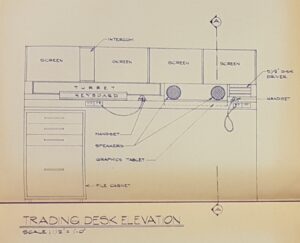
Looking back, this topic has been part of my life since 1982 when I was first introduced to the concept of a smart card. At that time we spoke of using the smart card to securely configure a trading deck on Wall Street and in the City of London. The goal securely and automatically configure the voice, video and digital support a particular market trader.
In 1993 to when I was tasked to drive the development of EMV, we could have talked about the fact we were creating a means of secure digital identity. A trusted Identity document based on the trust that existed between the cardholder and the financial institution.
Instead We talked about:
Today the Debit card could easily be enabled as a secure means of digital identification, with the Financial Institution being the trusted party. Simply knowing the public key of the international or domestic debit card payment scheme allows the party reading the card will know the person was issued this card by that financial institution.
While we in financial services focused on our requirements, the telecom industry was working on the SIM & GSM specifications under ETSI leadership. They created another form of Secure Digital Identity. They focused on securing the identity of the communications channel and were less worried about making sure the right consumer was present, although there is the ability to allow the user to lock the SIM and now even the mobile phone.
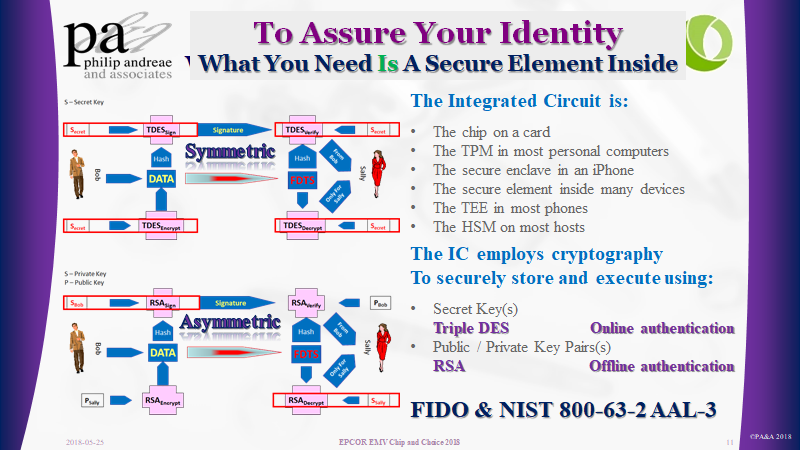
2013 I had the opportunity to join the FIDO Board. Within that body, the objective was to separate the concept of identity from the act of authentication. It works from the premise that as digital relationships expanded, the use of passwords and PINs are becomes an issue. The FIDO Alliance also recognized that the only way to secure our digital world, like we secured payments and mobile communications was with the introduction of multi-factor authentication rooted in the belief that the first factor had to be “what You Have” a secure element / enclave, TEE, TPM … capable of generating and or storing secret (symmetric) and private (Asymmetric) keys unique to the object and more importantly unique to the relationship.
Clearly identity and authentication are essential to secure relationships. And, in a digital world, communication is the mechanism that connects people and things together.
Helping consumers manage their relationships assuring privacy is an interesting angle. If I am understanding your platform, at least at the level of the subscription for telecommunications services this you are helping to manage.
Anyway. Back to the pitch. I would like to see about scheduling another conversation and figure out if there is anything I can do to earn an income and create revenue for you.
This Sunday our minister spoke of Mark 5:20-43 and how we must trust in Jesus.
Her evocative sermon provoked a wider or is it broader question,

“What is Trust”.
First we must ask the classic question what does the Dictionary and Wikipedia say. This then leads us to have to think of the use of the term. Are we using it to describe a legal structure, the nature of a business, a computational concept or the name of a film, song or other human creation?
Given this discussion started as a result of a sermon, the best approach is to consider the social and emotion context of trust. Understand the sociology, psychology, philosophy, economics and systems perspective, may offer clarity to the words “we trust … “. In the first paragraph the Wikipedia authors condensed a lot of thought into a short paragraph. {formatting of my doing}.
Definitions of trust typically refer to a situation characterized by the following aspects:
- One party is willing to rely on the actions of another party (trustee); the situation is directed to the future.
- In addition, the abandons control over the actions performed by the trustee.
- As a consequence, the is uncertain about the outcome of the other’s actions; they can only develop and evaluate expectations.
- The uncertainty involves the risk of failure or harm to the trustor if the trustee will not behave as desired.
In this flow of thought it is clear this word trust carries with it risk. It assumes we are thinking of tomorrow and there is an expectation the trustee will act in a manner that is consistent with our “the trustors” wishes, hopes and desires.
Vladimir Ilych Lenin expressed this idea with the sentence “Trust is good, control is better”.
In the field I have spent the better part of my life, computers have played a big part. Be it as a tool we programmed to perform a function or task. Or, the systems supporting the products and services we sought to promote. More recently, as we look to this global village we are a member of. We think about the need to establish mechanisms to assure trust between parties. Parties who probably will never meet, in person or even by chance speak to. We must therefore establish acceptable social and psychological mechanism with machines which we inherently are wary of.
Looking to the sociology of trust set of sentences stands out
“It does not exist outside of our vision of the other. This image can be real or imaginary, but it is this one which permits the creation of the Trust.” … “Because of it, trust acts as a reductor of social complexity, allowing for actions that are otherwise too complex to be considered (or even impossible to consider at all); specifically for cooperation.”
All of this leads one to wonder how in a anonymous world can trust be established.
Trust is specifically valuable if the trustee is much more powerful than the trustor, yet the trustor is under social obligation to support the trustee.
In a social context this thought offers a view as to the dominance a position the trustee must have in society. It also frames the responsibility and the obligation established by the trustor in the trustee.
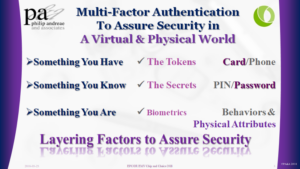
This then leads one think about Multi-Factor Authentication. MFA is emerging as the standard method companies are used to assure one of degree of “trust”. Trust in a claim of the identity of another, be it a customer, employee, citizen or recognized guest.
Is this enough? How can a company be assured of the identity of an individual? How can we, a third party, accept the claims or attributes offers when they are presenting themselves to us. Especially when they present themselves across a global digital highway, prone to the nefarious acts of those who seek to take advantage and profit.
Proof of identity therefore becomes the primary means of establishing trust in an seemingly anonymous space – Cyber Space. This need for proof of identity is the role of the Trustee. These parties who we instinctively have faith in can give us the ability to trust in the claims of identity and the associated attributes representing the characteristics, assets and relationships a person has.
For now I will stop. The next step is to think of and look at words. enrollment, proof, identification,registration, identifier, authentication, rights, privileges, claims, certificates and authority.
October 03, 2011
Cyberspace trust: Proving you’re not a dog
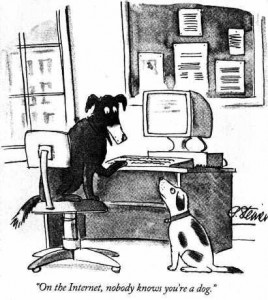
A very real discomfort underlies the classic joke: “On the Internet, nobody knows you’re a dog.” How can you prove your own identity and confirm the identity of others during virtual interactions? Every time you reach out to a friend on Gchat, post on a classmate’s Facebook wall, or send money to a colleague via PayPal, you are relying on a key assumption: that the person you’re reaching out to behind that Gmail address, Facebook profile, or PayPal screen name is who they say they are. Without this baseline confidence, online interactions and commerce would be paralyzed.
http://portalsandrails.frbatlanta.org/2011/10/cyberspace-trust-proving-youre-not-dog.html
Philip thinks: