BLOCKCHAIN Economy

A Conversation with Gemini

What is the economic reality of blockchain write only databases or ledgers.

Show thinking

Okay, let’s break down the economic reality of blockchain-based databases or ledgers, focusing on their characteristic as largely “append-only” (data is added, but extremely difficult to modify or delete once confirmed).

The economic reality is complex and highly dependent on the specific use case, the type of blockchain (public vs. private/consortium), and comparison to traditional database solutions. Here’s a breakdown:

  • 1. High Costs (Often Higher than Traditional Databases):
  • Development & Implementation: Building and integrating blockchain solutions requires specialized expertise, which is often expensive and less common than traditional database skills. Setting up nodes, smart contracts, and ensuring security is complex.  
  • Transaction Costs (Gas Fees): Particularly on public blockchains (like Ethereum), every transaction (writing data) requires a fee paid to network validators/miners. These fees can fluctuate wildly and become prohibitively expensive, especially for high-volume applications.  
  • Energy Consumption: Proof-of-Work (PoW) blockchains (like Bitcoin, though Ethereum has moved away) are notoriously energy-intensive, leading to high operational costs and environmental concerns. Proof-of-Stake (PoS) and other consensus mechanisms are more efficient but still require infrastructure and incentives.  
  • Storage Costs: Every node in the network typically stores a copy (or at least the headers) of the entire ledger. As the ledger grows, storage requirements increase across the network, although solutions like sharding aim to mitigate this.  
  • Scalability Limitations & Costs: Many blockchains face limitations in transaction throughput (transactions per second). Scaling solutions (like Layer 2 networks) add complexity and potential additional costs or trust assumptions.  
  • 2. Economic Benefits (The Value Proposition – Where Costs Might Be Justified):
  • Trust & Transparency: In scenarios involving multiple parties who don’t fully trust each other (e.g., supply chain, consortiums, international trade), the shared, immutable, and transparent nature of the ledger can reduce the need for costly intermediaries, audits, and reconciliation processes. This disintermediation is a key potential economic benefit.  
  • Immutability & Security: The high cost and difficulty of altering past records provide strong data integrity. This is valuable for applications where tamper-proofing is critical (e.g., land registries, intellectual property, voting systems – though practical implementations vary). This reduces risks associated with data manipulation or fraud.
  • Automation via Smart Contracts: Smart contracts can automate agreements and processes based on ledger data (e.g., automatic payment release upon verified delivery). This can reduce administrative overhead and speed up execution, potentially lowering costs.  
  • Resilience & Availability (Decentralization): A truly decentralized network has no single point of failure, potentially offering higher uptime and censorship resistance compared to centralized databases (though many “enterprise blockchains” are not fully decentralized).  
  • 3. The Crucial Question: Is Blockchain Economically Viable for a Specific Use Case?
  • Comparison to Alternatives: For many applications, a traditional, centralized database (SQL, NoSQL) managed by a trusted entity is far cheaper, faster, more scalable, and easier to manage. The key economic question is whether the unique benefits of blockchain (trustlessness, transparency, immutability) outweigh its significant costs and complexities for that specific problem.
  • Problem Fit: Blockchain makes the most economic sense when:
  • Multiple, mutually distrusting parties need to share and agree on data.
  • Immutability and auditability are paramount.
  • Disintermediation offers significant cost savings or efficiency gains.   A degree of decentralization is required for resilience or censorship resistance.
  • Private/Permissioned vs. Public Blockchains:
  • Public: Higher potential for true decentralization and censorship resistance, but often higher transaction costs (gas fees), lower throughput, and less control. Economic model often relies on native tokens.
  • Private/Permissioned: Controlled by a single entity or consortium. Generally faster, cheaper transactions (no public gas fees), and higher privacy, but sacrifices decentralization and potentially some trust benefits. Costs are shared among participants or borne by the managing entity. Often closer to a shared, immutable database than a truly decentralized system.
  • 4. Economic Reality Check:
  • Hype vs. Reality: Many proposed blockchain use cases haven’t proven economically superior to existing solutions after the initial hype.
  • Adoption: While adoption is growing in specific niches (DeFi, supply chain pilots, cross-border payments, NFTs), it’s far from mainstream for general database needs.
  • Immutability as a Drawback: The inability to easily change or delete data can be an economic liability, especially concerning errors, updates, or regulations like GDPR’s “right to be forgotten.” Workarounds exist but add complexity and cost.
  • In Conclusion:
    • The economic reality of blockchain ledgers is that they are often more expensive, slower, and more complex than traditional databases. Their economic viability hinges entirely on whether the specific problem requires the unique benefits of decentralization, transparency, immutability, and trust reduction among multiple parties, and whether these benefits provide value that significantly outweighs the higher costs and inherent limitations compared to centralized alternatives. For many standard data storage and retrieval tasks, traditional databases remain the far more economical choice

Cryptocurrency – built on the hopes and dreams of the masses

As is my habit each morning I run through a serious of Google Alerts scanning and reading those that tweak my interest.  One of these alerts helps me to stay abreast of what is happening in the crypto market.  Most often times the articles present the hype and expectation of those enamored with Bitcoin and the excitement the last ten years of cryptocurrency excitement has wrought.

One article’s conclusion deserves a bit more thought.

5 Costly Tech Mistakes Crypto Beginners Make

There’s a lot of money to be made in cryptocurrency, but it belongs to those who can avoid making ruinous mistakes.

Whether you’re trading or mining, it is important to treat your endeavor with the utmost care and diligence.

As a crypto newcomer, you will go much farther and enjoy success if you note these tech-mistakes and steer clear of them.

  This middle sentence once again reinforces my skepticism.

What is behind these immaterial assets?

Is the price of a bitcoin simply the result of the actions of crypto believers, speculators, and gamblers?

Is a cryptocurrencies price driven by the value of the reward required by miners to cover their cost for electric, space and computer resources?

Unlike the US dollar, the British pound, Swiss Franc or other stable country issued currency built on “trust” in the future of the USA, UK or Switzerland;  these new currencies are built on peoples’ belief in a speculative and trustless cryptographic universe.

In essence, these cryptocurrencies are built on
The hopes and dreams of many

Behind all of this is the cost of supporting these cryptocurrencies.  Costs measured in electric bills and the investment in racks of mining resources “computers”.  Is it the ever-increasing need for computation power that drives the ever-increasing need for higher rewards set against the process of halving, apparently designed to address inflation.

This mystery of “inflation” leaves me wondering if inflation of the price a built-in part of a scheme to assure the original and still invested success of the few?

Cryptocurrencies, Politics and the Future

A world of volatility and speculation

This morning hash rates, degrees of difficulty and the creating of derivatives to moderate the risk of Bitcoin mining drew me in.  Several years ago I was asked to participate in a fireside chat on Crypto-currencies at the Federal Reserve in Atlanta.


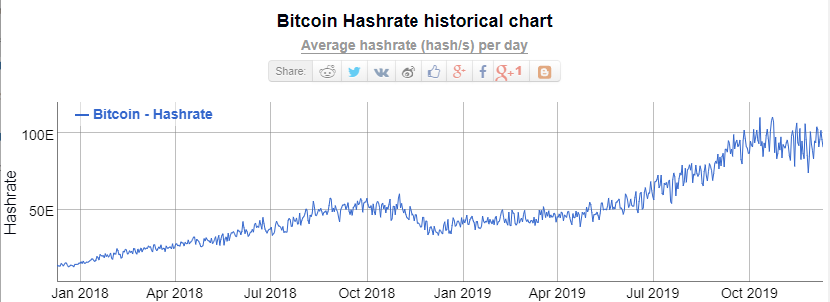
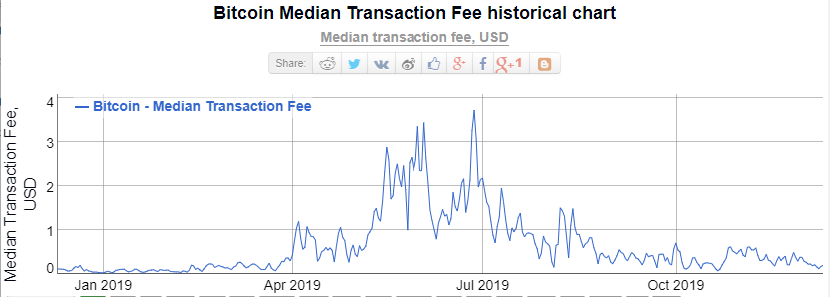
One of my concerns then and still today is the exponential growth in the cost of mining.  These charts offer a perspective on a concept called the Hash Rate, a measure of the work necessary to create a block. Clearly, as time marches forward, the work to earn the reward gets harder.  Thus creating a need to increase the fees charged to add a transaction within a block to the chain.

When people speak to the justification of Bitcoin they would speak to the reduction in cost.  Is this statement still valid?

Disruption, lies, and politics

While considering the potential of Bitcoin; the working of our government rambles on, as we consider the fate of the American President.  Lies, bribes, abuse, and obstruction seems to be the order of the day.

The division between political parties; drives division within families, cities, and two people sitting together over lunch creates animosity.

We are now a world driven to speculate or better said gamble while not wanting to find a gentle and graceful road to mutual satisfaction.

We need to reflect consider and potential restore faith in what is real, what is just and what is fair for all. 

Spending money on machines of war instead of investing in education and our environment makes no sense to this lone individual.  We need to once again seek peace and justice.

What is a Cryptocurrency or better yet why do we want them

As a member of a committee responsible to develop the agenda for Payment Summit this February in St Lake City, we’ve been discussing a panel on Cryptocurrency.  The initial conversation spoke of blockchain and cryptocurrencies and how these two topics, while related, need to be independent of each other.

With an agreement to focus on Cryptocurrency, I began to ask myself, “What is a cryptocurrency”?

Off to the Internet.  My computer instantly offered a definition.

A digital currency in which encryption techniques are used to regulate the generation of units of currency and verify the transfer of funds, operating independently of a central bank

        • ‘decentralized cryptocurrencies such as bitcoin now provide an outlet for personal wealth that is beyond restriction and confiscation.’
        • ‘States will undoubtedly resist the spread of cryptocurrencies.’
        • ‘Bitcoin was the first widely used cryptocurrency, but few people know it is not the only one.’
        • ‘What does your cryptocurrency allow people to do that they could not do otherwise, and how does it help them do existing tasks more quickly or cheaply?’
        • ‘If cryptocurrencies are like other speculative activities, the early players and the big players benefit to the detriment of the late entrants and the small players.’
        • ‘As with all cryptocurrencies, price is based on supply and demand.’‘Even with recent fluctuations, the total value of the cryptocurrency is still over eight billion USD.’
        • ‘The majority of cryptocurrency activity still appears to be speculative.’
        • ‘A cryptocurrency may be hackable, but it can also be really, really, really hard to hack—harder than robbing a bank.’

The interesting challenge in this definition is the words operating independently of a central bank”.

In September 2017 the Bank of International Settlement BIS published a report on Cryptocurrencies.  This report spoke to the idea of CBCC or Central Bank Cryptocurrency.  The authors offered a diagram known as the Money Flower.  The flower positions this idea of CBCC within the world of money and argues a Central Bank could easily create a sovereign cryptocurrency. 
The article then goes on to describe a series of examples.  As I moved through the document I was drawn to the idea of Digital Currency and once again was compelled to search for clarity.  At the same time I noted the recent announcement by China and how the
European Union recently suggested the European Central Bank consider just such an investment.

During my research, I was reminded of the work of David Chaum and remembered how early in the growth of Bitcoin someone suggested David could be Satoshi Nakamoto.  I am also reminded of my time at Europay and how we explored the use of Chip Cards, given their hardware and cryptographic capabilities, to create a Cash Replacement, Mondex.  In parallel with our efforts Visa Cash emerged, Proton, Chip Knip, Chipper and, others emerged.  This led me to a BIS report on Electronic Money.

Looking back in history to the early discussions of Electronic Money and read the early views of the European Union and the US Treasury, it reminded me of some of the original concepts and issues.  I’m reminded of words like anonymity, traceability, origination, and sovereignty.

Anonymity and the lack of traceability are what criminals and Silk Road Market Place saw as the benefit of Bitcoin.  The concepts of origination and sovereignty clearly are key to the thinking of Governments and Central Bankers and critical elements of the origin of Bitcoin, as expressed in the original white paper.

What these cryptographers have created is amazing, yet one worries about who is responsible for and benefits from the origination of Bitcoins, forks of Bitcoins and the multiple cryptocurrencies now in existence.

If we look inside Bitcoin its architecture promotes the idea of mining and allows the successful miner to originate new bitcoins.  They argue this is the incentive driving participation.  I then wonder about the cost of Bitcoin mining or the cost of Ethereum mining.  Does the cost of supporting Bitcoin justify its continued existence?  Does the supposed benefit of cryptocurrencies justify the profit earned by the miners who support the work to assure consensus?

As my research progressed  I ran into a speech given at a conference and the Bundesbank Money in the digital age: what role for central banks? The article attempts to address three questions:

      • What is money?
      • What constitutes good money, and where do cryptocurrencies fit in?
      • And, finally, what role should central banks play?

The author’s arguments are worthy of consideration.  Especially the questions of efficiency and trust.

The question we all must consider
What is money?
Especially in the global and emerging digital market place.

In the end, I remain confused and concerned.  Digital Money, Electronic Money, Digital Currencies, Cryptocurrencies, Feit Money, stablecoins and the potential of the distributed ledger clearly are set to disrupt much.