Letter for Shelby Perdue Daughter of

The following sting of emails sent to Shebly and various individuals July 19th 2025. Timed between receipt of her email and last of mine at 20:09. Some excluded for privacy reasons.

Finally your letter recieved and signed for May 5th did not acknowledge the letter delivered to the Board, their personal email, since Board email did not work at that time, and not yourself, April 27th, and, by hand, April 30th, to Hodnett Cooper.

PhilipAndreae.com/pleaseTypos are normal on my Samsung Galaxy S25 Ultra

Finally everything communicated on or from that website are clear

PhilipAndreae.com/pleaseTypos are normal on my Samsung Galaxy S25 Ultra

I also advise you that the board address is mine and as long I as include a satirical footer then all will know this is me the owner of the domain and therefore any communications from a website I own is my privilege.

PhilipAndreae.com/pleaseTypos are normal on my Samsung Galaxy S25 Ultra

Sorry my dispute is not with y0u it is with the community.

PhilipAndreae.com/pleaseTypos are normal on my Samsung Galaxy S25 Ultra

Above typos, the recipients will have, have been corrected for website clarity.

letter from Shelby Bricka Perdue

delivered 19:11 20250719

Mr. Andreae,

As you are aware, The Reserve at Demere Homeowners’ Association, Inc. is represented by the law firm, NowackHoward, LLC, and I am the attorney directly working with the Association.  

Please remove the members of the Board of the Association and its the property managers from additional emails. Any further correspondence concerning this matter must be directed to me.

Questions or problems outside of this matter concerning the Reserve at Demere should be addressed to Hodnett Cooper as the property manager for the community. 

Additionally, this communication shall place you on legal notice that any use of a domain name or email address intended confuse, mislead or defraud a person as to the source of the material violates Georgia law and engaging in this conduct may result in legal action being taken against you.   

Sincerely, Shelby Perdue 

Shelby Bricka Perdue | Partner shelby@nowackhoward.com  

One Alliance Center, Suite 1650

3500 Lenox Road NE, Atlanta GA 30326

Direct 770-863-8905 | Fax 770-863-8901 NowackHoward.com    

DEBT COLLECTION NOTICE: This is a communication from a debt collector. This is an attempt to collect a debt and any information obtained will be used for that purpose. 

EMAIL OPT OUT NOTICE:  If you do not wish to receive email communications from this firm, please email STOP to owners@nowackhoward.com. 

Notice: This e-mail message and all attachments transmitted with it may contain legally privileged and confidential information intended solely for the use of the addressee. If the reader of this message is not the intended recipient, you are hereby notified that any reading, dissemination, distribution, copying, or other use of this message or its attachments is strictly prohibited. If you have received this message in error, please notify the sender immediately by the telephone number listed above and delete this message and all copies and backups thereof. Thank you.

Notice: Please be advised that this Firm may be acting as a debt collector and that this communication may constitute an attempt to collect a debt, and any information obtained will be used for that purpose.  If the debt is in active bankruptcy or has been discharged through bankruptcy, this communication is not intended as and does not constitute an attempt to collect the debt.

BLOCKCHAIN Economy

A Conversation with Gemini

What is the economic reality of blockchain write only databases or ledgers.

Show thinking

Okay, let’s break down the economic reality of blockchain-based databases or ledgers, focusing on their characteristic as largely “append-only” (data is added, but extremely difficult to modify or delete once confirmed).

The economic reality is complex and highly dependent on the specific use case, the type of blockchain (public vs. private/consortium), and comparison to traditional database solutions. Here’s a breakdown:

  • 1. High Costs (Often Higher than Traditional Databases):
  • Development & Implementation: Building and integrating blockchain solutions requires specialized expertise, which is often expensive and less common than traditional database skills. Setting up nodes, smart contracts, and ensuring security is complex.  
  • Transaction Costs (Gas Fees): Particularly on public blockchains (like Ethereum), every transaction (writing data) requires a fee paid to network validators/miners. These fees can fluctuate wildly and become prohibitively expensive, especially for high-volume applications.  
  • Energy Consumption: Proof-of-Work (PoW) blockchains (like Bitcoin, though Ethereum has moved away) are notoriously energy-intensive, leading to high operational costs and environmental concerns. Proof-of-Stake (PoS) and other consensus mechanisms are more efficient but still require infrastructure and incentives.  
  • Storage Costs: Every node in the network typically stores a copy (or at least the headers) of the entire ledger. As the ledger grows, storage requirements increase across the network, although solutions like sharding aim to mitigate this.  
  • Scalability Limitations & Costs: Many blockchains face limitations in transaction throughput (transactions per second). Scaling solutions (like Layer 2 networks) add complexity and potential additional costs or trust assumptions.  
  • 2. Economic Benefits (The Value Proposition – Where Costs Might Be Justified):
  • Trust & Transparency: In scenarios involving multiple parties who don’t fully trust each other (e.g., supply chain, consortiums, international trade), the shared, immutable, and transparent nature of the ledger can reduce the need for costly intermediaries, audits, and reconciliation processes. This disintermediation is a key potential economic benefit.  
  • Immutability & Security: The high cost and difficulty of altering past records provide strong data integrity. This is valuable for applications where tamper-proofing is critical (e.g., land registries, intellectual property, voting systems – though practical implementations vary). This reduces risks associated with data manipulation or fraud.
  • Automation via Smart Contracts: Smart contracts can automate agreements and processes based on ledger data (e.g., automatic payment release upon verified delivery). This can reduce administrative overhead and speed up execution, potentially lowering costs.  
  • Resilience & Availability (Decentralization): A truly decentralized network has no single point of failure, potentially offering higher uptime and censorship resistance compared to centralized databases (though many “enterprise blockchains” are not fully decentralized).  
  • 3. The Crucial Question: Is Blockchain Economically Viable for a Specific Use Case?
  • Comparison to Alternatives: For many applications, a traditional, centralized database (SQL, NoSQL) managed by a trusted entity is far cheaper, faster, more scalable, and easier to manage. The key economic question is whether the unique benefits of blockchain (trustlessness, transparency, immutability) outweigh its significant costs and complexities for that specific problem.
  • Problem Fit: Blockchain makes the most economic sense when:
  • Multiple, mutually distrusting parties need to share and agree on data.
  • Immutability and auditability are paramount.
  • Disintermediation offers significant cost savings or efficiency gains.   A degree of decentralization is required for resilience or censorship resistance.
  • Private/Permissioned vs. Public Blockchains:
  • Public: Higher potential for true decentralization and censorship resistance, but often higher transaction costs (gas fees), lower throughput, and less control. Economic model often relies on native tokens.
  • Private/Permissioned: Controlled by a single entity or consortium. Generally faster, cheaper transactions (no public gas fees), and higher privacy, but sacrifices decentralization and potentially some trust benefits. Costs are shared among participants or borne by the managing entity. Often closer to a shared, immutable database than a truly decentralized system.
  • 4. Economic Reality Check:
  • Hype vs. Reality: Many proposed blockchain use cases haven’t proven economically superior to existing solutions after the initial hype.
  • Adoption: While adoption is growing in specific niches (DeFi, supply chain pilots, cross-border payments, NFTs), it’s far from mainstream for general database needs.
  • Immutability as a Drawback: The inability to easily change or delete data can be an economic liability, especially concerning errors, updates, or regulations like GDPR’s “right to be forgotten.” Workarounds exist but add complexity and cost.
  • In Conclusion:
    • The economic reality of blockchain ledgers is that they are often more expensive, slower, and more complex than traditional databases. Their economic viability hinges entirely on whether the specific problem requires the unique benefits of decentralization, transparency, immutability, and trust reduction among multiple parties, and whether these benefits provide value that significantly outweighs the higher costs and inherent limitations compared to centralized alternatives. For many standard data storage and retrieval tasks, traditional databases remain the far more economical choice

What Happens When the Lights Go Out

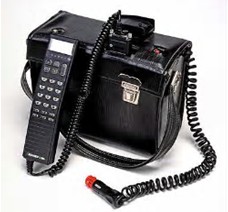
Since 1984, when I was told I needed to carry this mobile phone with me, there has been that nagging issue of needing to make sure it had enough life to get me to the next charge point.  My first phone was luck if it could last a half a day so they gave me two, one was always being charged while the other hung on my shoulder.  In 1993 while working on the development of the EMV Specifications we focused on the ability to authorize a transaction when the Point of Sale POS device was unwilling or unable to reach the issuer.  In 2013 I listened to Visa representatives explain how 100% of all payment transactions could be executed online.  Then I ponder getting a Tesla Model 3 and learn it is only capable of traveling a maximum of 310 miles, it make me wonder; how do I finish the last 19 miles to my fathers home.
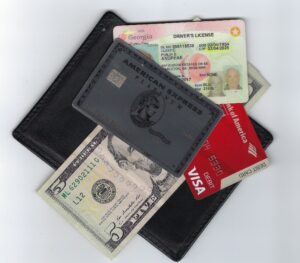
Today, I was reading an article emanating from the Money 2020 event when IDEMIA spoke of the idea of the mobile drivers license and that nagging feeling emerged.  What happens when the power goes off after the hurricane hit and someone asks me for my drivers license.  Its locked securely inside my dead mobile phone.  I then saw that their competitor Gemalto and even NIST are working on this concept of the mDL.

We live in a world where electricity is becoming as essential as water and food.  Yet, we hear of power outages that last weeks and even months.

It is like with Mobile Payments, if the phone is dead and in order to pay it must, then what?  The card remains the essential element of a successful payment transaction.
I dream of the day when I can merge my leather wallet and my mobile device into one.  Yet, I appreciate there are technical challenges like the need for electricity.  Until we lead with these technical challenges and not simply the dream.  Exciting concepts and ideas will go where so many have gone before.

Mobile Payment – Thoughts after listening

Thoughts resulting from The webinar Doug King of the Atlanta Federal Reserve gave on “Future Proofing Payments”

The long standing question of the future of Mobile Payments, again discussed and again similar conclusions.

  • Will the American market embrace the idea of mobile payments?
  • Is it a question of when or a question of why?
  • Why do emerging markets embrace new ways and mature markets resist?
  • Is it all about acceptance and the merchants investment in contactless reader capability?
  • Is it an all or nothing concern?
  • Could it be simply reality, as ling need our wallet with other cards e.g. our drivers license, why eliminate payment cards from the physical wallet?

Doug touched on all of these questions. He shared relevant statistics demonstrating the slow and possibly indistinguishable grow in usage of mobile wallets. He shared the success of several of the merchant proprietary mobile payment approaches.

Which leads me down the path of another question. What is the value proposition that will ignite the use of our phone and devices as carriers of our means of payment? The possibility to create value simply with a electronic wallet carrying only means of payment, does not create an exciting proposition.

Our mobile phones and connected devices provide us with such value

We have embraced dozens of apps. They help us to navigate, shop, explore, play and learn. Our phones are beginning to become security devices, taking advantage of sensors to integrate biometrics into how we access and authenticate ourselves as we browse and explore the ever increasing digital place we now call cyber space.

There is another phenomena emerging as a result of how we are transforming how we engage. Some called it the “Uberization” of payments, the ability to make payments frictionless. A change so profound we must stop and reflect and ponder what next.

I recognize there is a repetitive theme to my musing.

When physical world merchants fully embrace the concept of omni channel and build their virtual and physical experiences to complement and augment one another, then, with the ability to integrate payment seamlessly into the shopping experience a value proposition emerges.

Payment – Mobile Payments – Connectless payments and an opening to further discussion

Each day I receive a variety of articles on the subject of mobile payments and find countless opinions about the evolution, risks and capabilities of mobile payments.

As is always good form a definition is in order.  I could begin by suggesting a mobile payment is any time that while moving about I can purchase something from someone using some recognised means of payment or currency.  So at the most basic level of understanding carrying cash in our pockets was and still remains a form of mobile payments.  Yet this is not what we mean when we discuss mobile payments.  What we have done is combined two words from two worlds into a new thought.  Mobile emerging from the arena of telephony and the use of the concept of a phone that does not need to be connected with a piece of wire.  Wireless, cellular and mobile all are terms that we associate with the use of radio waves to connect a telephone to a network allowing us to make phone calls from someplace that is in proximity to a receiver or cell tower or satellite.  Now I’m sure all of my readers know these things and are wondering what is the point.

The point is that we also talk about contact-less payments that concept of waving a card in front of an antenna, thus  allowing the card to receive power through induction and then communicate with the device controlling the antenna.  Some people call it that “Tap and Go” feeling others refer to it a PayPass, Visa Wave, Express Pay card and if we travel the world we will find an assortment of other brand names such as Dexit.  In many cities transit agents discovered that by employing contact-less cards interfacing with – terminals they could create efficiencies, improve information about ridership and maybe even reduce fraud.

So now we have to discuss the application of the technology.  This brings us to the idea of closed loop and open loop systems.  Neither are new thoughts, charge cards issued by department stores are closed loop they only work at that companies stores.  Open loop refers to systems that are widely accepted because someone has gone out and branded a concept, convinced merchants it is convenient and then offered a “Card” to you and I so that we can be identified and employ this “Means of Payment”.  Classic brands that we think of as Open Loop systems include money, MasterCard, Visa, Interac, PIN, eurocheque and an assortment of national brands.

Yet all of these systems have inherent inefficiencies.  Inefficiencies that some see as benefits and others see as highway robbery.  Then there is that class of people who enjoy getting something for “nothing” they like the idea of counterfeiting money, replicating credit and debit cards, capturing our PIN and ultimately stealing our identity and more importantly our hard earned money.  I could also mention merchant discounts, late fees, interest charges, interchange but those are all for another day.

The operators of these systems understand or learn about these various methods of “Stealing” identity and money and have built systems to mitigate the risk, eliminate no minimize yes.  In Europe and throughout the world (except the USA) the members of MasterCard, Visa and the various domestic systems are working to reduce these threats by introducing Smart Cards or Chip Cards all cards employing the EMV specification that have a computer embedded within.  The benefit is that PIN can easily be introduced on credit cards, the cost of telecommunications can be reduced by allowing the computer in the card to make intelligent decisions when ever that card is used to effect a payment.

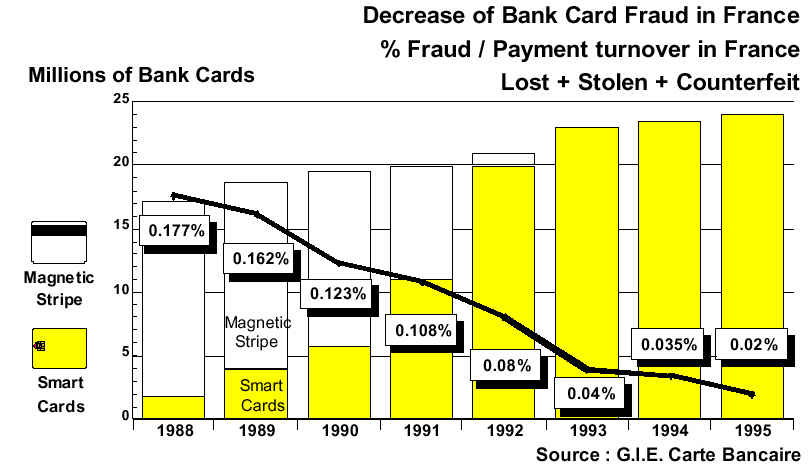
This movement to secure payment cards with the technology and specifications defined within the EMV specifications began first in France where they went out on their own developed their own specifications and proved to the world that smart cards or chip cards can and will reduce the level of card present fraud and can if employed properly also reduce the cost of telecommunications.  their success can easily be  seen in this chart that tracked their progress and success.

French Banks demonstrate the Smart Cards workFrench Success Story

Remarkable success, yet they were now faced with an issue.  First the criminals understood if they disabled the chip (computer) the merchant could still swipe the card and read the magnetic stripe.  This one easily could be solved by eventually not allowing cards that should have a chip to be swiped through the magnetic stripe reader.  But what about when these cards were used in Holland, England or anywhere that had not, and at the time no one had, adopted the same means of defense.  The net result fraud migrated from being a domestic issue to the cards being used in neighboring countries.  Obviously the French became proponents of a global migration to smart cards and convinced Visa, MasterCard and Europay to develop the EMV specifications, recognising that they would have to eventually convert.

I could continue to digress from my main theme and talk about how each country went through its decision making process.  I could then go on and talk about how far along they are in their implementations. Suffice it to say some are finished, others are diligently working towards completion and others are moving at a pace that does not cause undue expense and allowing natural replacement cycles to drive the timescale for implementation.

Here in the country where I live they also have a Chip Migration strategy.  Canada is inpilot or a trial depending on how the lawyers interpret the efforts of banks potentially colluding together.  By the summer cardholders in the Kitchener Waterloo area will be using these chip cards and the media, banks, merchants, processors and associations will be monitoring and learning how the Canadian’s feel about and their willingness to embrace the change.

The following chart outlines Interac’s schedule for deployment.  MasterCard is playing along without committing.  Whereas Visa has stated that they will push the liability for fraudulent transaction not protected by EMV to the Acquirer if their merchants are not compliant by October of 2010.Canadian Chip Migraation Interac's EMV Timeline

So how does all of this affect the introduction of Mobile Payments or Contact-less Cards.  A mobile payment is simply, today, a contact-less payment performed using a mobile phone with the contact-less interface inside as apposed to to using the card as the form factor..  Well some will say not at all, the drivers are different the business case is not the same.  Yet the core technology is a computer in the card.  So why worry, eventually all of this could come together.  Or will the USA decide to take another path all together.

So to end this particular blog I ask a simple question, based on the premise that the mobile and contact-less payments that we see emerging are all about speeding up low value <$25 dollar transactions. What happens when I want to use my contact-less mobile phone for a payment for say a $1,500 hotel bill.  Will I tap my contact-less device “mobile phone”.  Have to find a place to put it while I either enter my PIN or sign the receipt.  Today the clerk typically holds the card for me while I sign the receipt tomorrow what.  Or will they decide to merge contactless and EMV creating a more interesting problem.  I’ll need to keep that phone near the antenna while my PIN is verified and the transaction is authorized.

Or should we go on and talk about the security concerns that everyone has described in countless articles and numerous logs.  The idea that the criminal will walk down the street reading the content of your purse or wallet with their hidden antenna.

Or should we talk about who is going to pay the price of adding the contact-less antenna to the merchants point of sale equipment.

Let me hold those for another day and another flow of thought.

Interac's EMV timeline

Legacy infrastructure impedes truly innovative disruption

An interesting thought – Is the USA behind in adopting payment technologies.

Areas that one could ponder are:

* Payment Card Security
* P2P Mobile Payments
* P2P and P2B Electronic Funds Transfer as part of Home/Mobile Banking
* Elimination of Checks including Check images
* A/R and A/P electronic payments integration
* …

What would be interesting is to eventually be able to catalog the global differences and define the ultimate payment capabilities a country should adopt.

Please let’s share and explore.

Are the Pundits over thinking the ISIS proposition

Mobile payments is being discussed in the context of “creating” a new “means of payment” or in other words a new “Payment Brand”.  I would suggest  the expense and time it takes to create a new “Payment Brand” is significant not to ignore expensive. 

Just look at PayPal.  How long, on the backs of eBay, did it take to reach the point where they are ready to  enter into a venture with Verifone to become a “means of payment” their buyers can use at the real world stores of their sellers.

Two models for payments exist in the market today and frankly these two models have not changed, since the beginning of any form of commerce. 

The three party model and the four party model. 

Classically banks regulated and trusted to hold our moneys in accounts are fundamental to the act of payment.  They have always been key to developing and operating the payment systems. 

Unless of course we use cash. 

In both models two parties always exist – the Buyer and the Seller, the Payer and the Payee or the consumer/cardholder and the merchant.

In the four party model we add two Banks who support one of these two parties.  There is the bank with the relationship with the consumer/buyer/payer/cardholder, often called the Issuing Bank.  On the other side of the payment there is the bank with the relationship with the merchant/seller/payee, often called the Acquiring Bank.

The three party model, simply means that the Bank of the payer and the Bank of payee are the same.  The movements of funds flows from the buyers account to the sellers, as ledger entries, within a single institution.

American Express and PayPal are perfect examples of non-Banks who operate three party payment systems. 

The central bank is another example of a three party system.  All the banks within a country are clients of the central bank and have accounts at the central bank.

Clearly the three party model is the most efficient.  But, it requires that there is a monopolist who processes payments for all buyers and sellers in order for the system to truly work.  Reality dictates that a monopoly or agreement by all parties to use a single entity for their banking and payment services must exist for such a system to dominate the market.  

Therefore, the payment systems have evolved cooperatively; based on acceptance by the consumer and merchant of a recognized means of payment.  The banks work together to establish a set of rules and procedures they employ to transact payments.  Various four party models i.e. MasterCard and Visa along with checks, electronic fund transfers, dominate the payments landscape. 

Inherent to these models is  a Brand (acceptance mark), a set of rules and a clearing mechanism.  Everything works because there are agreed rules and procedures that govern how the two banks execute payments.  To complete the cycle these two banks ultimatelyexchange real money, typically through a settlement bank or the central bank representing the total value of the payments processed.

To add complexity to the landscape, the Issuer and Acquirer often contract with processors to do the work.  These to entities are identified in the graphic as the Issuing Processor and the Acquiring Processor.

Behind the term mobile payments, some think there is a more efficient method of affecting payments.  They believe inserting a new player into the game will make the whole system more efficient and therefore cheaper.  Or more appropriately they think that their new approach will allow them to earn a portion of the Merchant Discount (fee paid by the Merchant to the Acquirer) or the Interchange (fee paid by the Acquirer to the Issuer). 

The more I think, read and discuss, the more convinced I become that creating a new payment Brand is an expensive exercise and frankly believing we can create something new and more efficient than the existing four party models is irrational. 

So what does the Mobile Phone bring to the payment landscape? 

Clearly ISIS understands.  Mr Abbott states “We plan to create a mobile wallet that ultimately eliminates the need for consumers to carry cash, credit and debit cards, reward cards, coupons, tickets and transit passes.”  Key word “WALLET” by definition “A wallet  is a small, flat case used to carry personal items such as cash, credit cards and identification documents, such as a driver’s license. “  Interesting, a mobile phone is a small, flat object that can carry a digital facsimile of cash, cards, identifications documents … . 

Next we think about NFC “Near Field Communications”, a method of transferring data between the content of the Wallet to the merchant’s Point Of Sale device “POS”.   Tap instead of swipe.  NFC replaces the  read of the magnetic stripe with the transfer of the data from the Mobile Wallet to the merchant’s POS.  To achieve this goal PayPass and the otehr contactless payment cards simply stores what is on the magnetic stripe and passes it via NFC to the POS.  Given that a mobile phone is a computer we can introduce digital certificates and do it much more securely. 

This is exactly what  EMV Europay, MasterCard and Visa defined and employ.  Debit and credit card issuer throughout the world are now employing the  trusted characteristics of a chip card to secure their credit and debit card payments using digital certificates. 

With a Mobile Wallet (remember the SIM is a chip card) a trusted component is available, inside the consumer’s wallet, capable of supporting EMV and assuring the authenticity of the content (Card) of the wallet and the identity of the owner of the wallet.

Bob Egan in a recent Forbes article The ISIS Mobile Wallet: Are Visa, MasterCard and PayPal Under Siege? writes “To me it’s quite clear the ISIS is taking matters into its own hands. I predict we will see ISIS become the issuer behind new carrier partner plastic credit/debit and prepaid cards in addition to mobile wallet capabilities for those cards become resident as applications on mobile phones.” This suggests that Isis is going to compete with Barclaycard.  If this is the case then what does the following statement in the Isis release mean “Barclaycard US, part of Barclays PLC, is expected to be the first issuer on the network, offering multiple mobile payment products to meet the needs of every customer. “ 

So what is Isis planning?  Clearly Pundits are not sure.

Mobile Payments and Banking – Consumer reaction is negative

UK consumers reject mobile payments

Security is a major hindrance, says study Written by Angelica Mari, 23 May 2008

I must admit I am confused about the potential for the Mobile Phone becoming a mechanisms we employ when making payments.  If I was simply to take the reaction in an article recently published on VNUNET.com, I would worry.  Yet in other articles and industry analyst speculate that by 2012 we will evolve to employing the mobile phone as our i means of payment.  As I suggested in a previous posting there is still a lot of work to do in developing the business case. 

Yes Vivotech reports phenomenal numbers of devices installed and Inside Contactless talks about the significant numbers of contactless cards deployed.  Standards are emerging and I am sure that EMVCO will develop the necessary security to protect Mobile Payments (assuming you don’t lose your phone).  Then there is the interesting reality that there are more mobile phone users than there are people with Bank accounts.  Micro-finance and developing worlds are embracing work like what Vodaphone is doing to drive payments in the P2P space to the mobile device. Yet when will all of these experiments and trials prove that the key issues of security and stakeholder profit are there?