The Crypto What

When I first heard of cryptocurrencies, I immediately reflected back on the time when I sat with Mondex, in my portfolio of technologies.

We believed that you needed a point of origination responsible for issuing an amount of value that the economy could sustain in this card based electronic format.

Typically, the architecture assumed somebody would take monies on deposit or cash and exchange it for this digital currency, with the sovereign authority responsible for issuing the Mondex, multicurancy currencies, or its agents, the Banks.

It was assumed, when the digital currency form Mondex reached a critical element of the economy; transfer the origination function to the appropriate national authority.

My first memory, of bitcoin., is 2012, maybe 13. Here was this very ingenious cryptographic method of recording every transaction as a ledger entry created the ability to create a currency that was represented by records on a ledger that could only be written to, was signed.

And, had an immutable characteristic that guarantee nothing in the past could be changed.

Ok

Consensus leads to expense.

But, consensus assures trust

In an environment of zero trust.

The world then 2008

and

now 2025.

When did we stop trusting the party in the USA responsible for the money supply.

Do we intend to leave control with the speculators

AI companions contributed

Margin Satisfaction and the Golden Rule

https://claude.site/artifacts/071508b2-0cfc-4832-89b5-63769bcdf0c3

Marginal Satisfaction: A Different Measure of Success

In a world obsessed with profit maximization and shareholder returns, we often overlook a fundamental question: What truly creates satisfaction in our economic lives? The concept of marginal satisfaction offers an alternative lens through which to view our economic decisions and structures.

Beyond Monetary Metrics

Marginal satisfaction examines how each additional unit of a resource, experience, or product contributes to our wellbeing. Unlike the relentless pursuit of financial growth, it acknowledges that satisfaction follows a curve – additional wealth, consumption, or profit provides diminishing returns once basic needs are met.

This perspective challenges the Friedman Doctrine that has dominated business thinking for decades, which states that a company’s sole responsibility is to increase profits for shareholders. While this approach has created enormous wealth, it has also contributed to:

  • Environmental degradation
  • Widening inequality
  • Worker exploitation
  • Social fragmentation
  • Ethical compromises

The Golden Rule Economics

“Do unto others as you would have them do unto you.” This ancient wisdom appears across cultures and faiths, offering a profound economic principle as well as a moral one.

When applied to business and economics, the Golden Rule suggests that true satisfaction comes not from maximizing one’s own gain regardless of impact, but from creating mutual benefit. It recognizes that our economic destinies are intertwined – that an economy built on exploitation eventually undermines itself.

Voices of Balance

Many visionary leaders have recognized the need to balance shareholder value with broader stakeholder concerns:

  1. Paul Polman transformed Unilever by eliminating quarterly reporting to focus on long-term sustainability, demonstrating that purpose and profit can align.
  2. Hubert Joly revitalized Best Buy by investing in employees and creating a people-centered culture that ultimately delivered strong financial results.
  3. Rosabeth Moss Kanter has consistently advocated for the stakeholder approach, arguing that companies serve society best when they consider all constituencies.
  4. Larry Fink of BlackRock has used his influence to push companies toward stakeholder capitalism, recognizing that long-term value creation depends on serving broader societal needs.
  5. Marc Benioff of Salesforce embodies the 1-1-1 model: dedicating 1% of product, equity, and employee time to philanthropic causes while building a highly profitable company.

These leaders understand what marginal satisfaction economics suggests: that beyond a certain point, additional profit provides less satisfaction than meaningful impact, purpose, and contribution.

What Would Jesus Say?

The teachings attributed to Jesus in the Gospels offer a powerful perspective on economics and satisfaction:

“What good will it be for someone to gain the whole world, yet forfeit their soul?” (Matthew 16:26)

Jesus consistently challenged the prevailing economic wisdom of his day, suggesting that true wealth lies not in accumulation but in contribution. He warned about the spiritual dangers of greed and taught that we should care for the poor and marginalized.

“It is easier for a camel to go through the eye of a needle than for someone who is rich to enter the kingdom of God.” (Mark 10:25)

These “red letter” teachings don’t condemn business or profit itself, but rather the prioritization of wealth over human dignity and spiritual values. They suggest that true satisfaction comes from living in alignment with deeper purposes – creating value for others, serving needs beyond our own, and recognizing our interconnectedness.

The Path Forward

Embracing marginal satisfaction economics doesn’t mean abandoning profitability. Rather, it means recognizing that profits are one measure of success among many, and that beyond a certain point, additional profit yields less satisfaction than purpose, contribution, and mutual benefit.

By balancing shareholder value with stakeholder wellbeing, we can build businesses and economies that generate not just financial returns, but true and lasting satisfaction for all.

Made with Claudia.ai after chats with Gemini, and ChatGPT.

The Path Forward

Reimagining Economic Systems: A Framework for Universal Prosperity
In our current global discourse
, we often find ourselves trapped between two seemingly opposing economic models: the perpetual growth economy and the sustaining economy. But what if we could create something better? Something that combines the innovative drive of growth with the wisdom of sustainability, while ensuring no one is left behind?
The False Dichotomy
For too long, we’ve been told we must choose between economic growth and sustainability. The growth model promises opportunity but delivers inequality and resource depletion. The sustainability model offers stability but might limit human potential. Neither fully addresses the needs of all people – the 100%.
A New Framework: Progressive Sustainability
What we need is a framework that transcends this artificial division. I call it the Progressive Sustainability Framework. This approach combines three essential elements:
1. Universal Economic Security: Ensuring everyone’s basic needs are met through guaranteed access to housing, healthcare, education, and nutrition.
2. Innovation with Purpose: Maintaining the dynamic drive of market economies, but directing it toward solving real human challenges and environmental regeneration.
3. Democratic Resource Management: Treating our planet’s resources as a common heritage, managed sustainably for current and future generations.
Constitutional Evolution
Implementing this framework in the United States would require significant constitutional evolution. Our current constitution, brilliant as it was for its time, never anticipated the global challenges we face today. We need new amendments that establish economic rights, ensure sustainable resource management, and redefine corporate responsibility for the modern era.
This isn’t just theory – it’s a practical framework for building a better world. By combining economic security with innovation incentives and sustainable resource management, we can create a system that truly works for everyone.
The real question isn’t whether we can afford to make these changes. The question is: can we afford not to?

Your thoughts and perspectives on this framework are welcome. How do you envision a economic system that works for everyone?

This post explores ideas for evolving our economic and constitutional frameworks to better serve all people while ensuring long-term sustainability. Join the discussion in the comments below.

AI companions contributed

Navigating a Divided World: A Personal Approach

The current political climate can feel overwhelming, especially when it seems like the world is moving in a direction that doesn’t align with your values. But remember, while we may not be able to control the larger political landscape, we can control our own responses and actions.

Prioritizing Self-Care

  • Mental Health Matters: Practice mindfulness techniques like meditation or yoga to reduce stress and anxiety.
  • Physical Well-being: Ensure you’re getting enough sleep, eating nutritious food, and exercising regularly.
  • Digital Detox: Limit your exposure to news and social media, especially if it’s causing you distress.

Engaging Constructively

  • Educate Yourself: Stay informed about current events, but be mindful of the sources you rely on.
  • Open Dialogue: Engage in respectful conversations with those who hold different views.
  • Support Positive Change: Volunteer, donate, or advocate for causes you care about.

Protecting Your Peace

  • Set Boundaries: Limit your exposure to negativity and toxic people.
  • Focus on What You Can Control: Concentrate on the things you can influence, like your own actions and choices.
  • Practice Gratitude: Focus on the positive aspects of your life, no matter how small.

Remember, it’s okay to feel overwhelmed or frustrated. The key is to find healthy ways to cope and channel your energy into positive action. By taking care of ourselves and engaging in constructive dialogue, we can navigate these challenging times with grace and resilience.

Developed with the help Gemini

The decline of society based on the greed of wealth

## The Profit Squeeze:

When Good Ideas Turn Greedy
Let’s talk money, honey. But not the sexy kind, splashed across financial news channels, Community newspapers, virtual news or even People magazine.

Today, we’re stucm in the murky pool of profits and purpose.
We all like fairy tales:

A good idea blossoms into a business that solves problems, creates jobs, and maybe even throws a killer product launch party.

But somewhere along the yellow brick road, things can take a turn for the worse.
Enter the profit motive. It’s the fuel that keeps the engine of capitalism chugging along. But when profit becomes the sole passenger, we end with mush and situations when good ideas get squeezed into greedy machines.
Think about it. Healthcare, a system designed to keep us healthy, is now battling insurance companies more interested in spreadsheets than stitches. Education, the supposed equalizer, has morphed into competition where family taxes or student loans act as a lifelong ball and chain.
This profit obsession isn’t just bad for our wallets, it chips away at the very fabric of society. It widens the income gap faster than you can say “late-stage capitalism,”.

Leaving 99% behind in their dust.
But, fear not, fellow changemakers!

We’re not powerless. Here are some ways to fight back against the profit squeeze:
* **Support Social Enterprises:** Businesses that prioritize social good alongside profit can be a force for positive change.

* **Demand Transparency:** Ask questions about where your money goes. Support companies that are open about their practices.

* **Rethink Success:** Let’s redefine what “winning” means. It’s not just about the bottom line, but about the impact a business has on its employees, community, familoea, villages and the environment.

* **Get Political:** Advocate for policies that promote economic fairness and social responsibility.
Remember, the free market is supposed to be a two-way street. We, the consumers, have the power to steer it in the right direction.

Let’s not let good ideas get choked by greed. Let’s turn them into forces for a more equitable and sustainable future.
Now, go forth and be the change agent you wish to be. Remember you live in a world where { with a healthy dose of skepticism towards } “revolutionary” products or services benefit, in the first instance, the customer we seek to serve with a product or service.

AI companions contributed

Marginal Satisfaction

A framework for a coherent economic strategy built on margin satisfaction, stakeholder economy, and ethical principles:
Core Values:
Margin Satisfaction: Economic activities should aim to create value for all stakeholders (employees, customers, investors, community, environment) without diminishing the well-being of any one group.

Stakeholder Economy: Businesses have a responsibility to consider the impact of their decisions on all stakeholders, not just shareholders.
Golden Rule & Ethical Principles: Economic interactions should be guided by ethical principles such as fairness, compassion, and reciprocity (treating others as you wish to be treated).

Strategic Pillars:
Sustainable Practices: Businesses should operate in a way that is environmentally and socially responsible, considering long-term consequences of their actions.
Shared Prosperity: Economic growth should be inclusive, leading to a more equitable distribution of wealth and opportunities.

Employee Well-being: Businesses should invest in their employees’ well-being, offering fair wages, safe working conditions, and opportunities for growth.

Community Focus: Businesses should be active members of their communities, contributing to local development and social good.
Transparency and Accountability: Businesses should be transparent about their activities and accountable to all stakeholders.

Policy and Implementation:
Government Incentives: Policies like tax breaks or subsidies could encourage businesses to adopt stakeholder-oriented practices.
Consumer Power: Consumers can support businesses that align with their values and hold others accountable.

Socially Responsible Investment (SRI): Investors can direct their capital towards companies that demonstrate a commitment to stakeholder well-being.
Education and Awareness: Education about ethical economics and stakeholder capitalism can promote a cultural shift towards a more just and sustainable economic system.

Challenges and Considerations:
Balancing Interests: Finding the right balance between the needs of different stakeholders can be complex.
Measuring Progress: Developing metrics to measure the success of a stakeholder-based economy is essential.

Global Cooperation: Implementing these strategies effectively might require international cooperation to ensure a level playing field.

Inspiration from Faith Traditions:
Golden Rule: This principle of treating others as you wish to be treated can be applied to economic interactions, fostering fairness and cooperation.
Teachings of Jesus and Buddha: Both emphasize compassion, social justice, and caring for the less fortunate. These principles can guide economic decisions towards a more inclusive and equitable system.

Summary of Employee Ownership Model for Marginal Satisfaction Economy

In order to address the satisfaction of the employee as a key stakeholder the model emphasizes employee ownership, shared prosperity, and long-term focus within a stakeholder economy built on the concept of marginal satisfaction. Here’s a breakdown of the key elements:

Employee Ownership Structure:

  • Non-tradable Shares (35%): All employees receive non-tradable shares, giving them a permanent ownership stake in the company and a vested interest in its long-term success.
  • Tradable Share Pool (10%): A separate pool of tradable shares becomes available to qualified employees after 4 years of employment. The price is set based on the employee’s start date, rewarding loyalty.
  • Top Management Exclusion: Top management (defined by control over 5% of employees or revenue generation and earning 4x the average salary) is excluded from tradable shares but retains non-tradable ownership.

Incentives and Alignment:

  • Long-Term Growth: The share price for tradable shares reflects the company’s long-term growth, incentivizing employees to prioritize sustainable success.
  • Profit Sharing: Top management receives a guaranteed bonus component based on company profits, aligning their interests with overall profitability.
  • Retirement Liquidity: Non-tradable shares become tradable upon retirement, offering employees financial security and a chance to benefit from share value appreciation.

Return of Non-tradable Shares:

  • Vesting Period: A vesting period (e.g., 2 years) can be implemented for non-tradable shares. If an employee leaves voluntarily or is let go within the vesting period, they forfeit their non-tradable shares. After the vesting period, employees retain their non-tradable shares upon departure.
  • Buyback Option: The company may choose to offer a buyback option for non-tradable shares at fair market value, allowing departing employees to receive some financial benefit while maintaining the overall ownership structure.

Overall Benefits:

  • Shared Success: This model fosters a sense of shared ownership, aligning employee interests with company performance at all levels.
  • Long-Term Focus: The structure incentivizes both short-term (tradable shares) and long-term commitment (non-tradable shares), promoting sustainable growth strategies.
  • Fairness and Transparency: The clear ownership structure, profit-sharing mechanisms, and defined rules for non-tradable share returns promote fairness and transparency.

Challenges and Considerations:

  • Market Fluctuations: Employees with tradable shares might face short-term concerns due to market volatility. Clear communication and long-term focus are crucial.
  • Profit Fluctuations: Calibrating the profit-sharing bonus for top management is essential to ensure sustainability during lean periods.

Further Exploration:

  • Metrics for Bonus Structure: Explore metrics beyond just profits for determining the bonus component for non-tradable share employees.
  • Communication Strategies: Develop effective communication strategies to explain the model’s benefits and address employee concerns.
  • Culture of Shared Ownership: Foster a culture where all employees feel invested in the company’s success, regardless of ownership structure.

By addressing these challenges and continuing to refine the model, we can create a system that promotes employee well-being, long-term growth, and a more equitable stakeholder economy built on the principles of marginal satisfaction.

Remember, this is just a starting point. We can refine this framework further by:
Specifying concrete policies and mechanisms: How can we incentivize businesses to adopt stakeholder-oriented practices?

Addressing potential trade-offs: How can we balance economic growth with environmental sustainability and social justice?

Incorporating specific examples: Can we find real-world examples of businesses that are successfully implementing stakeholder capitalism principles?

By working together, we can explore these questions and develop a more concrete plan for an economic system built on margin satisfaction, stakeholder well-being, and ethical principles. This economic strategy has the potential to create a more just, sustainable, and prosperous future for all.


AI companions contributed

October 27th, 2022

What Next, You May ask. We shall See

An update of the website was in order and such is happening, and much must still until we satisfy my 2006 concern.

I looked around my site and saw https://www.bis.org/publ/bppdf/bispap114.pdf.

Updated perspective and brought forward truths. Blockchains and digital ledgers with smart contracts work and are fit for the right purpose. But please, memory and power are expensive.

Voter suppression cannot be what the political parties seek

I am confused. I thought the goal of a democratic society was to ensure each citizen of age had the ability and the right to vote. In 2020 there was and still is a pandemic often in history there have been natural disasters these challenges create issues voters have to consider when attempting to voice their intent on who shall represent them at a city, municipal, county, state, or federal level.

Many legislatures, Secretaries of State, or Lieut. Governors decided to expand the ability for voters to vote by mail. Our previous president argued mail-in voting was subject to fraud and built a case or better-said conspiracy theory that would allow him to contest the election of Joe Biden as the 46th president of the United States. Now the GOP is busy attempting to rewrite the law that will remove the ability of those unable to attend the voting place to use mail-in ballots. Why one should ask! To restrict the number and class of people who can vote in a democracy is unacceptable. Our political class should wish and work and make sure our democratic process of voting enables each of us the ability and the right to vote. Any attempt to limit someone’s ability to vote should be classed as a criminal act. By making this statement one could easily argue the GOP are criminals.

Often in history, those who seek power seek to suppress those who wish to also participate. We can only hope the good people of this country will decide that we are a free nation built upon laws that engender respect and seek to include everyone.

Social Media and the Threat of Mis or is it Dis Information

A long time ago, while installing Voice, Video, and Digital services on Trading Rooms in London and on Wall Street, stories of dis-information and the ability to manipulate the market were often told around the Bar at Harry’s on Hanover Square. Today we see manipulation in the political and economic spheres capable of alternating world order and drives nations into Civil war.

We must find a way of removing the risk of misinformation and restore truth and fair play into everything we hear and do.

The Surveillance State Exists for Profit

I hope we all understand the data collected on each of us

https://www.nytimes.com/interactive/2019/opinion/internet-privacy-project.html

https://www.nytimes.com/interactive/2019/12/19/opinion/location-tracking-cell-phone.html

As a technologist, the revelation of what is available did not surprise me. I understood how location can easily be captured from all of the electronic devices I use. Be it the GPS chip, the triangulation of Cell Towers or the IP address of the router I am using to access the Internet. Where I am is easily acquired by any application or server I am employing.

What bothered me is that “We the People” have not pushed our governments to regulate the capture and use of this very personal information and data. What bothers me is that most of the citizens of this country or this world do not take the time to read the terms and conditions or the privacy statements provided to us and so often simply consented to them without a thought. And, if they did read them, most of us would not appreciate the language and therefore the meaning of these legal documents.

The surveillance state is real. Marketing companies, employers and so many others are buying the data and using it to improve their delivery of services, advertisements and so much more.

https://www.linkedin.com/pulse/i-hope-we-all-understand-data-collected-each-us-philip-andreae/


What is a Cryptocurrency or better yet why do we want them

As a member of a committee responsible to develop the agenda for Payment Summit this February in St Lake City, we’ve been discussing a panel on Cryptocurrency.  The initial conversation spoke of blockchain and cryptocurrencies and how these two topics, while related, need to be independent of each other.

With an agreement to focus on Cryptocurrency, I began to ask myself, “What is a cryptocurrency”?

Off to the Internet.  My computer instantly offered a definition.

A digital currency in which encryption techniques are used to regulate the generation of units of currency and verify the transfer of funds, operating independently of a central bank

        • ‘decentralized cryptocurrencies such as bitcoin now provide an outlet for personal wealth that is beyond restriction and confiscation.’
        • ‘States will undoubtedly resist the spread of cryptocurrencies.’
        • ‘Bitcoin was the first widely used cryptocurrency, but few people know it is not the only one.’
        • ‘What does your cryptocurrency allow people to do that they could not do otherwise, and how does it help them do existing tasks more quickly or cheaply?’
        • ‘If cryptocurrencies are like other speculative activities, the early players and the big players benefit to the detriment of the late entrants and the small players.’
        • ‘As with all cryptocurrencies, price is based on supply and demand.’‘Even with recent fluctuations, the total value of the cryptocurrency is still over eight billion USD.’
        • ‘The majority of cryptocurrency activity still appears to be speculative.’
        • ‘A cryptocurrency may be hackable, but it can also be really, really, really hard to hack—harder than robbing a bank.’

The interesting challenge in this definition is the words operating independently of a central bank”.

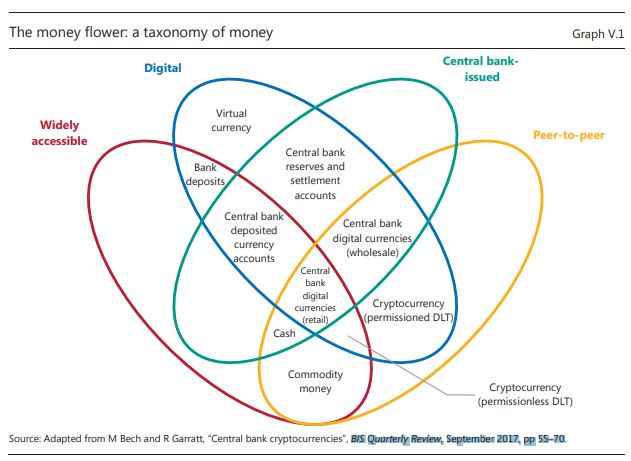
In September 2017 the Bank of International Settlement BIS published a report on Cryptocurrencies.  This report spoke to the idea of CBCC or Central Bank Cryptocurrency.  The authors offered a diagram known as the Money Flower.  The flower positions this idea of CBCC within the world of money and argues a Central Bank could easily create a sovereign cryptocurrency. 
The article then goes on to describe a series of examples.  As I moved through the document I was drawn to the idea of Digital Currency and once again was compelled to search for clarity.  At the same time I noted the recent announcement by China and how the
European Union recently suggested the European Central Bank consider just such an investment.

During my research, I was reminded of the work of David Chaum and remembered how early in the growth of Bitcoin someone suggested David could be Satoshi Nakamoto.  I am also reminded of my time at Europay and how we explored the use of Chip Cards, given their hardware and cryptographic capabilities, to create a Cash Replacement, Mondex.  In parallel with our efforts Visa Cash emerged, Proton, Chip Knip, Chipper and, others emerged.  This led me to a BIS report on Electronic Money.

Looking back in history to the early discussions of Electronic Money and read the early views of the European Union and the US Treasury, it reminded me of some of the original concepts and issues.  I’m reminded of words like anonymity, traceability, origination, and sovereignty.

Anonymity and the lack of traceability are what criminals and Silk Road Market Place saw as the benefit of Bitcoin.  The concepts of origination and sovereignty clearly are key to the thinking of Governments and Central Bankers and critical elements of the origin of Bitcoin, as expressed in the original white paper.

What these cryptographers have created is amazing, yet one worries about who is responsible for and benefits from the origination of Bitcoins, forks of Bitcoins and the multiple cryptocurrencies now in existence.

If we look inside Bitcoin its architecture promotes the idea of mining and allows the successful miner to originate new bitcoins.  They argue this is the incentive driving participation.  I then wonder about the cost of Bitcoin mining or the cost of Ethereum mining.  Does the cost of supporting Bitcoin justify its continued existence?  Does the supposed benefit of cryptocurrencies justify the profit earned by the miners who support the work to assure consensus?

As my research progressed  I ran into a speech given at a conference and the Bundesbank Money in the digital age: what role for central banks? The article attempts to address three questions:

      • What is money?
      • What constitutes good money, and where do cryptocurrencies fit in?
      • And, finally, what role should central banks play?

The author’s arguments are worthy of consideration.  Especially the questions of efficiency and trust.

The question we all must consider
What is money?
Especially in the global and emerging digital market place.

In the end, I remain confused and concerned.  Digital Money, Electronic Money, Digital Currencies, Cryptocurrencies, Feit Money, stablecoins and the potential of the distributed ledger clearly are set to disrupt much.


Review of the IMF The rise of Digital Money

While reading the recent document produced by the IMF I am compelled to wonder.

What is the difference between what they call Bank Deposits and e-money.  My first question, ignoring the words bank deposit.  Both are electronic accounts of value, recorded in someone’s ledger.  These two diagrams extracted from a BIS paper offer a perspective.  

They then speak to four attributed to the “means of payment”

  1. The Type, be it a claim or an object.
  2. The value, be it fixed or variable.
  3. If it is a claim who is liable?
  4. The technology, be it centralized or decentralized


They then speak to the five ‘Means of payment”.

Object-Based

  1. Central Bank Money (cash)
  2. Crypto-currency (non-Bank Issued)

As we think of the evolution of these object-based means of payment, we need to reflect on a new term “Central Bank Digital Currency” CBDC.

As a historian, I then wonder where things like Digi-cash and Mondex fit into the classification.  The value was originated and then distributed into a personal and secure storage device (Wallet).  Redemption or better said the guarantee, was provided by a party.  Maybe not a bank or the central bank, yet, easily embraced by such an institution.  Somehow history seems to lose sight of the origins of money and assumes the existence of a central bank.  Here in the USA, the formation of a Central bank was one of many areas of political discourse.

Claim-Based

  1. b-money (Bank issued)
  2. e-money (Privately issued)
  3. i-money (Investment funds)

The magic word behind all of these discussions is “Liquidity”.  The bottom line does the receiver of the money appreciate the value of the unit of measure and is the receiver confident they will be able to convert that money into another form, of their preference


Blockchain made simple

Let’s start at the beginning, the transaction, the distributed ledger entry. Think about the content of the transaction as the payload. Next think of the payload as land deed, cryptocurrency value, record of ownership, journal entry, smart contract … marriage contract. Either two or more people seek to exchange and record. Another way to think about all of this is as a block of data, code or other digital representation of something duplicated in every participant’s copy of the current ledger. No matter what happens, a secure system must be established for a smooth cryptocurrency transaction to take place. Maybe look for the best vpn for crypto trading? Could be an option, but only in the later stages when the initial nitty-gritty of the process is established.

A governance model is required

What is essential, before anyone can do anything.

The parties seeking to exploit a distributed ledger must define how it will work.

It is what the community or parties seek to represent and manage, using distributed ledger technology, agree.

The whole process of defining the payload begins when the community agrees to and sets off to publish the processes, procedures, rules, functions, and purpose of their application. It is this act of governance we use to define how and what will be conveyed in the payload to be stored and recorded on a blockchain. Which blockchain, protocol, and cryptographic processes; obviously it is a decision of the community.

We need to be clear before we can do anything with the payload. Ourselves and ultimately others will have initially and subsequently defined the mechanics and processes designed to assure the integrity of the blockchain itself.

A Transaction is appended to the chain

There are two parties to each event recorded within these transactions. The agreed events, transactions and smart contracts are ultimately included in a block and properly extended onto the chain for everyone to see and read. More about Confidentiality in another post.

Once governance is established
People can now interact

Each party has an address and then addresses unique to each asset e.g. coin. The address, in most cases, is simply an asymmetric cryptographic public key.

    • The individual, as is always the case with cryptography, has their own private key(s); they must retain, never lose and keep secret.

When the two parties decide to record an event; the sale or transfer of the title to a car.

    • A formal record of a property, a transaction, ledger entry is created.
    • The basic data.
      • The seller’s public key
      • the buyers public key
      • the payload
      • a hash
      • the signature created by the seller using their private key.

The transactions are broadcast to the network, buying and selling included. These transactions can take place through various methods; for instance, digital currencies could be purchased online, whereas to sell, you may have to use Bitcoin ATM and other ideas, which you can learn on Coin Cloud or similar company blogs.

The nodes or miners continuously work to assemble a defined number of transactions and create the next block.

The chain’s role is to record the providence of an asset and the immutability of all the associated transactions.

    • Each active node or miner is attempting to create the next block.
    • The mathematics involved and the use of hashes to bind this new block to the existing blocks in the chain is beyond the scope of this blog.
    • Let us simply assume the mathematicians and cryptographers define as part of the original design of each chain an infallible solution to the issues of economics, security, integrity, and immutability.
    • These specifications will define the hash game and how one adds the next block to the chain retaining the immutability of the present and the past

By being the first to calculate the cryptographic nonce

The winner receives a reward.

    • Hopefully proportional to the cost of work or other discernable and agreed method of reward.
    • The other active nodes then test to see if they agree the first got it right.
    • If consensus is reached the new block is appended to the chain.
    • This all assumes 51% or more of the miners or nodes reach consensus on the winner’s answer. And no one can control 51% or anything closer than 33%.

Around and around the game continues, as transactions are added and immutably recorded on the chain.

This whole process fundamentally assures history cannot be altered.

Chains split and fun things happen

If the process is not elegantly managed in full sight of all the participants.

Going Cashless

For some twenty plus years, I can remember hearing people speak of the dream of an economy without coin and paper money.  A dream, driven by the desire to promote the use of electronic payments.

Over the last months, a number of articles focus on promoting the idea of a cashless society.  They all speak to the advantages and attempt to promote the concept, arguing we can:

  • Eliminate the concern of thugs insisting at gunpoint for the cash
  • Reduce the risk of employee theft
  • Stop paying people to count all those dirty coins
  • Remove the need for an expensive safes
  • Stop paying to have a specialist truck take the money to the bank
  • Eliminate the grey market

The business case for a merchant to eliminate cash seems to be beneficial.   Many have tried and succeeded to no longer accept cash.

At the same time articles report on the new regulations; various cities and states are implementing and considering.  These regulations are intent on outlawing merchants from going cashless.  The argument often focuses on how eliminating cash disadvantage the underbanked.

Then there is a reality! As a consumer, I recently have been surprised at the need to carry cash and the unsettling pleasure of finding out I still had cash in my leather wallet.

The first wake up to this reality took place while driving from St Simons, GA to the Orlando International Airport. In the trusting hands of Google Maps, I traveled down I-95, across I-4 and was directed to the FL-417. Suddenly a road sign informed me that I was on one of the various Florida toll roads.  Above my head was a road sign indicating which lane, based on my preferred method of payment, to move into. Driving a car that was not mine and knowing it did not possess a PeachPass, my only option was cash.

Fortunately, I had cash and was able to continue my journey.

The following Friday my father and I went to The Lodge to play Sniff, a dominoes game. The game was competitive and cash was the only method to settle. With a bit of cash in my pocket, I was able to pay the few dollars I lost.

One Saturday a street vendor in front of the local Harris Teeter was selling spare ribs. When I went to pay they informed me, they only accepted cash. Once again I was fortunate, I had enough cash and was able to buy those delicious ribs for dinner.

On various Sundays, when the collection plate came around, I’ve had a check or a bit of cash and was able to leave my tithing.

On a number of occasions, the valet, tour guide or other service individual deserved a tip and I’ve had a few dollars in my wallet.

Two more events brought the reality of how society does not want cash to disappear.

One morning, I wanted to enjoy a pastry. Not having $2.75 to pay for the Danish, Sweet Mama’s, a local baker, charged me $0.50, an eighteen percent surcharge, simply to use a credit card

Finally, yesterday as a guest for lunch at the local Rotary Club, I was confronted with a series of cash only events. This time I did not have any cash and was not in a position to contribute to various worthy causes.

We dream of a cashless society. Yet churches, valets, toll booths, street vendors and the Rotary all continue to desire or require cash. Some are not even willing to accept anything but cash.

Looking at our society from two different angles, we must accept the continuing need for cash.  Be it the underbanked, unable to acquire a credit or debit card; or those who carry many credit cards, both need to use cash simply to eat or enjoy life.

Later today I will have to visit the ATM and make sure I have a bit of cash in my wallet.


https://www.paymentssource.com/news/target-outages-show-the-failings-of-cash-as-backup

A world between yeaterday and tomorrow

The week of March 25, 2019 I had the opportunity to visit with a room full of community banks with assets in the 100 million to billion range. Organization with 25 to maybe 300 staff.

The presentations taught me more about the difference between what large International Organizations worry about and what these small community banks need to learn. Faster Payments, Zelle, same day ACH all new services these organizations must integrate into their organization, both technically and procedurally.

Things I have been exposed to are new challenges for these small town banks.

Words like liquidity risk clearly top of mind. Yet, as we move from over night settlement to real time settlement.

Phone fraud, risk mitigation all greater challenges not necessarily appreciated yet alone understood.

In the end what is clear these community banks exist because of the small towns they understand and work within. Do those of us exposed to a larger world understand what drives these communities banks, at least not I.

Of Stakeholders or Shareholders

In South Africa’s Fabled Wine Country, White and Black Battle Over

Elizabeth Warren Proposes Breaking Up Tech Giants Like Amazon and Facebook

Two articles this morning remind us of the challenge of our time. The same challenge of past times. The concentration of wealth and power has and remains why class struggle and revolution often time follow the concentration, which to often is the flaw of capitalize.

When one class can separate itself from another. Those who have the ability to achieve this isolation, forget the pain of those on the bottom.

Stakeholders – the people, clients, customers and workers deserve the same respect and chance for a comfortable life as the shareholders

Distributed Ledger and Things

As I sat to write, I was drawn to the Wikipedia’ Bitcoin article. As I read the story of how it all happened memories and concerns once again flowed through the neurons of my mind. Silk Road and their involvement and the evolution of the value of a Bitcoin, struck me as a magical mystery tour through a world of mathematicians, anarchists, profiteers and speculators.

I then remember reading

an element of a report from the Bank of International Settlement on crypto currency. The picture above is intriguing for those of us who appreciate the complexity of payments. The article gets ever so intriguing when one continues to read and finds this interesting illustration of

the difference between what we all are familiar with and what those who understand DLT and Bitcoin appreciate. The central focus of this new technology is to address one and only one concern. Trust in the intermediary.

I must admit this particular article is not the one I originally intended to speak to. I do though recommend reading it.

The article I had intended to reflect on is Central Bank Cryptocurrencies. In this document they speak to the possibility of the banks issuing a stablecoin. The recent announcement of JPMorgan Chase is one example of such.

This then causes me to reflect on the various use cases and conversations with people about the potential of DLT. I wonder why, at least here in the USA with our judicial and regulatory framework and the rule of law; we would seek to replace the existing intermediaries with a permissionless distributed ledger and the associated consensus mechanisms of a public ledger. There is enormous and growing cost in consensus built on “Proof of Work” and massive duplication of the ledger or as most call it the chain. Be it the electrical cost, the cost of a data center or the specialized computers necessary. The people and companies, the nodes and miners, will expect a reward for their effort.

Which is cheaper, if a reasonable level of trust exists?

Where are we going from here

This is the question. There are those that believe Block-chain and all of the other distributed ledger technologies are the answer to everything. I would suggest one much consider:

    • The level of trust the various parties have in each other.
    • The cost of multiple copies of the distributed ledger.
    • The cost of the consensus mechanism versus a trusted intermediary.
    • The governance required to maintain security, software and specifications.
    • The value and ethical issues of anonymity.

This then begs the question of a permissioned or a permissionless ledger. Which then begs the question of governance and who is responsible to establish the rules.

It is clear there is value in the idea of a distributed ledger. I would suggest caution in deciding if it makes sense for your use case.

      • What are the goals and objectives of the solution?
      • What are the economics of the various approaches?
      • Who are the stakeholders?
      • Who determines the rules and manages change?
      • Can the participants trust an intermediary?
      • Does everyone fear what another could do?

Helping you to understand the answers to these questions is what we do.

As Facebook Raised a Privacy Wall

NYTimes: As Facebook Raised a Privacy Wall, It Carved an Opening for Tech Giants

As Facebook Raised a Privacy Wall, It Carved an Opening for Tech Giants https://nyti.ms/2GqnbC9

As I read this article my mind asked the question what drives an organization and its American employees to forget they are American citizen’s with responsibilities to protect this nation from the acts of our enemies.

Excess profits, what other motivation could there be. The one motivation which is and will remain the greatest threat to society, the environment and our grandchildrens’ future.

Be it the concentration of power which drives excess profits or the reduction of quality, weight, volume or size, simply to maintain price and margin the shareholder will be served after senior management take its plenty. Stakeholders – client and employees come second, after the key executive and strategic shareholders are rewarded.

Russian’s and our other enemies will find our weaknesses and take advantage deluding us with propaganda and lies, all to achieve their aims.