
Apple exemplified an era of global capitalism that has passed from The Economist https://www.economist.com/leaders/2021/08/28/apple-exemplified-an-era-of-global-capitalism-that-has-passed
Category: eCommerce
EMVCo Good or Evil
https://www.securepaymentspartnership.com/wp-content/uploads/2019/12/Payment_Insecurity_Final.pdf
In 1993, I was asked by the then CEO of Europay International to establish a relationship with Mastercard, and Visa focused on developing the specifications necessary to assure the interoperability of chip card-based security for credit and debit payment cards. The result published in 1996 was the “EMV Integrated Circuit Card Specifications for Payment Systems.”
From these humble beginnings, EMVCo has emerged as a key organization in managing the standards behind card payment systems. In the white paper Payment Insecurity, commissioned by the Secure Payment Partnership, the author reminds us of the difference between standards managed by an open body and those tightly controlled by an exclusive group of competitors. One wonders if the owners of EMVCo will listen and strive to open up their membership or continue to use this entity to protect their proprietary interests.
In the introduction, the author speaks of a series of questions he intends to address. The first question of the paper
Is EMVCo furthering the entire U.S. payments industry or simply protecting Visa and Mastercard’s market share? page 5
begs the question, why limit the discussion to the USA?
This American only focus is driven by the desires of the Unaffiliated Debit Networks and a set of merchants. The paper ignores fundamental and, yes, anti-competitive elements of the EMV specification – the AID or the Application Identifier. It was and is directly related to the Brand responsible for the underlining technology incorporated into the Chip.
I then read the following complaint and am driven to ask how the consumer interpreted the prior Debit versus Credit prompts.
Visa’s response to this solution was to require merchants to display to consumers a choice between “Visa Debit” and “U.S.
Debit” at checkout. – page 13
In essence, what Visa required was simple, the terminal should comply with the EMV specification for “application selection,” key and inherent in the multi-application design of EMV and the underlining ISO 7816.
Moving further into the document in Section 6.1, the author attempts to document the history leading to the creation of EMVCo. As one of the founding members, the author’s sources were not involved and did not understand the history.
First, only France had a smart card solution designed to address Credit and Debit card fraud. They referred to their implementation as B Zero Prime.
Second, the UK in 1995 was driven by Visa to embrace an earlier version of the Visa specifications adapted to the unique requirements of the UK market and branded UKIS. UKIS and the unique UK requirements are responsible for changing many of the shall’s in the EMV 2.0 version of the specifications to should’s in the EMV 3.0 version. This accommodation was the result of legacy limitation within the X25 network the United Kingdom depended on for card authorizations.
To further identify issues with his record of history, the statement on page 22
EMVCo developed standards for chip cards that could work with credit, debit and stored-value cards
It is fair to suggest EMV attempted to incorporate Stored-Value cards in the specification. But as a result of the competitive realities of Europay’s Clip, Mastercard’s Mondex, and Visa Visa Cash stored value solutions, they agreed to exclude stored value cards from the specifications.
It then goes on to suggest EMV compromised and offered a Signature option. There was not a compromise; it was intentional. The goal, afford the Issuer the ability to determine, by Cardholder, which cardholder verification method they could be configured for. One need was to address issues of the disabled, e.g., the Blind.
Debit Routing as a result of the Durbin amendment. One might wonder why EMV did not consider this idea of multiple networks associated with a card.
EMVCo was unable and unwilling to resolve the lack of a debit AID because EMV was never designed for the U.S. market.
I sense that there is another front coming out of the Debit Networks seeking to argue the anti-competitive nature of EMV. The paper, link below, draws me to wonder about the argumentation surrounding “Application Selection.” Please let’s get back to basics – the “AID=Brand=Payment Scheme” drives “Routing.”
On page 13, it argues consumer confusion. I would argue it ignores the past. The EMV default user prompts of “Visa Debit” and “US Debit” are no more confusing than the historic “Credit,” and “Debit” prompts. I would argue consumer confusion already existed. The EMV specification for Application Selection simply afforded the Issuer the ability to provide more descriptive prompts by employing the “Application Preferred Name” instead of the default “Application Label.”
This whole fight surrounding EMV and Payment Security is really a fight about the future of Card Payments. On one face, they argue the Payment Networks did not assure the security of the card payments to protect revenue. On the other hand, they argue EMVCo is a closed standards organization designed to protect and assure the interests of its shareholders, without consideration for the other stakeholders in the payment, e.g., the merchant.
In the end, the argument comes down to the role, definition, and control. How we structure the underlining payment transaction is what we need to talk about. Who provides the mechanism, guarantee, and support for a particular mechanism decides the rules.
To Identify or to Authenticate what is the difference?
Today I read an article on LinkedIn
‘Identification’ is to give an answer to the question of ‘Who is he/she?’, while ‘Authentication’ is to answer ‘Is he/she the person who he/she claims to be?’
This distinction for me is clear. Yet, based on this article, and personal observation, people do not appreciate the unique difference between these two words.
For those who remember the film War Games, the two young adults were able to access the game simply by learning tidbits about the author of the program. “Joshua” is the critical fact our young hackers unveiled. This single word was both the identifier and the password. A simplistic form of Identification which some may confuse with Authentication.
Our driver’s license number, credit card numbers, passport number, social security number, employee number, email address or other aliases; are identifiers. These values are and should have remained, simple means of linking someone to the person who initially registered on a web site.
We then link these identifiers to a means of Authentication, an Authenticator. We then use the authenticator combined with the identifier to assure Identification. The recent NIST 800-63 standard defines the strength of an Authenticator. The simple reality the authenticator can be a combination of things you know, things you have, and things you are. Combining these factors create different strengths of Authentication.
Back in the day, a password, if properly constructed, was a very strong means of authentication. Unfortunately remembering numerous and unique passwords is unmanageable.
One of the issues we face is how so many entities, companies, and other enterprises have taken the identifier and allowed it to also become a means of Identification, a secret.
As soon as a simple number or string of letters designed as public information, to be shared with others; became a means of Identification we created an untenable situation.
NYTimes: Transaction Costs and Tethers: Why I’m a Crypto Skeptic

Transaction Costs and Tethers: Why I’m a Crypto Skeptic https://nyti.ms/2NYYSdw
As a technologist with an understanding of cryptography and very aware that in order to remain secure and tamper proof we increasingly increase the complexity of the work to assure the integrity of what we are using cryptography to protect. I wonder why so many people got so excited about Bit coin and Blockchain. As I have written before the cost to assure the integrity of the ledgar. Be it the original work to calculate the nonce or the subsequent work to confirm that the nonce the miner calculated was the right one, there is a need to spend money buying work specific computers, renting or building a facility to houses these work units and the power to cool and run these computers.
Mr. Krugman properly outlines the challenges. He effectively focuses on two issues. The cost and the idea of tethering.
It is this need to identify the value of the coin. Governments help to stabilize their defined currency. The intrinsic value or use of Gold, establishes its value.
Understanding and being able to clearly articulate how cryptocurrencies are valued and how then can achieve the stability necessary to support commerce is essential. This is what tethering is about. How do we establish and more importantly share the nature of the valuation.
What is EMVCo goal with the release of their SRC framework
October 2017 EMVCo published version 1.o of their Secure Remote Commerce Technical Framework. Today I decided to read and appreciate what they are trying to accomplish and then consider how it ties into what I remember and think we need to do moving forward.
Clearly the challenge links back to the now infamous New Yorker Cartoon.  We have not successfully established a means of assuring the identity of an individual when presenting payment credentials (the PAN, Expiry date, name, billing address and CVV. The first attempt, still not 100% implemented, was the introduction of CVV2, CVC2 or CID a 3 or 4 digit number printed on the back or the front of the payment card.
We then developed something called SET or Secure Electronic Transactions and unfortunately the payment networks were not willing to allow Bill Gates and Microsoft to earn 0.25% of every sale for every transaction secured by SET he proposed to build into Microsoft’s browser. Without easy integration into the consumer browser, the challenges of integrating SET into the merchant web pages and the Issuer authorization systems caused this effort to fail the death of some many other noble but complicated attempts to create a means of digital authentication.
Next came 3D-Secure, a patented solution Visa developed. It offered what was considered a reasonable solution to Cardholder authentication. Unfortunately, given the state of HTML and the voracious use of pop-ups, the incremental friction, led to abandon shopping carts and consumer confusion. Another aborted attempt at Internet fraud mitigation.
Yet 3D-Secure was not a total failure. Many tried to enhance it, exploit it and avail themselves of the shift of liability back to the Issuer. Encouraging consumer engagement and adoption was futile in some markets mandated and cumbersome in others.
Now let’s consider what EMVCo is attempting to do with their Secure Remote Commerce Technical Framework. As I started to read, I ran into this:
“As remote commerce becomes increasingly targeted and susceptible to compromise, it is important to establish common specifications that protect and serve Consumers and merchants.”
Clearly the authors do not have institutional memory and cannot remember the various attempts alumni of these same organizations spent time on and encouraged many to invest in their implementing. Clearly this lack of historic context will leave some pondering the purpose of this paper.
I then read this sentence and reflect back on a recent hearing on “Social Security Numbers Loss and Theft Prevention” in front of The House Ways and Means Subcommittee on Social Security
“Over time the Consumer has been trained to enter Payment Data and related checkout data anywhere, making it easy for bad actors to compromise data and then attempt fraud.”
Once again, I stand troubled by how the Payment Data clearly printed on the face of the card and especially the PAN, 11-19 digits, designed to simply be an identifier, was converted into an authenticator. Like the social security number, the drivers license number, the passport number and your library card number, the PAN and other “Payment Data” was never designed to be an authenticator. It was meant to be data a merchant could freely record.
The secure features of the card now the EMV cryptographic techniques otherwise referred to as the Application Request Cryptogram “ARQC”
 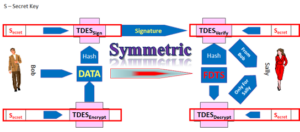 were meant to offer the “What You Have” factor in a multi-factor authentication scheme.
As I began to appreciate the scope of this document, the term “Consumer Device” becomes critical. I began to wonder if a PC is a consumer device or if a consumer device is only something like a mobile phone, watch or other like appliance. Fortunately, later in the document, the definition clears up any confusion created by the earlier use of this term.. This said, I then wonder about the difference between what they define as Cardholder Authentication and Consumer Verification?
After reading through all the definitions, I ponder why the authors had to change terminology? Why could they not embrace known and recognized nomenclature. Do we need a new vocabulary?
I wondered:
If this is another attempt to create a revenue stream for the payment networks?
Or, is this the effort of a “closed standards” body to reduce the potential value of the W3C WebPayments activity?
In search of an answer to this last question, I found this discrete comment inside the SRC FAQ.
9. Are any other industry bodies working in this area?
EMV SRC is focused on providing consistency and security for card-based payments within remote payment environments.
EMVCo aims to work closely with industry participants such as W3C to capitalise on opportunities for alignment where appropriate.
Having read bits and pieces of this and the WebPayments efforts one does wonder what is EMVCo trying to do. We shall see?
Why do we need Tokens and Tokenization
Recently I was directed to a link http://paymentsjournal.com/tokens-work-because/ and wanted to write the author Sarah Grotta. As I wrote the message crystallized in my head and maybe as this prior post already discussed, this idea of tokenization made me cringe.
I contend that Tokens exist because we turned the PAN Personal / Primary Account Number, like we turned the SSN Social Security Number, into an authenticator. One can must ask the question. How can a random value (an identifier) become an authenticator and remain secure?
EMV works because it renders the Card unique, hence addressing the question of counterfeit, by employing the first factor of the classic MFA Multi-Factor Authentication concept “What You Have”. EMV defined a common set of secrets and digital credentials; securely stored in a Secure Element or Chip Card.
We here in the United States decided not to implement the second factor, the Personal Identification Number or PIN, for a variety of reasons. Hence, why Lost and Stolen remains an issue or weakness in the American Card Payment environment.
Biometrics are emerging and could solve for the assurance of cardholder presence. The challenge is how to effectively (cost and convenience) locate the biometric sensor and facilitate the matching of the sensors output to the persons registered biometric. Let alone, how does one make sure the right persons biometric was registered and associated with the device.
In the mail order / telephone order, now cyberspace, we did not replicate merchant authentication, the first factor – “What You Have. The card, once was secured with things like the magnetic stripe, using CVV1, the Hologram and the other physical features. We simply shifted the liability to the merchant and called it a “card not present” transaction.
People can claim all sorts of goodness because of tokenization. They can talk about how the EMVCo’s tokenization framework describes the use of tokens in device and domain specific scenarios. All of this, an issuer, could have done; if they, like some did, simply issued another number, a PAN, to the wife, bracelet, watch, ring or whatever other permutation they deemed appropriate. They can talk about dynamic data. yet what they often forget to include when they use the words “Dynamic Data” they are really talking about a cryptographic value as described in EMVCo Book 2.
Yes, this does mean the question of how the PAN and its digital credentials get deployed; has to be addressed. This said, GSMA with EPC did offer some thoughts, last decade, when they described the Trusted Service Manager
Instead handset oligopolies replaced the MNO with the their Mobile Pay wallets. They working with the 
 Payment Networks and focused on control and the creation of income. They, as monopolist will, have created barriers, restricting others from offering comparable services. The TSP now becomes this restrictive service that guarantees the power of companies like
 Apple and Google, supported by their friends, the payment network operators.
The original article also spoke of the PAR; another data element merchants, processors and the industry, will have to invest in supporting.
I ask the question.
If we had assured the authentication and verification of every payment transaction
Using Multi-Factor Authentication
Why did we need to turn the PAN into a dynamic value?
My contention, simply use the appropriate level of cryptography.
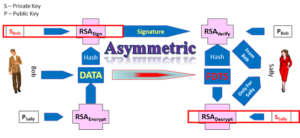 If the Issuer or their processor is in control and understands basic EMV and Cryptography, then securing the PAN is not an issue.
Consider household financial management. If each member of a household has a unique PAN; budget, tax preparation and understanding who spent what where is a lot easier. The husband,wife and children should have their own unique PAN, stored in the clear in their devices and on their card.
The real requirement, my personal devices, including my payment card, simply need to be linked to one PAN their Personal Account Number, associated with the individual. The PAN Sequence number could easily allows each device to be uniquely identified, if necessary. The card and devices becomes the carrier of your identifier. A thing that can be authentication as something you have.
Here is where the second factor comes in. Is the person presenting the PAN the rightful and authorized individual? All this required, is assurance to the shareholders that the presentment of the PAN is a unique and authorized event. This is best achieve by using either something you know or something you are to bind the individual to the instrument carrying the Identifier.
Yes, a bit of friction to assure the consumer they are securely paying for what they want to buy
Since the World Wide Web came of age and merchants saw its potential. The question of how to secure the  Card Not Present space, this question of cardholder presence, has not been properly addressed. Visa and MasterCard (when they were not for profit associations) created the utility of the Card Verification Result CVV2, CID or CVC2 which would be printed on on the card and not part of the magnetic stripe, the problem the bad guys could still steal the card or get hte card number and capture CVV2.. MasterCard and Visa then created SET, 3D-Secure and now, as for profit owners of EMVCo, are proposing, maybe even will mandate, the industry implement EMV 3D-Secure.
Each, an attempt to provide some means of Authentication and Verification.
Each introducing a level of friction as a means of security.
This is the problem. The market did not start by emphasizing the need for security by educating the consumer. The industry needed to help the consumer understand they should care and want to securely pay for what they intend to buy.
Instead:
- The Zero Liability Policy was adopted.
- The merchant was more than happy to sustain a degree of lose (fraud) in exchange for sales and profits.
The result, as all anticipated would happen, was blissfully ignored and eventually they cried out about.
Fraud migrated to the weakest point
Just like water finds its way to the lowest point.
EMV, introduced in the Face to Face card present environment, pushing the bad guys: be they criminals, state actors and terrorists to find alternate another channels for their financial gain.
EMV and now the recently published WebAuthN and FIDO specifications create effective mechanisms for Consumer Authentication.
Let us please remember – the PAN, a user name, your social security number or your email address are excellent Identifiers. They should not be authenticators and they are not a means of “Identification”.
Let us also remember, the term Identification means that one is assured of the irrefutability of identity.
The big question:
- Why did we have to get rid of or replace the PAN?
- Why did we and continue to need to invent and invest in all this addition overhead?
- Why did we not simply address authentication?
Some will argue the challenge of using the PIN or a Password, as a means of Verification, is because it is to hard to remember. Especially, if each password people use to access website, services, building, has to be unique. Some will argue imposing friction to add security is not convenient. Others will remind us that security is and has been a necessity since the beginning of time.
Why didn’t we when we created this great new digital shopping mall?
Bottom line each of the devices used to present or acquire the PAN, must be capable of authenticating the identity of the authorized presenter, in both the physical and virtual world.
At least these are the views of someone who believe history provides a baseline for tomorrow and tomorrow must be designed as a function of where you want to be, knowing where things came from.
of Tokens and Things

Things, now there is a big word.
- I am a thing
- It is a thing
- I know a thing
- Things must therefore be anything
The dictionary rambles on about things.
Tokens, What is this thing?
 Tokenization why is everyone so excited?
Tokenization and the Search for Identity
The belief in tokens emerges from the need to address security in a world where an identifier becomes an authenticator.
The PAN on the front of a ID-1 Card defined and governed by the International standard IS)/IEC 7812-1. When it was originally conceived there was no desire to turn the PAN into PII Data. 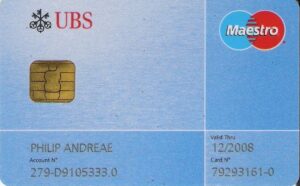 They simply wanted the PAN to be an index, “a pointer” “an Identifier”, to an account, or relationship, a card issuer (financial institution) created between itself and the cardholder. In our quest to take advantage of the telephone, the mail and ultimately the internet as a set of sales channel. The Payment System actors agreed if the card acceptor “merchant” would accept liability. Then, they could simply use the PAN, the expiry data and cardholders name to effect a card payment. This acceptance of liability was an acknowledgement they could not inspect the card and verify that the physical security features where present, hence the token was not present to be authenticated.
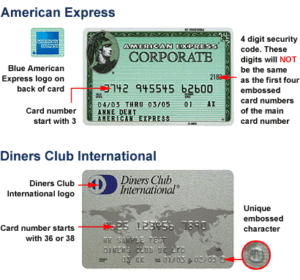
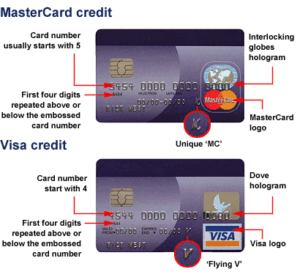
Society in its infinite wisdom followed another path with the Social Security Number. A number originally designed to act simply as a unique value representing each person here in the United States. Unfortunately, as is often true, we took the short cut, assumed this number, stored on hundreds of databases and recorded on an equally large number of forms, could be used to authenticate that you the individual was present.
mysteriously and without thought society allowed these numbers to take on values they where never intended to assume. They became “secrets” number that if known to another could be used to take over our identity. They can make payments in our name. They can apply for loans and take over our financial assets without the true individual being the wiser.
Those that seek to profit and do not share societies morality find ways of taking advantages of our desire to cut cost and reduce friction. They create near perfect counterfeits of these tokens, they take advantage of our naivety and they seek to disrupt and profit.
We could do as we have often done in the past – replace the token with a token. We could claim by tokenizing these identifier with another vale we were adding layers of security. We argued that if this new tokenized value could only be used by that merchant or with that physical device; security would be restored. The question how long would that new think provide the security its champions claimed it would offer.
A Shift from Check-out to Check-in will reshape the way merchants engage with their consumers
Think Uber, think order ahead, think account on file. With these ideas in your mind think engagement and Omni channel. Then consider the need of merchants to assure revenue by delighting and engaging with their customers in meaningful ways. Their focus, increasing basket size, more frequent visits and loyalty; in other words increased sales.
Then remember, Check-out is about friction, payments and long lines. These characteristics merchants seek to eliminate, reduce the cost of and enhance the experience around.
If we think Check-in, using big-data, geo-location, BLE, facial recognition, consumer centric apps and other techniques, we can image a world where human and device based personal assistants engage with the merchants loyal customers in a friendly, informed and satisfying way.
For payment people this means we need to remember that merchants want lower cost payments and friction-less check-out.
Bottom line, for loyal customers solutions that retain the payment credentials securely in the cloud. For one time and infrequent customers, they will look to incent loyalty and registration or simply accept classic means of payments e.g. cards.
This drive to move from recording a loyal customers visit to engaging when the customer arrives or better yet when they are doing their research is what we the consumer seek.
We are all about saving time, enjoying life and satisfying our needs and wants. Merchants that focus on the customer and their shopping experience will succeed and prosper./ Those that do not focus on delighting their customer will learn.
Identity and Payments
A presentation provided at the December United States Payment Forum to an audience of 50 plus individuals
A look at the actors that support Internet Payments

The payment landscape is a complex space with an array of stakeholders specializing a focusing on various aspects of the processing of a payment. This diagram is oneof several used to form a backdrop to various educational sessions Philip offers to organizations and executives seeking to identify and position themselves in the payments landscape.
This particular one seeks to help people understand who the key actors to a card not present eCommerce transactions.
Tokenization and the search for Identification and Authentication
These two words began to fascinate me as I began to understand the value of cryptography while working through the goals we established when developing EMV and attempted to secure the payment credentials when used on the Internet.
With EMV we were trying to address the challenge of the fraud (an issuer cost) resulting from the ease of counterfeiting the token of the token which was a token of a token already.
This last broken token is the magnetic stripe on the payment card.
The payment card, in and of itself, is a token. An instrument imbued with physical security features e.g. the hologram and signature panel. Security features the merchant is supposed to check when attempting to allow a buyer, the consumer, to use the payment credential associated with the card to make payment for good and services.
The PAN is just a unique number, another token. This unique number is simply the index, The identifier within the payment credentials, which associates the payment with the underlining source of funds.
The source of funds, the PAN or Token pointing to, is then either a line of credit, prepaid balance or bank account.
The card, the hologram, the magnetic stripe and the printed security features and the PAN had reached the end of their useful life, as security features or tokens. The criminal knew how to compromise the card and associated static data.
As we entered the 90’s, the card as the carrier of the payment credential, with those physical security features, was longer a means of Authentication. These layers of authentication had been compromised. In other words the token was broken!
To address this concern, in 1993 the founders of EMV embraced the chip card and its Cryptographic capabilities. In particular, the use of symmetric and asymmetric algorithms to provide a new set of tokens the merchants (asymmetric) and Issuer (symmetric) could use to Authenticate the unique carrier of the payment credential – the token – the chip card.
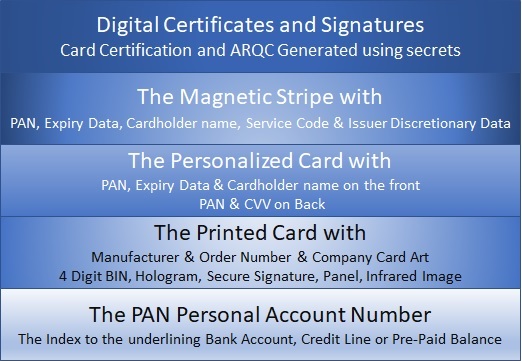
On the Internet the challenge is different. The physical features of the card are not easily accessible, hence useless. In 1993, when WWW became the thing of conferences, everyone said lets think of the internet in the same way we allow merchants to sell stuff via mail and telephone. Everyone simply decided and agreed to exploit the acceptance rules agreed on for those other virtual environment, the phone and the mail.
Bottom line, in the world of mail order / telephone order and now a browser; merchant simply agrees to accept the cost of fraud, given the CARD is NOT PRESENT. Worse still how do they prove the right cardholder in present?. For the merchant, given the potential of the Internet, it is was a small price to pay.
Everyone simply accepted that be capturing the data embossed on the front (PAN, expiry date and cardholder name) and the CVV printed on the back of the card and, in some cases, using the power of AVS “Address Verification Service” a modicum of security could be factored in. At least for a time!
SET “Secure Electronic Transactions”, a cryptographic mechanism Visa and MasterCard cooked up, was developed circa 1995-1996 and deployment was attempted. The challenge, the limitations of the then deployed technologies and the inability to provide a reasonably convenient user interface. The problem begins with loading payment credentials into the browser and more importantly figuring out how to use them when shopping.
A set of great ideas foiled by convenience.
Next came 3D-Secure, an invention of Visa. This time the idea was to exploit the power of passwords and secret questions to authenticate the user.
Nice idea, well thought out; but, unfortunately not designed with the consumer in mind.
Another feeble failed attempt to develop a mechanism to authenticate the buyer. Or better put, solve the dilemma the New Yorker so aptly described
“On the Internet nobody knows your a dog”.
All this begs the question – how will we secure payments on the Internet?
3D-Secure 2.0, maybe? Or maybe W3C and the FIDO Alliance have the answer in what is called WebAuthN.
To address this question we must begin by defining the problem.
When we think about payments and we think about shopping on the internet it is all about someone or something {read issuer} agreeing that the consumer will make good on the promise to pay and therefore the issuer is willing to guarantee payment towards the merchant. The challenge, how do we confirm it is the legitimate person seeking to pay with their means of payment.
In other spheres of endeavour it’s about granting access to someplace or some website. In the physical world we have a key that we can insert into the lock or a security device {card} we can insert or tap on a reader programmed to recognize our credential and allow us access.
On the Internet, the use of a physical card with physical security features, numbers, letters, and a magnetic stripe was not feasible. Instead, we ended up employing user names, passwords, and payment encryption. Payment encryption, which secures sensitive financial information during online transactions, offers a crucial layer of protection. The user name – a unique identifier, and the password, a secret, support the identification of the person using the browser or connected device, from somewhere out there.
If we could each create and remember complex secrets, these cumbersome things call passwords. And, more importantly, never share them with nefarious individuals seeking to take advantage of our naiveté. All would be at peace in the world of security and convenience. The problem is expecting you and I to remember the myriad of complex passwords and not get tricked into sharing our secrets.
Is there an answer, I believe so and at Money 2020 October 25 we will be discussing this very topic. Wednesday Morning at 8:30 in the Titian room at The Venetian in Las Vegas on Level 2, join us as we discuss Identity is Fundamental: What You Need to Know About Identity & The Future of Money.
Alternative Payment Methods
Ed Kountz of jupiter in his recent blog on Alternative online Payments offers an opinion that credit and debit cards where not designed for the Internet. It is interesting to reflect back in history and remember when it was not the magnetic strip that was important to the execution of the transaction but the numbers printed on the front of the card a merchant could simply would say into a phone or type onto their telephone keypad to get an authorization.
Move to the Internet and instead of asking the merchant to type in the account number and expiry date we ask the consumer to fill in an Internet form. How can one argue that ISO7810-3 cards where not built for the Internet.
Back in the day, circa 1993, when we began to think about how we would secure payments over the Internet and address words like dis-intermediation. It was clear that by any definition the ubiquitous credit card was already a vehicle for enabling eCommerce. All the internet did was to take mail order and catalogue business and give it the power to become a global operation; no longer limited by the cost of a telephone call or postage. Nowadays, of course, the internet has become such a vital part of our everyday lives, with people looking up things like “internet in my area” to make sure that they are getting the best deals possible so that they can be confident that their connection won’t let them down.
And, of course, Mr Kountz is correct, there is a real issue with security and the Internet. Yet the issue is no greater than what was faced when Card Not Present transactions started happening as telephone ordering became common place. Did the payment associations attempt to keep up? MAYBE!
First we saw the introduction of CVC2/CVV2 and address verification as tools to address the risks of someone who had captured the data on the face of the card from employing that card maliciously. Not a bad solution, if the merchant was willing to make the changes to their web sites and call center procedures.
Next came SET, now here was the perfect solution, yet at a cost that simply did not offer anyone a reason return on investment; even if Card Not Present Fraud was an issue. Since then the payment associations tried to develop a simpler yet equally secure solution called 3D-Secure, Verified by Visa or SecureCode. The idea is sound. The issue of adoption came down to the simple issue of figuring out how to get the consumer to go through the additional step of activating their 3D-Secure password and better yet remember it. Versus what became the reality, they simply said this is too difficult, I don’t need to buy that today, so they abandon the shopping cart. Merchants saw 3D-Secure as a way to lose potential business and at a rate alarmingly larger than the cost of fraudulent transactions.
So what is the answer? Create new means of payment that are designed for the specific trading environment (mobile, Internet, Mail Order, telephone Order, face to face …) or figure out how to get everyone to work together to come up with a workable solution that exploits the power of the Visa, Discover, MasterCard and American Express Brands.
In my opinion it is about communications and working together as a team. Not once has the merchant been asked to participate in developing more secure solutions to payments. They are simply told through compliance and rule changes this is what they shall do.
Maybe the new Visa and MasterCard will find that merchants are now shareholders and bringing them to the table is in the interest of everyone especially the consumer. Or is it time for a new payment Brand that is built to serve the merchant and operated by the Banks?