Smart Cards with Fingerprint Scanners

Over the last couple of years the reality of fingerprint cards is a hot topic in conversation, white papers and press articles.  It led me to think about the challenges and opportunities associated with this intriguing convergence of technologies.

My purpose is not to determine which solution is best or which companies are developing and selling them.  My goal is simply to explore.

The first consideration begins when the card is constructed.  Here we must ask the mechanical question relative to how the electronics are integrated into the strata of an ID-1 card.  This then begs the question of making sure this new card conforms to the specifications dictated by Payment, Networks, Governments or other bodies who define the use of these branded cards.  If we continue to think about the card manufacturing process we need to think about electronics and the use of heat in the typical lamination process or the inclusion of metallic materials used to create a particular look.  One needs to think about the method of connecting the various internal components to the other electronic elements  as the fingerprint scanner, antenna(s)m LEDs, batteries, the EMV chip or contact plate on the face of the card.

The second set of concerns must be related to the personalization of the card.  First question is where will it be personalized? in a branch or within a bureau?  How will it be personalized? With a thermal printer, laser engraver or embossing machine?  Will any of the  personalization processes adversely affect the electronic?. Similarly it will be appropriate to confirm whether any of the various card transport mechanisms will disrupt or damage the sensor and related electronics.

At some point in the processes the consumer must register their fingerprint and the resulting template must be instantiated into the card.  How will this be done?  Some speak of an in branch process.  Others talk about some type of first time cardholder activation process performed when they receive the card in the mail.

Clearly there are a lot more questions the issuer, card manufacturer and personalization provider need to address.  Let alone the method of making sure the cardholder knows how to use the card at the point of sale or ATM

The key question is the cost of the card, is it worth it?

The Dual Interface Business Case

These cards and often times the terminals are more expensive than a classic “Dip” EMV card

How much, is dependent on volume, complexity and the pure skill of negotiation. This incremental expense is the first factor one must quantify when building the business case

  • for enabling, in the case of the terminal
  • adding in the case of the card, the contactless antenna
  • upgrading the software by adding the contactless terminal kernels or selecting the appropriate chip software and profile

This then must be compared to the incremental value
For the merchant, issuer and ultimately the cardholder

To explore the benefits lets think about

  • The user experience
  • Availability of merchant contactless acceptance
  • The intersect of the cardholder base with the contactless acceptance infrastructure

As we look around the world and consider what stimulates dual interface card issuance and merchant NFC enablement. Two scenarios emerge.

  • A country made a collective decision and drove NFC terminal enablement and dual card issua.
  • A merchant segment, typically transit, decided to introduce electronic fare-collection.

The first scenario is often driven:

  • By the payment schemes
  • The belief NFC “Near Field Communications” mobile payments will happen
  • A country simply wants to start dual interface and prepare for mobile payments

Which ever option they select, the merchant and financial institutions, within the country, typically migrate together.

In the case of the second scenario, merchant driven migration. We can look to the United Kingdom as a perfect example. “Transit For London” made the decision to migrate from paper tickets to an electronic fare-collection solution based on NFC. The initial deployment was a closed loop payment card, branded the Oyster Card, they quickly decided to upgrade the solution to support Open Loop e.g. Visa, MasterCard and American Express enable dual interface cards and NFC enabled mobile phones.

Given the importance of public transit to the urban demographic. Their decision to embrace open contactless fear collect, becomes a driving factor for issuers and therefore a ripple effect on merchant enablement.

America, as is true in many things, is different.

Contactless was tried last decade without much success.

Issuers did not see any significant lift in consumer spend nor did the merchant see any real increase in revenues. This experiment did not create a perception of a real benefit for either the merchant of the cardholder. Later in this same period, Starbucks launched their QR code mobile payment solution. From its original deployment to now it has been a resounding success.

Around the same time and based on the work of GSMA and the European Payment Council, major telecom operators began toying with NFC based mobile payments. Here in the United States two pilots emerged, the original Google Pay pilot and ISIS (SoftCard) offer. The results were intriguing, the commitment half hearted and frankly both solutions had issues. Google Pay tried to model its solution after de-coupled debit. Whereas the mobile network operators behind SoftCard, wanted to charge the issuers rent and load fees associated with the payment credentials they would store within the SIM.

Merchants Attempted to Create a new Payment Scheme

Major retailers in their continued quest to improve the customer experience and reduce the cost of payments; came together to create MCX the Merchant Commerce eXchange. The hope, merge their existing private label charge card programs together into a Mobile App capable of working across the family of MCX merchants.

Terms where written, in particular one agreeing these merchants would not accept another competing Mobile Wallet. Net result, the merchants agreed not to enable the NFC interface for any of the Visa, MasterCard, Discover or American Express contactless cards or NFC enabled mobile payment devices.
MCX slowly faded into oblivion, as the merchants struggles with the idea of sharing customer relationships and transaction data. Some merchants notably Walmart, Target, Macy’s and Kohl’s set out to build their won mobile wallets embracing QR codes and other none NFC based techniques.

The Introduction of HCE

While this was going on, north of the American border, the idea of HCE “Host Card Emulation” was created by the founders of Simply tapping 2011. It was ultimately by Android and released as part of KitKat in version 4.4 of the Android operating system. With HCE now inside the Android Operating System it unlocked the NFC interface from dependence on the SIM and MNOs. Now any application could take advantage of the NFC interface, once supported by the internarional payments schemes, enabling wider deployment of NFC enabled mobile payments. Google moved ahead to expand its payment ecosystem and Royal Bank of Canada embraced HCE. As Issuers enabled the ability to authorize the load of EMV secured Payment Credentials into the OEM Mobile Wallet or the Issuer’s own mobile app. Consumer now had the opportunity to experiment with mobile payments that communicate with the POS, just like a dual interface card.

Let’s not forget Apple Pay.

Given their brand value and total control of the Apple operating environment, Apple was able to turn to Issuers and suggest they enable the load of EMV secured Payment Credentials into the Apple Pay Wallet. They came at payments with all guns loaded. They knew the value of their brand and were able, unlike the MNOs to ask for a 0.15% of the issuers’ interchange revenue. Most importantly, they facilitated Visa and Mastercard domination of the role of the Trusted Service Manager TSM-SP or better said the Token Service Provider TSP.

Merchant Acceptance Is Key

As has been true with any solution designed to serve a two sided market, issuance and acceptance must grow together to assure the operator success and prosperity. Without a national imperative and with the experience of the original ZIP (Discover), Express Pay (Amex), PayPass (MasterCard) and PayWave (Visa), the merchant must determine if it is worth the effort to enable the NFC interface and train their staff to support Contactless payments.

Transit, like has been true around the world, absolutely sees the value of using contactless, for fare collection and are busy engaging with Visa and MasterCard to embrace and assure acceptance of bank branded dual interfaces cards. Urban areas such as Chicago (CTA), Salt Lake City (UTA), LA Metro, Portland OR (Trimet) and Philadelphia (SEPTA) are live with deployments. Others are in various stages of planned, including the MTA in New York City.

The Business Case

For issuers, where transit is seeking to exploit open loop contactless payments, at the turnstile, there is a revenue opportunity to deploy dual interface cards.

In rural areas or urban communities where public transportation does not exist. The business case is dependent on what local merchants do and if they intend to or will be forced to enable the NFC capabilities of their POS.

This is the big question. Does the merchant see value? Do they believe contactless will increase revenue, reduce time at checkout or do they believe Apple Pay, Android Pay and the other mobile NFC enabled devices are the future?

  • If the answer to these questions is yes then Issuers should seriously consider deploying dual interface cards.
  • If the jury is still out then the investment in dual interface cards may not yet be worth it!

What is the Future Payment Credential Carrier

One cannot discuss contactless payments without thinking about how Apple Pay, Android Pay, Samsung Pay, OEM Pay, Issuer Pay … Device Pay play into the future of cards. Some years ago there were three belief systems

  1. Cards are here to stay the mobile device is a fad
  2. The wallet is replaced by the mobile device
  3. The card is the token of last resort

I think we know mobile devices are not a fad. Until mobile devices never run out of power they will not replace the wallet or all of the cards.

To say much more, given the fogginess my crystal ball, would be to wild a bet.

The following articles produced by the Secure Technology Alliance offer a series of perspectives on the value of migrating to a dual interface card.

Alliance Activities : Publications : Contactless Smart Cards

Alliance Activities : Publications : Payments : Contactless Payments

Alliance Activities : Events : Webinar: Contactless EMV Payments: Issuer Opportunities

Alliance Activities : Events : Webinar: Contactless EMV Payments: Merchant Opportunities

Dual Interface Construction

When we think about the migration to contactless or Dual Interface cards it is important to have a general understanding of what goes into creating the card and the constraints one has to think about, as they work with their marketing teams to design these cards.

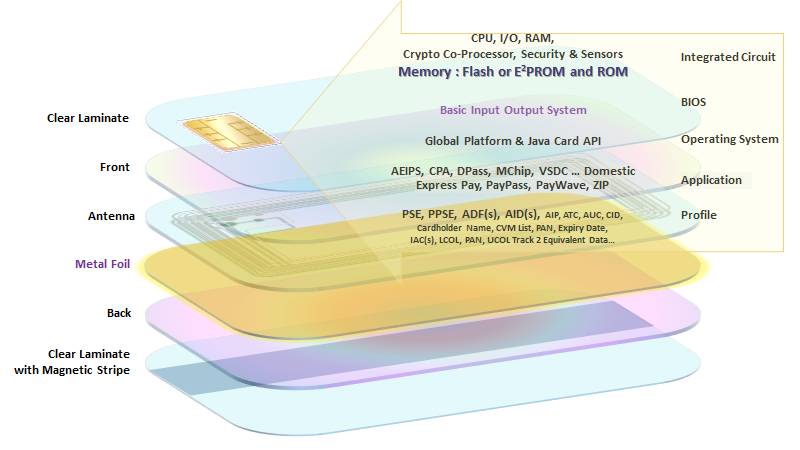
The design of a payment card involves assembling multiple of PVC into a sandwich that will be bonded and then punched out to form the card body.

  • On the face of the card: a clear laminate to protect the surface
  • On the back a clear laminate with the magnetic stripe affixed to it

In the middle two printed sheets

  • The front
  • The back

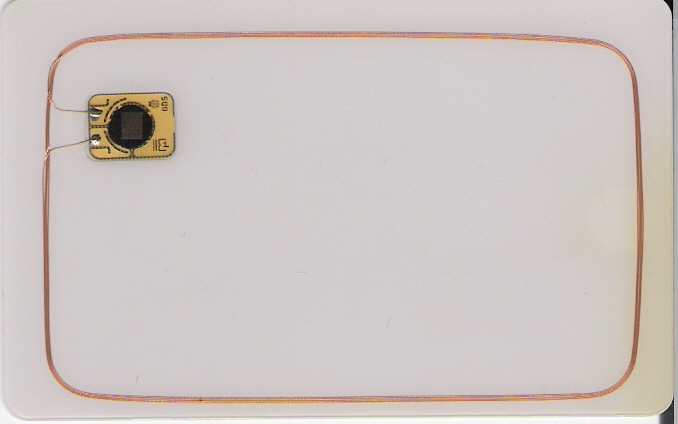
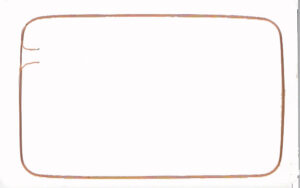
In the middle of the card body, your manufacturer will need to insert an antenna.   The antenna is typically provided to the card manufacturer as an inlay, as seen on the left.  The inlay is a sheet of plastic with the copper antenna, sometimes aluminum embedded within.  The card manufacture will add this inlay into the middle of sandwich.

On the right is an example of a six layer card construction including one element as an example, a metal foil.  This has been included given it has an impact on the effectiveness of the radio signal.  More about this a little later.  Using pressure and heat, the layers of the sandwich are bonded together in a process called lamination.  The bonded sandwich is then run through a series of additional processes designed to create an ID-1 card as specified in the ISO 7810 specifications supplemented by the additional payment network requires, such as the signature panel and the hologram.

After quality inspection the next step is to mill and embedded chip into the card body and simultaneously assure a connection between the contacts on the back of the chip and the antenna.  There are various means of connecting the chip to the antenna.  These different methodologies for connecting the chip to the antenna is a specific skill and is the responsibility of your card manufacturer.  Look to your manufacturers to propose, construct and certify your card to your requirements and employing their unique processes, techniques and technologies.

One thing you will need to be aware of is how the use of the antenna affects the certification process.  It is important to understand that the combination of ink, materials and methods of construct means; each construction will need to go through a unique certification.  This need for certification is a result of the use of radio frequency to communicate between the card and the terminal.  Think of your cell phone when your inside a big building or within an elevator and how the conversation maybe disrupted.  It is this possibility of the radio signal to be disruption based on the materials employed and the method of construction.

When metal elements like metallic foils and layers are used in card construction, the challenge increases.  Eddy currents are emitted by the metal and will interfere with the level of power and quality of communications emanated by the antenna and radio in the POS  received by the antenna and the computer in the card.

So far we have spoken only of the hardware.  The chip in the card is a computer and needs an operating environment, application and data in-order to function.  The introduction of the contactless interface alters the operating environment, the payment applications and the data which is loaded into the card.  All of this impacts the card manufacturing and card personalization process.


Will the US truly embrace dual interface cards or is our phone the future

When the US decided to migrate to EMV, it took the safe course

When it was time to migrate to EMV here in the USA, both issuers and acquirers focused on addressing the market and the required technology, one step at a time.  They recognized the confusion created by the Durbin Amendment, the reality of the competitive US debit market, the complexity of the merchant environment and the legacy infrastructure underneath the American card payment system.  Unfortunately unlike in other parts of the world the American merchants tended to migration to  EMV in the following order credit & debit, Common AID, contactless (MSD mode), Mobile Pays and finally contactless (EMV mode).  This journey is still a long way from complete with less than 25% of the terminal base contactless enabled, let alone in EMV contactless mode.

The larger and most invested merchants also worried about the impact of sharing data with the likes of Amazon, Google and Apple.  The “honor all card” rule is also the “honor all wallet” requirement.  Wal-Mart, Target and Home Depot were clear, they did not intend to expose the NFC antenna to the various NFC Mobile Wallets.  Instead they are implementing solutions, post MCX, based on their mobile apps using QR codes and often times enabled to support frictionless payment.

We are now looking at the second wave of card issuance and Issuers are wondering what merchants will finally do about enabling contactless.    As the Issuers prepare to issue their cardholders with their second EMV enabled card they must also think about the future of the card in the context of the future of mobile payments.

Are the payment credentials carried in the mobile wallet the companion of the card
o
r
Is the card the companion (fallback) for the payment credential carried in mobile wallet / device

Or
Are we on a journey to a new paradigm

Where facial recognition, loyalty, geolocation
Enabled by the always connected devices

We surround ourselves with
Help merchants to focus on
the shopping experience

And
Turn the Payment into

A frictionless “thank you”


Of NFC, Mobile and History

Today I read Karen Augustine’s  Mobile Payments Use in the U.S. Lags

As I read and reflected on what Karen wrote, I reflected on my experiences as a sagged payment consultant and executive, with international experience.

What I see is an issue of legacy and muscle memory – setting a pattern for the future.  Said another way – our history defines the boundaries of our future.

Asia did not have electronic payments.  I am sure did not want to embrace the globally dominate American solution.  Therefore, they had the opportunity to start fresh.  It is very much like what Spain went through, went they moved from cash to electronic card-based payments.  They bypassed the check.

Her article brings back memories of life in Belgium in the 90’s.  Writing a check was a rare occurrence.  Direct debit mandates, a MisterCash card and a Eurocard was all we needed to buy and enjoy life.  Electronic payments was the norm, paper checks were a rare oddity and cash, well yes there was a very present grey economy.

Here in the USA we developed our payment systems off the back of regional or state banks with acceptance networks limited to a local domain.  Moving to a national system required early adoption of a common national currency.  We then went on to replace IOUs with paper checks and store cards with credit cards.  In time we enhances the ACH system and developed support for remote deposit and check capture.

Why do we need to move the card into the wallet?  Why change habits that are comfortable and work?  Most of us drive to shop and therefore must have our drivers license.  We must carry a physical document with us.  We simply carry two or more ID-1 sized cards.

You make the statement and was once again reminded of times past.

“… universal mobile wallets and more often driven from merchant based applications that often incorporate loyalty and rewards, which to date still remain nascent in universal mobile wallets.

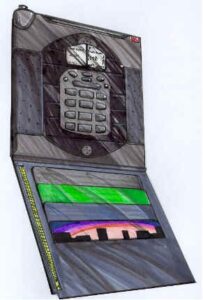
When I produced this rendering, back in 1996, I was on stage talking about a world where leather and technology converged.  I imaged Bluetooth, NFC, secure elements, GPS and our various credentials converging into this personal device.  Those credentials grouped into: travel, identity, membership, loyalty and payments; easy to find and present.

When contactless payments were  introduced, in 2004, by Visa’s with PayWave and MasterCard’s PayPass; I argued why contactless cards – how can the issuer afford the extra dollar per card (cost of the antenna and inlay) and the merchant the extra 60 dollars to enable the NFC reader?  The way Issuer income works, “Interchange”, the consumer would need to spend more on that issuer’s card.  For the merchant to justify the necessary POS investment, meant the retailer believed the consumers would spend more, because it was “easier”.  Was Tap To Pay going to make me spend more.  Maybe for small ticket purchases, I may use cash less; but at the merchants expense!  We argued the cost of cash was more than the Merchant Discount.  Some agreed.  Many wondered what the blank are they trying to sell us!
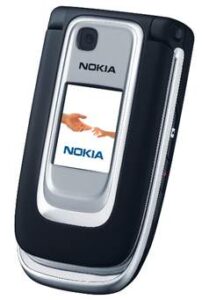
Around the same time America was exploring this contactless experience, the European Payment Council and GSMA debated and ultimately offered an approach for mobile card based contactless payments https://www.europeanpaymentscouncil.eu/sites/default/files/KB/files/EPC220-08-EPC-GSMA-TSM-WP-V1.pdf .  Handset manufactures like Nokia had already added NFC Antenna’s to their mobile phones and mobile network operators, the MNO, saw the SIM as the secure element capable of holding payment credentials.

Some tried, the Trusted Service Manager as a service was developed and deployed.  The challenge, the economics of the model.  In this case the MNO saw revenue and wanted to charge fees to load the payment credential into the phone and better yet charge rent to store these payment cards in our phones.  Again I ask the question, by changing the way we pay, do I cause us to want to spend more? I think not!

Maybe some would argue, with  a credit card people am able to buy things today that they cannot afford.  Let them end up in debt.  This is true.  But then is debt  at 18% a good thing?  Europeans simply decided to establish a line of credit, as a feature of a Current Account, at reasonable interest rates.

We could go on and talk about how Apple saw the possibility of a 0.15% income stream from ApplePay based mobile payments and how the EMVCo tokenization framework evolved to support their desire to protect the Apple Brand.

What is clear, we could solve George’s problem and replace his Full Grain Vegetable Tanned Cow Leather leather wallet with a Mobile Wallet managed by Apple, Google, Samsung or …

Or, we could think about the consumer and what they really want?

As your article made clear, and so many others have shared, Asia leaped forward.  Be it AliPay or WeChat, the device, the mobile phone, became the consumers wallet, their method of engaging, shopping, learning and exploring.

We need to accept to simply replace what we are comfortable with, with something new; which does not enhance our experience, is simply not worth it!

Many of us, like Karen, would argue the experience of shopping is what the mobile phone can enhance and let the act of payment become the afterthought.  A simple click to say – yes, I agree to pay.

Amazon got it right with One Click.  Others, as the patent expires, are embracing the same technique to simplify payment to a friction-less act of satisfaction.  When my favorite stores offer me an mobile app designed to enhance my shopping experience, to thrill me with offers and entice me with things I want; then yes I will become more loyal, I will shop at their store more frequently and maybe even buy a few things I did not intend to buy.

Many years ago while attending conference of groceries  in Abu Dhabi – one of the speakers share an experience.  when that supermarket executive instructed each store to put the beer across from the diapers, the intended result occurred.  The husband, sent to get the diapers, ended up buying  a six pack too.
Maybe, like this experience reveals, if we focus on the consumer experience and on delighting them.  They will embrace change.

If there is no value why should we?

Years ago I prepared and published an idea.  I called it Cando.  I was still committed to the idea of the mobile wallet.  I was an early adopter of the smart phone and saw its potential.
 

A Shift from Check-out to Check-in will reshape the way merchants engage with their consumers

Think Uber, think order ahead, think account on file. With these ideas in your mind think engagement and Omni channel. Then consider the need of merchants to assure revenue by delighting and engaging with their customers in meaningful ways. Their focus, increasing basket size, more frequent visits and loyalty; in other words increased sales.

Then remember, Check-out is about friction, payments and long lines. These characteristics merchants seek to eliminate, reduce the cost of and enhance the experience around.

If we think Check-in, using big-data, geo-location, BLE, facial recognition, consumer centric apps and other techniques, we can image a world where human and device based personal assistants engage with the merchants loyal customers in a friendly, informed and satisfying way.

For payment people this means we need to remember that merchants want lower cost payments and friction-less check-out.

Bottom line, for loyal customers solutions that retain the payment credentials securely in the cloud. For one time and infrequent customers, they will look to incent loyalty and registration or simply accept classic means of payments e.g. cards.

This drive to move from recording a loyal customers visit to engaging when the customer arrives or better yet when they are doing their research is what we the consumer seek.

We are all about saving time, enjoying life and satisfying our needs and wants. Merchants that focus on the customer and their shopping experience will succeed and prosper./ Those that do not focus on delighting their customer will learn.

Is recent EMV announcement the catalyst the U.S. needs to catch up?

August 22, 2011

Is recent EMV announcement the catalyst the U.S. needs to catch up?

During this past year, the team at Portals and Rails has published several articles exploring the growing risks in card-based payments and the need to move to a more sophisticated and secure enabling technology. But overhauling a payment system is no easy task, as there are many players that need to collaborate, from the card networks to the bank issuers and merchants. How does the industry organize itself to orchestrate a much-needed transition?

http://portalsandrails.frbatlanta.org/2011/08/lessons-from-mario-brothers-finding-keys-to-fighting-fraud.html

Interesting question for the industry as we go through this transformation to a fully connected world where everything happens between our mobile phone and the merchant, friend, family, phone or cash.


ISIS the new Mobile Commerce JV … What next

This goes back to november 2010 when the announced ISIS (renamed SoftCard now dead and buried)

Over the last week many of us have read and attempted to understand what are the goals and objectives of Isis and its owners AT&T, Verizon and T-Mobile.

Visa reacted, pundits speak of ISIS becoming a new payment brand/system and Google, Ericson, Apple and RIM all are embracing NFC and speaking to inclusion in the mobile phone.

To include all these links would take more space than appropriate. A simple Google search with key words like ISIS Mobile Commerce etc. will quickly get you to more than you could digest.

In the Isis press release they speak of creating the Mobile Wallet and talk about offering their services to merchants, Banks and carriers. Yet in what capacity? Clearly the relationship between the citizen and merchant today belong to the merchant, carriers and banks. So one wonders if ISIS will interact directly or if the Banks, merchants and Carriers will be the channel to market for the underlining services ISIS offers.
Of significance is Bill Gajda’s, Visa’s head of mobile products, statements which does not identify Isis as a threat or a competitor. He speaks to collaboration. It will be interesting to see what MasterCard will say.
As I thought about what ISIS wants to be, I was drawn to reread a paper produced by GSMA and ECP Global Switch Mobile Association and European Council for Payments. That paper is titled.
Trusted Service Manager Service Management Requirements and Specifications

Doc: EPC 220-08, Version 1.0 January 2010

What occurred to me is that Isis could set itself up as a “Trusted Service Manager” TSM, taking on a trust function supporting Issuers and Mobile Network Operators MNO and why not the merchant; who all all talk about the capabilities of the mobile phone and will want to dematerialize their cards and install their certificates, data and applets within the context of a mobile wallet. ISIS can then derive their revenue from fees assocaited with “Trust” and assuring the identity of the owner of the phone,.

I do not see ISIS becoming a new means of payment. I see them becoming an enabler that helps build the business case to drive the necessary investments merchants and carriers must make to assure the consumer that they can move all their cards into their mobile phone. Mobile Commerce is the key words that leads me to think about coupons, loyalty, rewards, push marketing …

As we all know contactless and NFC are not getting the traction one might have expected. Mobile loyalty, Mobile commerce, services branded as a means of enhancing the customer experience those I do imagine will excite merchants and consuemrs to demand NFC capabiliites. Imagine walking into a store and getting coupons and discounts as you tap and add to your shopping cart. Clearly merchants appreciate that they can drive consumers to buy more it they can excite them.

So what is ISIS truly going to do, compete, collaborate or enable?

The path for the USA to EMV

http://www.finextra.com/community/fullblog.aspx?blogid=5875

EMV: Let the planning begin


There’s no way around it – EMV transition planning will be complicated. However, while EMV is a complex specification, the good news is that it can grow over time. Thus the key is to implement an infrastructure that lets you start with a simple, single portfolio that can expand and mature with you. Looking forward, the goal is to do it once, do it properly and avoid the pain of re-doing it when it’s time to move into mobile payments

I agree totally with this sentiment. Mobile is here. EMV addresses the requirement to include Dynamic data in a payment transaction to address questions of identity and irritability.

Update 02/22/2012

Having had a chance to sit inside EMVCo working group meeting and being fully aware of those words read every time that reminded us of our confidentiality and sharing of patent and secrets that might jeopardize the future of EMV.

What I saw was the successful release of the EMV contactless specifications and type approval processes capable of testing tap if one remembers the distance has to be 2 cm instead of 10.  Otherwise the protocol and security will last us until 2025.  Plans where underway as I left that where focusing on expanding the standardization of mobile and the development of a next generation or EMV 2.0.  They are talking about 2015 and 2017 for probably dates that these new specifications and processes would be in place to allow widespread adoption so that circa 2030.  If hey are right we have a new and transparent solution that opens and never hinders access to whatever we have the right to access.  what about the next 17 years,

Well, EMV works.  It already includes mobile and contactless.

Visa and MasterCard have said yes.  Amex is OK, discover has had lots of ads for payment people with EMV knowledge and such titles.

The Federal Reserve seems to be on-board and Global Platform, NFC and Mobey forum seem to be OK.

Looks like a plan to me.

Are the Pundits over thinking the ISIS proposition

Mobile payments is being discussed in the context of “creating” a new “means of payment” or in other words a new “Payment Brand”.  I would suggest  the expense and time it takes to create a new “Payment Brand” is significant not to ignore expensive. 

Just look at PayPal.  How long, on the backs of eBay, did it take to reach the point where they are ready to  enter into a venture with Verifone to become a “means of payment” their buyers can use at the real world stores of their sellers.

Two models for payments exist in the market today and frankly these two models have not changed, since the beginning of any form of commerce. 

The three party model and the four party model. 

Classically banks regulated and trusted to hold our moneys in accounts are fundamental to the act of payment.  They have always been key to developing and operating the payment systems. 

Unless of course we use cash. 

In both models two parties always exist – the Buyer and the Seller, the Payer and the Payee or the consumer/cardholder and the merchant.

In the four party model we add two Banks who support one of these two parties.  There is the bank with the relationship with the consumer/buyer/payer/cardholder, often called the Issuing Bank.  On the other side of the payment there is the bank with the relationship with the merchant/seller/payee, often called the Acquiring Bank.

The three party model, simply means that the Bank of the payer and the Bank of payee are the same.  The movements of funds flows from the buyers account to the sellers, as ledger entries, within a single institution.

American Express and PayPal are perfect examples of non-Banks who operate three party payment systems. 

The central bank is another example of a three party system.  All the banks within a country are clients of the central bank and have accounts at the central bank.

Clearly the three party model is the most efficient.  But, it requires that there is a monopolist who processes payments for all buyers and sellers in order for the system to truly work.  Reality dictates that a monopoly or agreement by all parties to use a single entity for their banking and payment services must exist for such a system to dominate the market.  

Therefore, the payment systems have evolved cooperatively; based on acceptance by the consumer and merchant of a recognized means of payment.  The banks work together to establish a set of rules and procedures they employ to transact payments.  Various four party models i.e. MasterCard and Visa along with checks, electronic fund transfers, dominate the payments landscape. 

Inherent to these models is  a Brand (acceptance mark), a set of rules and a clearing mechanism.  Everything works because there are agreed rules and procedures that govern how the two banks execute payments.  To complete the cycle these two banks ultimatelyexchange real money, typically through a settlement bank or the central bank representing the total value of the payments processed.

To add complexity to the landscape, the Issuer and Acquirer often contract with processors to do the work.  These to entities are identified in the graphic as the Issuing Processor and the Acquiring Processor.

Behind the term mobile payments, some think there is a more efficient method of affecting payments.  They believe inserting a new player into the game will make the whole system more efficient and therefore cheaper.  Or more appropriately they think that their new approach will allow them to earn a portion of the Merchant Discount (fee paid by the Merchant to the Acquirer) or the Interchange (fee paid by the Acquirer to the Issuer). 

The more I think, read and discuss, the more convinced I become that creating a new payment Brand is an expensive exercise and frankly believing we can create something new and more efficient than the existing four party models is irrational. 

So what does the Mobile Phone bring to the payment landscape? 

Clearly ISIS understands.  Mr Abbott states “We plan to create a mobile wallet that ultimately eliminates the need for consumers to carry cash, credit and debit cards, reward cards, coupons, tickets and transit passes.”  Key word “WALLET” by definition “A wallet  is a small, flat case used to carry personal items such as cash, credit cards and identification documents, such as a driver’s license. “  Interesting, a mobile phone is a small, flat object that can carry a digital facsimile of cash, cards, identifications documents … . 

Next we think about NFC “Near Field Communications”, a method of transferring data between the content of the Wallet to the merchant’s Point Of Sale device “POS”.   Tap instead of swipe.  NFC replaces the  read of the magnetic stripe with the transfer of the data from the Mobile Wallet to the merchant’s POS.  To achieve this goal PayPass and the otehr contactless payment cards simply stores what is on the magnetic stripe and passes it via NFC to the POS.  Given that a mobile phone is a computer we can introduce digital certificates and do it much more securely. 

This is exactly what  EMV Europay, MasterCard and Visa defined and employ.  Debit and credit card issuer throughout the world are now employing the  trusted characteristics of a chip card to secure their credit and debit card payments using digital certificates. 

With a Mobile Wallet (remember the SIM is a chip card) a trusted component is available, inside the consumer’s wallet, capable of supporting EMV and assuring the authenticity of the content (Card) of the wallet and the identity of the owner of the wallet.

Bob Egan in a recent Forbes article The ISIS Mobile Wallet: Are Visa, MasterCard and PayPal Under Siege? writes “To me it’s quite clear the ISIS is taking matters into its own hands. I predict we will see ISIS become the issuer behind new carrier partner plastic credit/debit and prepaid cards in addition to mobile wallet capabilities for those cards become resident as applications on mobile phones.” This suggests that Isis is going to compete with Barclaycard.  If this is the case then what does the following statement in the Isis release mean “Barclaycard US, part of Barclays PLC, is expected to be the first issuer on the network, offering multiple mobile payment products to meet the needs of every customer. “ 

So what is Isis planning?  Clearly Pundits are not sure.

The Future of Money

I took offence when I looked at the picture included in the article published on Wired.

http://www.wired.com/magazine/2010/02/ff_futureofmoney_move/

The arduous path that he has carved out for a card transaction assumes a lot of unnecessary intermediaries that have included themselves within the picture.

For me the story can be simplified.

Credit card processing involved a minimum of five parties.  The Issuing bank and its technology arm, the acquirer and its network and the scheme (Visa, MasterCard … ).  Everyone else is about the realities of the ISO marketplace and the proliferation of parties offering added value services along the transaction path.


Remember a credit card transaction is simply


Swipe/Tap/Dip/PIN.

Add transaction amount, time, merchant etc.

Ask Acquirer for approval.

Acquirer passed to scheme

Scheme routes to Issuer

Issuer approves and sends back the authorization.

then if necessary sign receipt

That night batches of requests for payment are sent from the acquirer to the Issuer with the Scheme, reconciled and settled.


Then there is ACH.  Yes the technology needs a modernization the functionality must be stream lined and ubiquity must be embedded in the pricing model.

Electronic checks that are facsimiles of hand written checks cleared through the Check 21 system should not be eliminated, they are efficient and provide a great personal audit trail.  handling the paper should be pushed as close to the original transaction as possible so that personal accountability is induced.  The person I handed the check to has the check.  So if there is a problem I have to deal with him.

Otherwise all the necessary transactions are possible and with the move to STP “straight through processing” the ability to assure availability of funds can be assured.

What are most of the other schemes.  First like American Express they are three party solutions with a man in the middle holding funds on account in a pre-paid scenario or capable of submitting as your proxy transactions into the ACH and card systems.

Yes the three party system is the most efficient.  Unfortunately it has one problem, it is not open.

Visa and MasterCard, although viewed as restrictive, are open systems.  They accept; any properly sanctioned bank as a member willing to abide by the rules and maintain sufficient reserved.  For a new system to acquire this status either means they become a bank and meet those incremental regulations or they focus on building critical mass as American Express has proven can be done.

So as this next article concludes, what is can improve and probably is better than something new.

http://www.wired.com/magazine/2010/02/ff_futureofmoney/all/1

The Future of Money: It’s Flexible, Frictionless and (Almost) Free

This is what I have done as the following snapshot indicates:

www.andreae.com/presentations

Critical mass versus ubiquity the future of payments

In a paper recently published by the Federal Reserve they begin to consider what actions the FRB should take to drive the further adoption of P2P electronic payments and the reduction in paper checks.

http://www.bos.frb.org/economic/ppdp/2010/ppdp1001.pdf

Their introduction speaks to the differences in adoption of electronic payments in the USA and Europe.  Intriguingly they include privacy concerns as a key issue.  This being said, having lived in Europe for 15 years, I am not sure the desire for privacy is greater in America.  What can be said is that the moment when the underlining infrastructure was developed defines the ideas and feature sets.  Newer systems learned grew as other economies embraced and proved the viability of innovative ideas.

They go on to discuss the fate of eCash (Mondex, VisaCash) and the need to create ubiquity in order to assure success.    Clearly, as they outline, the major adoption issue in the field of payments is achieving a density of merchants willing to accept a particular means of payment  and simultaneously demonstrating a significant number of consumers willing to employ said means of payment.

Unfortunately for the inventors of neat solutions the reality is that without figuring out how to assure ubiquity the new idea they will not be a success.  If we look at contactless, MasterCard clearly recognised this reality and funded the initial investment in equipment.  Without this investment one wonders if PayPass would have reached the low levels it has.

The interesting thought that emerges from this paper is that the wide spread deployment of mobile phones means that an infrastructure that both merchants and consumers have is in place and if one can find an intuitive means of exploiting this installed base, part of the deployment problem is mitigated.

In my heart, I believe mobile will allow the establishment of new ways of paying,  The next question can today’s infrastructure support P2P payment instructions and will the issuers and acquirers figure out how to make money without cannibalizing existing revenue streams.

What next for Smart Card and Mobile Phone

Why not start implementing EMV in the USA. It is the right thing to do. One global standard.

“Chip and PIN”, EMV … ISO 7614

The New York Times, in the previous post, looks at the issue from the obvious perspective.  The result is as one would expect.  Remember when France first introduced smart cards 1984or mandated then back in 1992 and the acceptance nightmare.

In the past I have written on the idea –

Push PCI/EMV into one coherent electronic and secure smart card reader and PIN Pad.

Mandate all new 1 July 2010; with the understanding that the reality –  every piece of equipment will be replaced in a reasonable period, say 7 to 10 years.

VARs should easily be able to do that.

The incremental ($8/device) on the device side goes down over time, as equipment becomes more affordable.

On the system side, most international providers have a solid EMV implementation they can port over to the US platform over that same 7 year time frame.

At the Network switches, gateways and IPSPs; data formats should be changed sooner, say three years from day one.

Issuers can then decide, when to embrace one  global two factor authentication solution; using contact and contact-less EMV  cards to support card authentication [Factor 1] and card holder verification processes (eg. Chip and PIN) [Factor 2] .

Biometrics were understood when EMV was created.  The mechanisms are in place to introduce an agreed, more secure, biometric verification process [Factor 3].