
Part 1 of 7 in The Asymmetry — Seen From Their Side: are the rules we demand from an adversary rules we would accept ourselves?
Ukraine relinquished the Soviet nuclear weapons on its territory. Russia promised to respect Ukraine’s sovereignty and borders. Under Vladimir Putin, Russia retained its nuclear arsenal, seized Crimea, and invaded Ukraine.
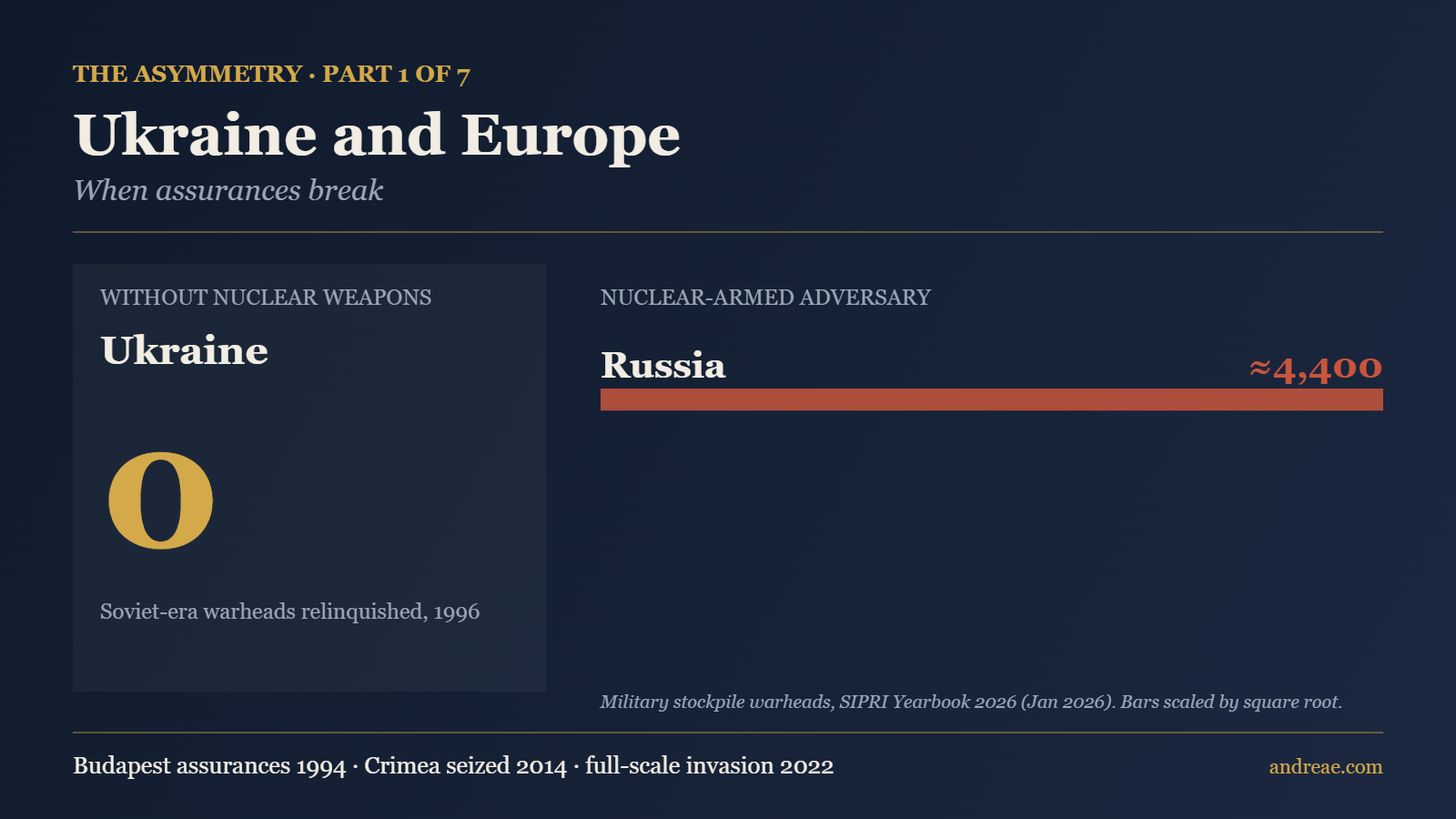
The asymmetry: Ukraine gave up the weapons; one of the states that offered security assurances retained its own arsenal and invaded. Russia’s estimated military stockpile is approximately 4,400 nuclear warheads, while Ukraine has no nuclear arsenal of its own. That is a comparison of national arsenals, not a count of weapons deployed immediately beside Ukraine.
From the promise of peace to war
- 1991: Ukraine becomes independent as the Soviet Union dissolves; Soviet nuclear weapons remain on its territory.
- 5 December 1994: Ukraine, Russia, the United States and United Kingdom sign the Budapest Memorandum. Russia, the United States and United Kingdom reaffirm commitments to respect Ukraine’s independence, sovereignty and existing borders and to refrain from threats or the use of force. The memorandum provides security assurances, not an automatic military-defense guarantee.
- 1 June 1996: Ukraine completes the transfer of its last nuclear warheads to Russia.
- 2014: Putin’s Russia seizes Crimea and war begins in the Donbas.
- September 2014 and February 2015: The Minsk Protocol and Minsk implementation package seek a ceasefire and political settlement; neither secures a lasting peace.
- 24 February 2022: Putin launches Russia’s full-scale invasion of Ukraine.
For the underlying disarmament documents, see George Washington University’s National Security Archive. For the transition from the Donbas war to full-scale invasion, see the United Nations account.
What did the assurance protect?
Sit in Kyiv now. What protection did the promise deliver when Putin attacked?
European NATO members have a collective-defense treaty commitment backed by the alliance’s military power and nuclear deterrence. Ukraine receives substantial outside assistance, but it is not a NATO member and does not enjoy Article 5 collective defense. Shared geography does not mean shared protection.
Wisdom requires an important limit to our conclusion: surrendering the weapons did not prevent Russia’s aggression. It does not prove that keeping those weapons would have prevented an invasion, nor that independent Ukrainian control or long-term upkeep of the inherited arsenal would have been straightforward.
Before a government accepts another security assurance, it should ask: who must respond if it is broken, how quickly, and with what effective protection?
The Golden Rule asks a more personal version: would we accept that promise for our own families?
A world seeking fewer nuclear weapons must make restraint safer—and broken promises costly.
Sources and reading
- SIPRI Yearbook 2026 — military nuclear-stockpile estimates.
- Arms Control Association — Ukraine nuclear weapons and security assurances.
- United Nations Treaty Series — Budapest Memorandum.
- National Security Archive — disarmament chronology and primary documents.
Full exhibits and research trail: The Asymmetry — Seen From Their Side.
Continue: Part 2 — Taiwan: Without a Deterrent of Its Own · All seven parts and related reading.
Philip Andreae, in collaboration with ChatGPT. Research and editorial method: AI Working Method.