
Othering begins in me.
I see a name on a job application and hesitate before I read the qualifications. I hear an accent and wonder whether I can trust what I’m being told. I learn how someone worships, or that they don’t, and think I know what they believe about me. What did any of them do to earn my suspicion?
Then a beautiful woman walks into the room, and I look up before she speaks. When she does, she sees the flaw in an argument the rest of us have been nodding along to. I noticed her beauty first. Her reasoning is what made me think again. Would I have listened as closely if she hadn’t caught my eye?
I give the man who carried a stranger out of a burning house the first word. I give it to the woman who stood her ground when everyone else backed away. Their courage earns my respect. Does it earn them the first word on whatever we’re deciding today? A celebrity may get the same hearing simply because I know the face. Think of the last time you said, “She’s not what I expected.” What did you expect? Who taught you to expect it? Who else had something worth saying while you were looking the other way?
Othering begins when I let what I think I know about a group decide what a person deserves from me. By then I have already decided who I see as the Other. A moment of caution around someone unfamiliar is human. Who taught me which accent, which name, which belief should make that caution last?
A first impression can form before I have time to ask what prompted it. A voice, a name, or a way of dressing can stir a feeling before I know much about the person. People around me help teach me which cues to notice and what to make of them. That is one way bias enters my judgment. I still have a choice about whether I let that first feeling settle into a judgment.
Turn the Golden Eye inward
Who have I made the Other? Why that person? What have I learned from them directly, and what did I bring into the room before we met? If I call my judgment experience, whose experience am I claiming as my own?
Across the world, the names change. Each of us can ask who we trust with a key, whose child we want beside ours in class, or whose word we take when two people tell different stories. Which answer would we give in public? Which one did we act on yesterday?
The Golden Eye asks me to see the judgment forming in me, then look outward and see the person who has to live with it. Who pays when I get it wrong? What reason would I accept if the same judgment were made about me?
Who taught me?
Family. A child learns where it is safe to belong. At the table a name comes up and the room goes quiet. That is a lesson. A relative tells an old story and everyone knows which part to laugh at. That is a lesson too. By the time the child meets the people in the story, what chance do they have to introduce themselves?
Education. In a study of 61 children aged six to nine, children whose teachers used assigned color groups in classroom routines showed more favoritism toward their own group than children whose teachers did not use those groups. The adults gave the distinction a job to do. Think back to school. Whose accent got corrected? Whose account of the past earned full marks? Which of those lessons did you carry out of the room? Bigler, Jones, and Lobliner, Child Development 68(3), 530–543 (1997)
Nation. Ask two people raised on opposite sides of a border when a conflict began. One names the day of the attack. The other starts with what happened before it. Where the story begins decides who appears to have struck first and who gets to say they were defending themselves. When our version reaches the part where our side did harm, do we tell it with the same care?
The history we allow to remain
Someone decides what to write down. Someone decides what to keep. Someone chooses what goes in the schoolbook. A child comes home believing they have heard the whole story.
The historian Michel-Rolph Trouillot followed those silences through the making of records, the assembly of archives, the telling of history, and the weight later generations give to particular events. Some accounts never reach an archive. Others sit there for anyone to read and still never make it into the lesson. Michel-Rolph Trouillot, Silencing the Past
A nation can do this. So can a family. Whose account of an event would your family rather you never asked for? When you tell the story, do you give that person a voice?
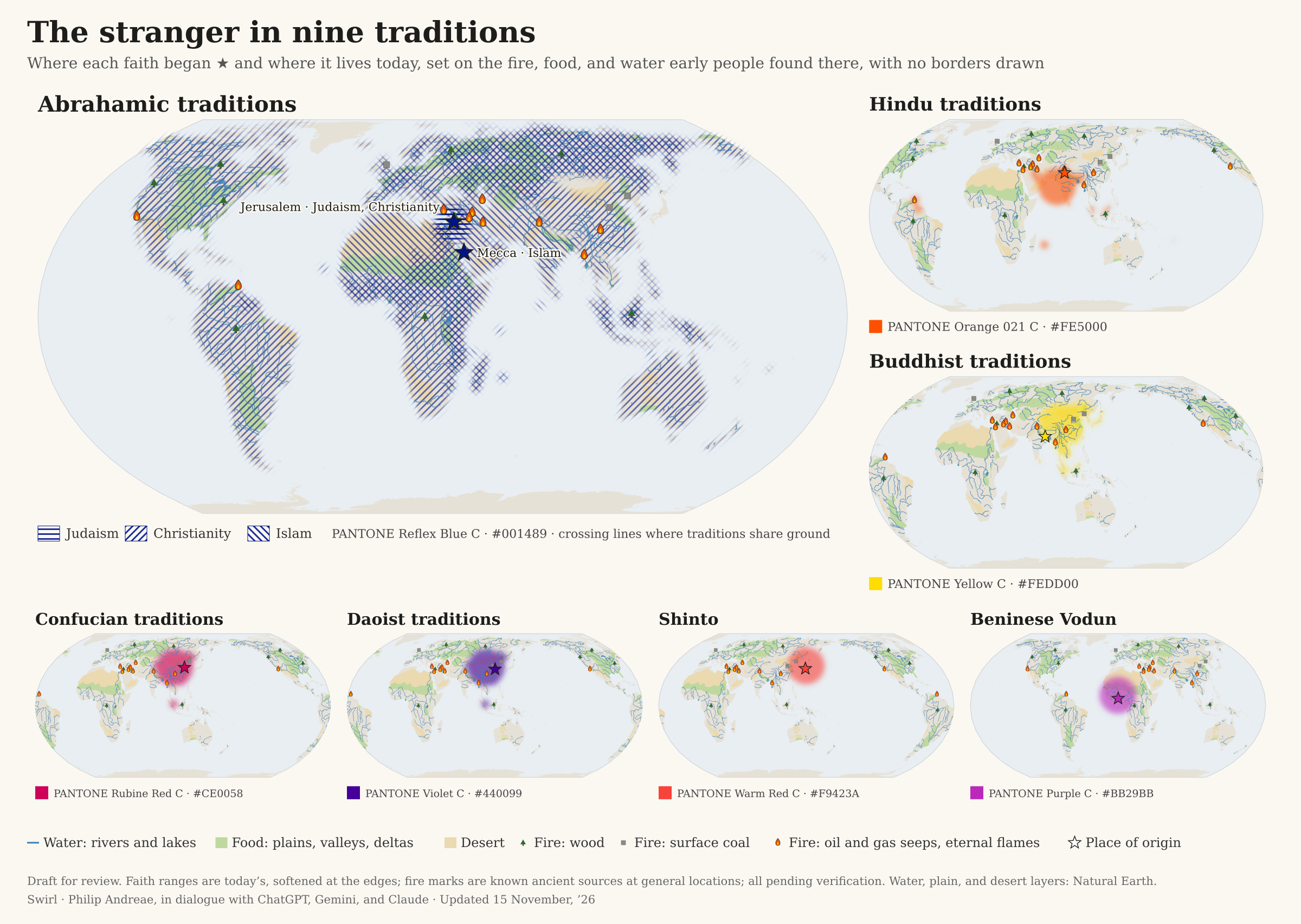
How nine traditions speak about the stranger
A child hears a sacred teaching in the words an adult chooses. The adult explains who the stranger is, what we owe that person, and when the obligation ends. The child also watches what we do when someone we distrust asks for help. Which lesson will the child remember?
I brought these nine examples together through the Golden Rule. I chose passages and accounts that raised questions for me about welcome, reciprocity, or who has the authority to draw a boundary. The selection reflects the questions I brought to it and leaves out many other traditions and readings.
| Tradition | What it asks of us |
|---|---|
| Judaism | Leviticus 19:33–34 tells the community to love the resident stranger as one of its own and reminds its hearers that they were strangers in Egypt. When your family remembers being unwelcome, does that memory open the door or guard it? Leviticus 19 |
| Christianity | In Luke 10:25–37 the Samaritan stops and helps. Jesus asks which of the three was a neighbor to the man left by the road. Whom would you least want to credit with showing you how to live your own faith? Luke 10 |
| Islam | Qur’an 49:12 warns against suspicion, spying, and backbiting. The next verse says peoples and tribes were made so that they may know one another. When did you last speak about people you had made no effort to know? Verse 12 · Verse 13 |
| Hindu traditions | Bhagavad Gītā 5.18 describes the wise seeing with equal vision across social standing and species, from the learned priest to the outcaste. What would equal vision demand if a distinction you take for granted were the source of your own standing? Bhagavad Gītā 5.18 |
| Buddhist traditions | Dhammapada 129–130 asks us to take ourselves as the measure when we consider another’s fear of violence and love of life. Whose fear do we call reasonable? Whose do we call proof that they are against us? Dhammapada 129–130 |
| Confucian traditions | Asked for one word to live by, Confucius answers with reciprocity in Analects 15.24. Do not do to others what you would not want done to yourself. Who have you quietly decided the rule does not cover? Analects, book 15 |
| Daoist traditions | Chapter 49 of the Daodejing describes the sage meeting both those judged good and those judged unkind with goodness. Who has to earn the ordinary kindness you give your own people freely? Daodejing, chapter 49 |
| Shinto | The Encyclopedia of Shinto describes harae as purification and also records a historical use of the term for a penalty. That distinction prompts a question of my own. When I carry a ritual boundary into ordinary life, what gives me the right to judge who belongs there? Kokugakuin University, Encyclopedia of Shinto |
| Beninese Vodun | The priest Wêtê Agbonon describes knowledge passed by word of mouth from elder to learner, shaped to the one who listens. Who gets to tell us what a living tradition means? Whose voice do we hear when its story is told outside the community? Vodun Bénin, “Speech and orality” |
Where the line is drawn
Read Leviticus’s welcome to the resident stranger alongside Deuteronomy 7’s commands concerning particular peoples in the setting of conquest. In Matthew 10, Jesus first sends the Twelve only to Israel and tells them to avoid Samaritan towns. In Matthew 28, he sends his disciples to all nations. Qur’an 60:8 allows kindness and justice toward those who have not fought believers over their faith or driven them from their homes. The next verse forbids alliance with those who have. The encyclopedia entry on harae also records a historical use of the term for a penalty imposed for transgressions against the social order. Wêtê Agbonon teaches that one must learn when to speak, before whom, and what must stay unsaid.
Read each passage in its setting. Then ask which line you would reach for if you already wanted to keep someone out. Who gave you the authority to make your reading binding on them? Who in your own community could challenge it? What would it cost them to try?
Deuteronomy 7 · Matthew 10 · Matthew 28 · Qur’an 60:8 · 60:9
Nine voices and the Golden Rule
Leviticus grounds welcome in memory. Luke puts mercy on a road. The Qur’an asks what it would take to know one another. The Gītā describes equal vision. The Dhammapada asks us to reckon with another’s fear as we would our own. Confucius names reciprocity. The Daodejing offers goodness freely. Shinto’s example concerns purification. Vodun’s concerns the care owed to knowledge and to the person who receives it.
When I inherit teachings that welcome and teachings that draw boundaries, which do I reach for when I have the power to decide who belongs? Who gave me the authority to make my reading binding on someone else? If I were the stranger in this room, what would I ask the people deciding what I deserve? When I have the power to decide, will I grant them the same hearing? The Golden Rule
When my judgment becomes someone else’s burden
I pass over a name on a list. Someone else loses an interview. I call a parent unreasonable before hearing what the school did. A child still has to walk into that classroom on Monday. I vote for a rule and go home. A neighbor has to live under it.
I heard two stories on the radio that made me ask who gets to speak when the stakes are high. In 1998, Alexander Litvinenko and fellow Russian security officers went public with allegations about their own service. The British inquiry describes what led to the press conference and records that some officers appeared in masks or sunglasses. That leaves me with a question. When I ask someone to speak up against people who hold power over them, do I reckon with what speaking could cost them and their family? The Litvinenko Inquiry, paragraphs 3.48 and 3.60–3.61
Then I heard the Donbas discussed as part of a possible bargain over Ukraine’s security. Othering begins before the decision, in whose voice I learn to trust. The Asymmetry asks what that difference looks like once it has become a difference in power. Who gets heard when other people negotiate over your home? I can talk about territory while picturing only a map. Who gets to tell me what that line would mean for their home, whether they stayed or were driven away? If I have a say in the decision, what would it take for their answer to change my mind? Ukraine and Europe — When Assurances Break
Think of a decision you helped make about somebody who had no seat at the table. What did you know about their conduct? What did you assume from the people you thought they belonged to? If they had made the same decision about you, what would you have demanded to know?
The person I left out has a right to ask me why. Can I answer them to their face?
Now turn the table. When you hear an accent or see a name, do you let what you think you know about a group decide what that person deserves? When your community gives you reasons to welcome someone and reasons to shut them out, which do you reach for when the decision is yours?
Do you give the person you would leave out the same hearing you would ask for yourself? If they stood in front of you and asked why, could you answer them to their face?
Sources and review
These entries paraphrase the linked readings. Claude reported checking the linked English renderings for the Qur’an passages listed in its review, the Gītā, Analects, Daodejing, Dhammapada, Luke and Matthew, and checking the Kokugakuin and Vodun Bénin entries. Claude confirmed the Sefaria page titles but did not see the verse text there. ChatGPT checked the Bigler study’s publication details and abstract and read the report paragraphs cited from the Litvinenko Inquiry.
The record does not establish that each entry was reviewed by a practitioner or specialist from its tradition. The Trouillot passage and the two Sefaria verse readings still need a documented source check. The map’s ranges and ancient fire-source locations remain provisional.