
Part 5 of 7 in a series continuing The Asymmetry — Seen From Their Side, which asks whether the rules we demand from an adversary are rules we are willing to apply to ourselves and our allies.
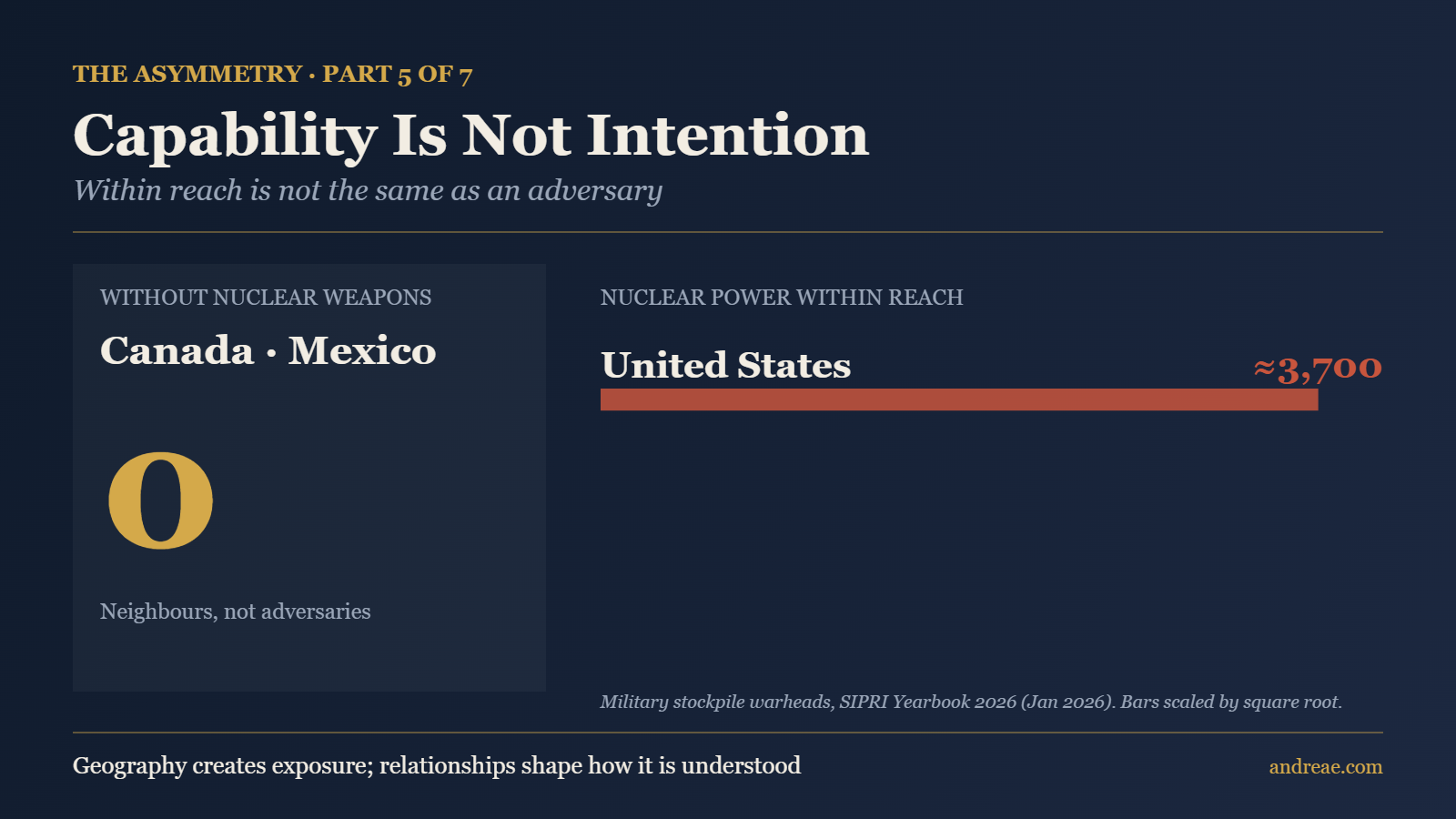
American weapons could also reach Canada or Mexico. Neither is treated as a current nuclear adversary of the United States. Geography creates exposure; relationships shape how that exposure is understood. The same principle must apply when we examine Iran, Israel or any other country.
We should ask five practical questions: who owns the weapon; where is it; what is its delivery range in kilometers; how many are stored; and how many are deployed? Aircraft already stationed in a region count as potential delivery capability where nuclear certification and mission assignment are supported by evidence. But being nuclear-capable does not establish that an aircraft is nuclear-armed. A ballistic missile and a cruise missile reach their targets differently; a conventional Tomahawk is not a nuclear warhead.
Where classified information is not publicly available, we must say so. We may calculate averages from three or more genuinely independent published estimates where they exist, and show one qualified number. We must not transform a hypothetical resupply schedule into an established deployment. The exhibits preserve those distinctions.
Full exhibits and source trail: The Asymmetry — Seen From Their Side.
AI collaboration: Andreae.com/aiwork — working method.