
When a weapon protects us but threatens our neighbor, whose rules are we asking the world to obey?
16 October 2026
Ninety warheads nobody admits to
Israel has nuclear weapons. About ninety, by the count of the Stockholm International Peace Research Institute. Israel will neither confirm nor deny it. Everyone else confirms it for them. [4]
Israel never signed the Nuclear Non-Proliferation Treaty (NPT). Iran did. Iran has no confirmed nuclear weapon. Not one.
Guess which one has been bombed.
Twice. Israel and the USA attacked Iran in June 2025, and again from 28 February 2026. On the first day of the second war, Iran’s Supreme Leader was killed. A June memorandum was meant to end it. It did not. As I write, the USA is blockading Iranian oil, ships are dodging the Strait of Hormuz, and the rest of us are paying for it at the pump. [1][3][7]
Before anyone writes to me: Iran is no innocent. Its leaders have called for Israel to disappear. It has fired hundreds of missiles at Israel and armed those who attack it. And the International Atomic Energy Agency (IAEA) now says it cannot tell how much of Iran’s most dangerous enriched uranium exists, or where it is. That is not a footnote. That is the stuff of nightmares. [6]
So sit in Jerusalem. We see an enemy that says it wants us gone and may be weeks of centrifuge time from the means.
Now sit in Tehran. We see a neighbour with ninety warheads, backed by a friend with 3,700, telling us we may not even think about it.
Both fears are real. Only one fear is allowed to be armed.
What We Seek in This History — A Dialogue
We ask: Why revisit history when the danger is happening now?
We answer: Because the present did not arrive without a past. Treaties, territorial decisions, displaced families, broken assurances and military alliances shaped the fears that now guide governments. We study their sequence not to excuse today’s conduct, but to understand how today became possible.
We ask: Are we seeking to defend one government and condemn another?
We answer: No. We examine the behavior of governments, the security of people, and obligations that can be checked. We can recognize Israeli fears without endorsing every Israeli policy; we can understand why Iranians may fear powerful adversaries without excusing Iranian threats or nuclear safeguards failures. We refuse to turn criticism of a state or ideology into a judgment about an entire people or faith.
We ask: Why must the story include Zionism, Palestine and the changing relationship between Iran and Israel?
We answer: Because land and belonging are part of this history. Jewish self-determination, the legacy of persecution, Palestinian dispossession and resistance, British and international decisions, and the radically different Iran–Israel relationships before and after 1979 all matter. Omitting inconvenient chapters would make our account easier—and less true.
We ask: Why examine Ukraine, Taiwan, the Korean peninsula, Japan, and even the reach of weapons toward Canada or Mexico?
We answer: To test whether our rule remains a rule when the names change. Geography tells us where a weapon could reach. Alliances and history affect how a capability is perceived. Neither automatically establishes hostility. We must not demand one evidentiary standard of an adversary and a more forgiving one of an ally.
We ask: What can our inventory establish—and what can it not establish?
We answer: We ask who owns a weapon; where a relevant launch platform or weapon is physically located; which payload and delivery system are involved; how far it can reach in kilometers; and what is deployed rather than stored. A nuclear-capable aircraft is not proof of a nuclear-armed aircraft. An owner’s global arsenal is not the number stationed beside a neighbor. Information not publicly available is not evidence of absence. Capability must never be silently promoted into intention.
We ask: How do we separate truth from persuasion?
We answer: We distinguish evidence, inference and invention. We date claims, show sources, identify legal differences, and leave genuine unknowns visible. If our conclusion changes with better evidence, then our conclusion must change.
We ask: What do we ultimately seek?
We answer: We seek a rule of mutual security that can survive being spoken from either side of the table. The Golden Rule gives us the test of reciprocity. Wisdom, Truth, Reverence, Unity and Equality give us five ways of examining where power has become privilege. We do not ask our history to pronounce anyone innocent. We ask whether we can find a rule we would accept even when another nation possesses the power to enforce it.
The danger is not theoretical
Today, the war involving Iran is disrupting shipping through the Strait of Hormuz and driving energy costs upward. The United States is enforcing a blockade of Iranian oil exports. In the occupied West Bank, Palestinian families trying to harvest their olives have faced attacks by Israeli settlers. These are not distant memories. They are events of this week. [1][2][3]
We experience their consequences even when we live thousands of kilometers away: fuel, food, uncertainty, and the possibility that one more decision will make a terrible conflict worse.
My question is not who deserves to be afraid. It is whether the rules we demand from an adversary are rules we are willing to apply to ourselves and our allies.
Start with five places in which people live within the reach of nuclear powers while possessing no confirmed nuclear arsenal of their own. The figures below count each owner’s global military stockpile, not weapons stationed next door. [4]
| Place | Its own nuclear weapons | Nuclear power or powers in its security crisis |
|---|---|---|
| Iran | None confirmed | Israel ≈90; United States ≈3,700 |
| Ukraine | None; Soviet-era weapons relinquished | Russia ≈4,400 |
| Taiwan | None | China ≈620 |
| South Korea | None | North Korea ≈60; U.S. nuclear umbrella |
| Japan | None | China, Russia and North Korea; U.S. nuclear umbrella |
Iran and Israel: the asymmetry we are living through
Israel has an estimated 90 nuclear warheads, but maintains its policy of neither confirming nor denying their existence. It has never joined the Nuclear Non-Proliferation Treaty (NPT). Its Jericho ballistic missiles provide a regional—and potentially longer—nuclear delivery capability. [4][5]
Iran joined the NPT as a non-nuclear-weapon state. It has no publicly confirmed assembled nuclear weapon. But the distinction cuts both ways: the International Atomic Energy Agency reported in September, ’26 that it could no longer verify the size or whereabouts of important Iranian enriched-uranium stocks. Iran’s safeguards problems are serious; its regional attacks and support for armed groups have also created legitimate fears in Israel and among Iran’s other neighbors. [6]
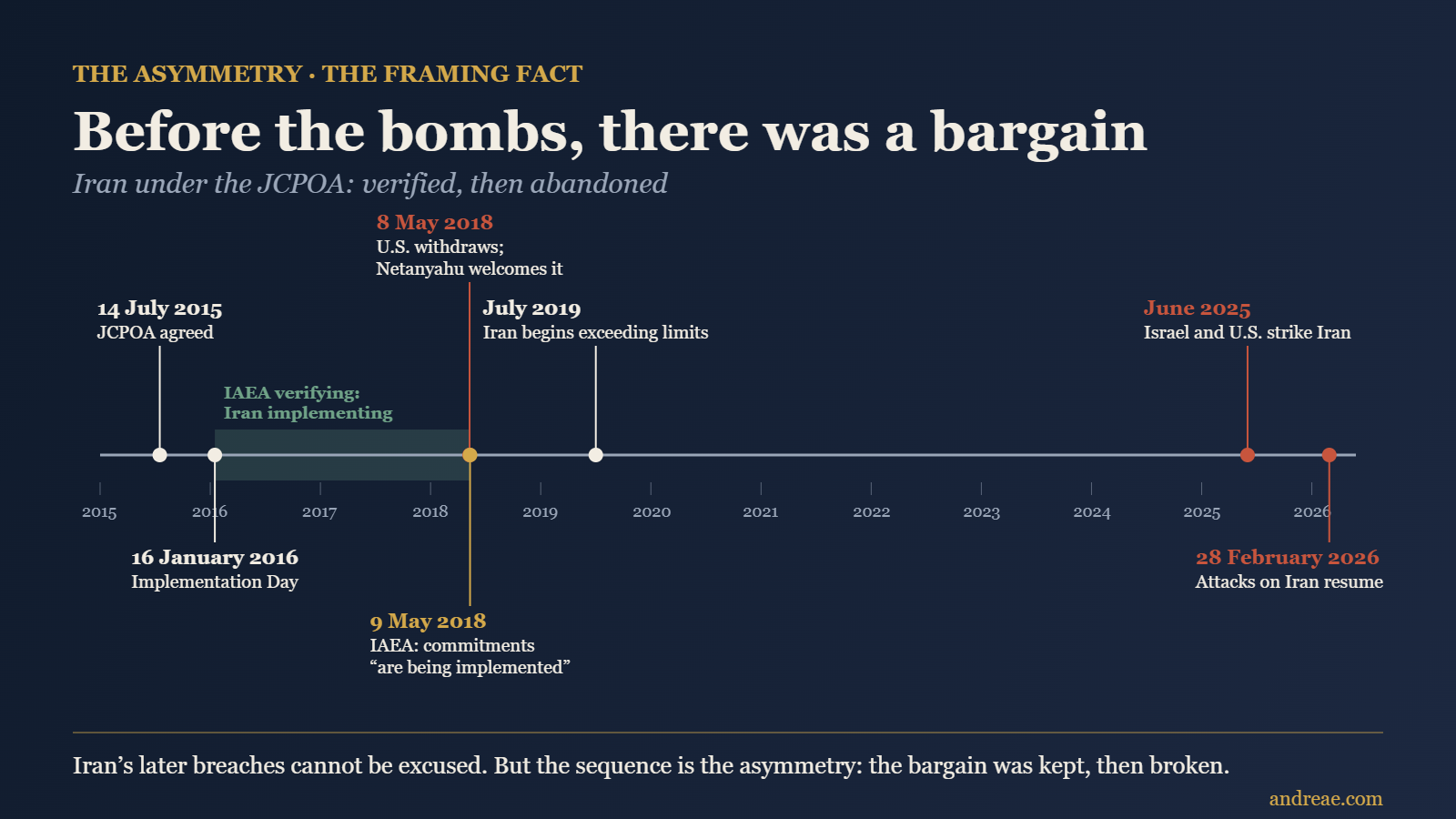
Before the bombs, there was a bargain. In 2015 Iran accepted limits on enrichment and intrusive international monitoring. On 9 May 2018 the IAEA confirmed that Iran was implementing its nuclear-related commitments. The day before, President Trump had withdrawn the United States from the agreement; Prime Minister Netanyahu had publicly opposed it and welcomed the American decision. [22][23][25]
Iran began exceeding the agreement’s nuclear limits in 2019, and its later safeguards failures cannot be excused. But imagine the question in Tehran: if we accept restrictions and inspections, yet the bargain can be abandoned and threats continue, what will protect us? We cannot establish another leader’s private thoughts. We can establish the sequence that made such fear plausible. [24]
Israel and the United States attacked Iran in June 2025 and again beginning on 28 February 2026. Iranian strikes and the wider regional war followed. An interim U.S.–Iran agreement in June, ’26 did not produce enduring peace. In October, ’26, blockade, attacks on shipping and regional retaliation have continued. [1][7]
So sit for a moment in Tehran. We see a neighboring adversary with weapons we are told we must never acquire, and a superpower with thousands of nuclear warheads that has participated in attacking us. Then sit in Israel. We see an Iranian government whose threats, missiles and proxies make security feel fragile. We can understand both fears without declaring either government innocent.
The asymmetry: Israel’s presumed arsenal is tolerated outside the treaty; Iran’s potential arsenal is treated as a threat warranting coercion and force. The legal obligations differ. The insecurity does not vanish because we can explain the legal distinction.
Why the land question still matters now
We cannot explain this conflict by counting weapons alone. Modern political Zionism sought Jewish national self-determination in Palestine; the horrors of European antisemitism and the Holocaust made the demand for refuge urgent. But refuge for one people could not erase the people already living there.
Britain supported a Jewish national home through the Balfour Declaration and its mandate. In 1947, the United Nations recommended partition. The Jewish Agency accepted the plan; Palestinian Arab representatives rejected the division of their homeland without their consent. Iran also voted against partition. The 1948 war left approximately 750,000 Palestinians as refugees. Land, homes and self-determination were not abstractions to the families who lost them. [8][9]
Nor is dispossession merely historical. In a 2024 advisory opinion, the International Court of Justice found Israel’s continued presence in the territory occupied in 1967 unlawful, and said that settlement activity must cease. Israel disputes the Court’s conclusions. Yet UN monitors documented more than 1,600 settler attacks in the West Bank between January and August 2026, and the violence against olive harvesters this week shows what continued loss of access to land means in daily life. [2][10][11]
A necessary correction to an easy narrative: Iran did not maintain an unbroken policy of hostility toward Israel. Despite its 1947 opposition to partition, the Shah’s Iran cultivated close economic and security relations with Israel before the 1979 revolution. The Islamic Republic’s later hostility has a distinct history. [12]
We should scrutinize Zionist political claims and Israeli state policies where they are used to justify territorial control or exceptional security rights. That is not a judgment about Jewish people as a whole, nor does it erase Jewish historical connection to the land. It is a challenge to the proposition that one people’s survival entitles a state to deny another people land, safety or political agency.
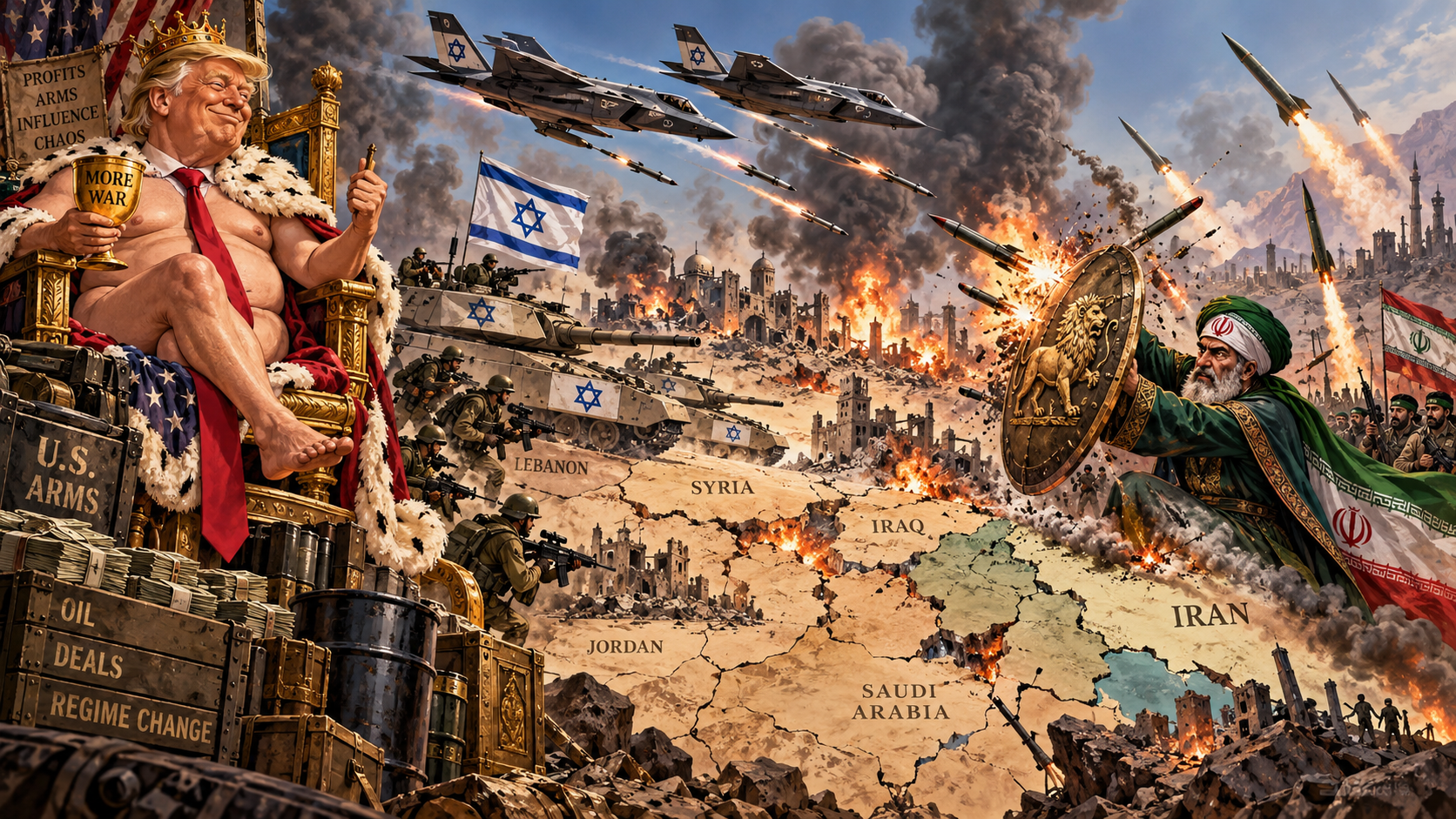
The third line on the map is the territory some expansionist Zionist politicians have said Israel should encompass—not territory Israel currently possesses. In 2023, Bezalel Smotrich spoke beside a map incorporating Jordan and the Palestinian territories; in 2024 he invoked expansion toward Damascus, and in 2025 Netanyahu expressed sympathy with a “Greater Israel” vision without specifying a fixed border (2023 map; 2024 remarks; 2025 interview). These are documented political claims, not established national borders or a single agreed territorial plan.
The series continues
The questions in this essay continue over the next seven days. Each part stands on its own. Read every published part; each is added on its publication day.
- Ukraine and Europe — When Assurances Break — Tue 20 October, ’26
- Taiwan — Without a Deterrent of Its Own — Wed 21 October, ’26
- Korea — Little Time to Correct a Misjudgment — Thu 22 October, ’26
- Japan — The Same Aircraft, Two Meanings — Fri 23 October, ’26
- Capability Is Not Intention — Sat 24 October, ’26
- A Promise We Have Not Kept — Sun 25 October, ’26
- What Would We Do? — Mon 26 October, ’26
Continue the inquiry: The Golden Rule — Andreae.com/Goldenrule
Exhibits — The evidence behind the essay
These supporting exhibits are part of the article, not substitutes for it. Quantities are best available public estimates as of the stated source dates. They are not claims about which countries intend to use nuclear weapons.
Exhibit A — Nuclear inventories (January 2026)
Source: SIPRI Yearbook 2026. “Stored” means military-stockpile warheads not counted as deployed. “Total inventory” also includes retired warheads awaiting dismantlement; we do not double-count weapons hosted abroad. [4]
| Owner | Military stockpile | Deployed | Stored (not deployed) | Total inventory |
|---|---|---|---|---|
| Russia | ≈4,400 | ≈1,796 | ≈2,604 | ≈5,420 |
| United States | ≈3,700 | ≈1,770 | ≈1,930 | ≈5,042 |
| China | ≈620 | ≈34 | ≈586 | ≈620 |
| France | ≈290 | ≈280 | ≈10 | ≈370 |
| United Kingdom | ≈225 | ≈120 | ≈105 | ≈225 |
| India | ≈190 | ≈12 | ≈178 | ≈190 |
| Pakistan | ≈170 | Not separately assessed | Not separately assessed | ≈170 |
| Israel | ≈90 | Not separately assessed | Not separately assessed | ≈90 |
| North Korea | ≈60 | Not separately assessed | Not separately assessed | ≈60 |
| Iran | None confirmed | None confirmed | None confirmed | None confirmed |
| WORLD (9 states) | ≈9,745 | ≈4,012 | ≈5,733 | ≈12,187 |
Notes: For Pakistan, Israel and North Korea, SIPRI does not present a reliable split of military stockpiles into deployed and non-deployed categories. “None confirmed” for Iran is not an IAEA determination that all nuclear activity is peaceful; see Exhibit D.
Exhibit B — Territory, delivery and physical reach
Illustrative systems, not all weapons or a target list. Each number describes a delivery system, not the distance between national capitals. The range of aircraft-delivered gravity bombs cannot be stated independently of aircraft range and basing. [5][15][20]
| Owner | Reported physical location | Example regional delivery reach | Relevant distinction |
|---|---|---|---|
| Israel | Israel; exact nuclear storage not public | Jericho III: up to ≈6,500 km | Ballistic; nuclear-capable |
| United States | U.S.; sea-based; European host states | AGM-86B: ≈2,400 km + launch aircraft | Cruise missile; aircraft-dependent |
| Pakistan | Pakistan | Shaheen II: up to ≈2,000 km | Ballistic; India-focused deterrent |
| Russia | Russia; submarines; reported Belarus assets | Kh-102: ≈2,500 km + launch aircraft | Air-launched cruise missile |
| China | China; sea-based assets | DF-26: ≈4,000 km | Ballistic; conventional or nuclear |
| India | India; sea-based assets | Agni III: up to ≈3,500 km | Ballistic; nuclear-capable |
| North Korea | North Korea | Hwasong-12: ≈4,500 km | Ballistic; status uncertain |
| France | France; sea-based assets | ASMP-A: ≈500 km + launch aircraft | Air-launched cruise missile |
| United Kingdom | UK; sea-based assets | Trident: intercontinental | Excluded from local-range comparison |
U.S. nuclear weapons hosted abroad: FAS estimates about 100 B61 bombs across six bases in five NATO countries—Belgium, Germany, Italy, the Netherlands and Türkiye. Possible additional UK storage remains uncertain. Those weapons are included in, not added to, the U.S. inventory. Storage location, certified aircraft presence and assigned nuclear missions are separate facts. [20]
A public inventory cannot establish per-base command-to-loading time, rapid freight deliveries or maximum nuclear warheads available within twelve hours; those operational details are not publicly available. A hypothetical figure must never appear as a verified deployment.
Exhibit C — The timeline that leads into October 2026
| Date | Event and why it matters |
|---|---|
| 1917 / 1947 | Britain endorses a Jewish national home; later UN partition is accepted by Jewish leaders but opposed by Palestinian Arabs and Iran. |
| 1948 | War, creation of Israel, and displacement of about 750,000 Palestinians. |
| 1967 / 1979 | Israeli occupation of West Bank, East Jerusalem and Gaza begins in 1967; the Iranian revolution ends the Shah-era relationship with Israel. |
| 1994 / 1996 | Budapest security assurances; final nuclear warheads transferred from Ukraine in 1996. |
| 1995 | NPT extended indefinitely with a resolution on a Middle East WMD-free zone. |
| 2003 / 2011 | Iraq invaded after inaccurate WMD claims; Libya dismantles WMD programs and later experiences NATO intervention and regime collapse. |
| 2014 / 2022 | Russian seizure of Crimea; full-scale invasion of Ukraine. |
| 2015–2019 | Iran accepts JCPOA nuclear limits in 2015. In May 2018 the IAEA verifies implementation; Trump withdraws the U.S. with Netanyahu’s public support. Iran begins exceeding limits in 2019. |
| 2024 | ICJ advisory opinion finds Israel’s continued presence in occupied Palestinian territory unlawful. |
| 2025 / Feb 2026 | Israel–Iran war and U.S. strikes in June 2025; U.S.–Israeli attacks on Iran begin again 28 February 2026. |
| May / June 2026 | NPT review ends without consensus; U.S.–Iran interim memorandum signed in June, ’26, with conflict later resuming. |
| Sept / Oct 2026 | IAEA safeguards concerns remain unresolved. War-related shipping restrictions, West Bank settler violence, Chinese drills and North Korean tests persist. |
Exhibit D — What the nuclear treaty does, and does not, establish
Iran: an NPT non-nuclear-weapon state, with safeguards obligations. The September 2026 IAEA report said the agency could not determine the current size, composition or whereabouts of important enriched-uranium inventories because it lacked the necessary access and information. No assembled Iranian nuclear weapon is publicly confirmed. These are three separate observations. [6]
Israel: has not joined the NPT, does not acknowledge nuclear possession, and is estimated by SIPRI to have approximately 90 warheads. Treaty membership differs; geography and the resulting security dilemma do not depend on treaty membership. [4][5]
1995 regional resolution: called for an effectively verifiable Middle East zone free of nuclear, chemical and biological weapons and delivery systems. The resolution was a diplomatic undertaking accompanying indefinite NPT extension, not a claim that every state had already accepted identical safeguards. [18]
Exhibit E — Source trail
The numbered links correspond to claims in the essay. Direct source documents are preferred over commentary. Where a secondary estimate relies on SIPRI/FAS work, it must not be counted as an independent observation.
[1] Reuters, U.S. blockade and Iranian shipping, 16 Oct 2026
[2] Reuters, attacks on Palestinian olive harvesters, 16 Oct 2026
[3] Reuters, Middle East / Russia-linked oil-price escalation, 16 Oct 2026
[4] SIPRI, Yearbook 2026 nuclear forces summary, 8 June 2026
[5] CSIS Missile Threat, Jericho III (updated 2024)
[6] IAEA, GOV/2026/50, Iran safeguards, September 2026
[7] Reuters, June 2026 U.S.–Iran memorandum / ceasefire
[8] UN, history of Palestine partition and objections (1947)
[9] UNRWA, Palestine refugees / 1948 displacement
[10] ICJ, advisory opinion summary, 19 July 2024
[11] UN OCHA, West Bank humanitarian update, 18 September 2026
[12] Encyclopaedia Iranica, Iran–Israel relations, Shah era to 1979
[13] Arms Control Association, Ukraine assurances and June 1996 last warhead transfer
[14] Reuters, Chinese live-fire exercises watched by Taiwan, 12 Oct 2026
[15] CSIS Missile Threat, Chinese DF-26 ballistic missile
[16] AP, North Korean underwater missile tests, 14 Oct 2026
[17] FAS / Bulletin, United States nuclear weapons, March 2026
[18] UNIDIR, 1995 NPT Resolution on the Middle East
[19] United Nations, NPT 2026 Review Conference outcome, May 2026
[20] CSIS Missile Threat, regional missile range database
[21] U.S. Air Force, F-35A permanently stationed at Misawa, Japan, March 2026
[22] IAEA, Director General Yukiya Amano statement confirming Iranian JCPOA implementation, 9 May 2018 — https://www.iranwatch.org/library/multilateral-organizations/international-atomic-energy-agency/statement-iaea-director-general-yukiya-amano-following-president-trumps
[23] GovInfo, National Security Presidential Memorandum ceasing U.S. participation in the JCPOA, 8 May 2018 — govinfo.gov
[24] UK House of Commons Library, Iran’s JCPOA compliance and breaches beginning 2019 — https://commonslibrary.parliament.uk/research-briefings/cdp-2021-0157/
[25] Iran Watch, Prime Minister Netanyahu’s statement following the U.S. withdrawal, 8 May 2018 — iranwatch.org
AI collaboration: Andreae.com/aiwork — working method.