Thinking about cards

In 1991 I had to learn the difference between million dollar transactions and hundred dollar transactions. As I came to explain, when telling my life story, I had to shift my thinking from 100 transactions at a million to 1,000,000 for a hundred. This transition took me from capital markets to payment cards.

Today, I wonder about the future of the ID-1 based payment card? A piece of plastic 3 3/8 x 2 1/8 with rounded corners.

In another blog I spoke of how this ID-1 object became a token responsible to act as the first factor, something you have. Printed, encoded and embossed characteristics were the security features. Today, with EMV as the global standard for payment CARD security; cryptography and the “secure element” replace those physical security with digitally mastered circuitry embedded inside something capable of protecting those secrets cryptography requires. We digitized the payment card. What we now must do is shift our vocabulary to tokens and credentials.

We need to embrace a new way of speaking we need to think about our “Payment Credentials”.

Today, we now tap our phone to pay, we use our phone to browse the internet, we shop & book tickets with apps and we listen to music & watch movies all from this device we apparently use, thousands of times a day. For those of us who remember computers that filled floors, we now are capable of buying more powerful computers, similar in size to those same cards. Think about the Raspberry Pi, a computer almost as small as a card, not quite! Yet!

The embedded secure element integrated inside our payment cards are being integrated into phones, bracelets, rings and things. The question; will they replace the card we are now comfortable with? Yes – maybe? Will we embrace these objects as the new carriers of our payment credentials? Many hope so.

In oder to think about the probability of cards disappearing, one must begin by think about the number of cards now in circulation. In round numbers we can think about 1.2 billion debit and credit cards, 300 million prepaid cards and 300 million retail branded cards. In round numbers, 1.8 billion payment cards. We next must think about our population and how many people now carry cards – 115 million households and 242 million Americans over the age of 16, according to a recent census. We now has a numerator and a set of denominators.

The question then becomes, how many payment cards does an American want to carry and how many payment credentials will an American end up having.

I would argue a debit card and a credit card is all we need to carry in our leather wallet, purse or pockets. Those other payment credentials can easily be accessed from wallets in the cloud or in our digital objects.

Merchants can integrate payment capabilities and focus on factoring their consumer receivables, behind relationships designed to service, thrill and sell. In an App and API enables economy, cards become a burden as the experience becomes the essential component of our lives.

Deciphering Digital – Your Phone is Your Wallet

Today Wednesday October 18, 2017. I had the opportunity to provide the closing keynote to the EPCOR Annual Payments conference.  Today, I was reminded of the reality that payments is not only about cards it is the engine that fuels the revenue of a financial institution.  ACH, Wires, Cards, checks, transfers and even cash are revenue earning services; our community banks call payments.

My speach was about the future and focused on the evolution of our phone in this new digital age we all must learn to embrace.

Tokenization and the search for Identification and Authentication

These two words began to fascinate me as I began to understand the value of cryptography while working through the goals we established when developing EMV and attempted to secure the payment credentials when used on the Internet.

With EMV we were trying to address the challenge of the fraud (an issuer cost) resulting from the ease of counterfeiting the token of the token which was a token of a token already.

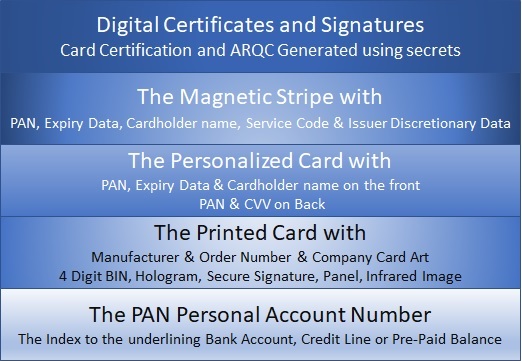
This last broken token is the magnetic stripe on the payment card.

The payment card, in and of itself, is a token. An instrument imbued with physical security features e.g. the hologram and signature panel. Security features the merchant is supposed to check when attempting to allow a buyer, the consumer, to use the payment credential associated with the card to make payment for good and services.

The PAN is just a unique number, another token. This unique number is simply the index, The identifier within the payment credentials, which associates the payment with the underlining source of funds.

The source of funds, the PAN or Token pointing to, is then either a line of credit, prepaid balance or bank account.

The card, the hologram, the magnetic stripe and the printed security features and the PAN had reached the end of their useful life, as security features or tokens. The criminal knew how to compromise the card and associated static data.

As we entered the 90’s, the card as the carrier of the payment credential, with those physical security features, was longer a means of Authentication. These layers of authentication had been compromised. In other words the token was broken!

To address this concern, in 1993 the founders of EMV embraced the chip card and its Cryptographic capabilities. In particular, the use of symmetric and asymmetric algorithms to provide a new set of tokens the merchants (asymmetric) and Issuer (symmetric) could use to Authenticate the unique carrier of the payment credential – the token – the chip card.

On the Internet the challenge is different. The physical features of the card are not easily accessible, hence useless. In 1993, when WWW became the thing of conferences, everyone said lets think of the internet in the same way we allow merchants to sell stuff via mail and telephone. Everyone simply decided and agreed to exploit the acceptance rules agreed on for those other virtual environment, the phone and the mail.

Bottom line, in the world of mail order / telephone order and now a browser; merchant simply agrees to accept the cost of fraud, given the CARD is NOT PRESENT. Worse still how do they prove the right cardholder in present?. For the merchant, given the potential of the Internet, it is was a small price to pay.

Everyone simply accepted that be capturing the data embossed on the front (PAN, expiry date and cardholder name) and the CVV printed on the back of the card and, in some cases, using the power of AVS “Address Verification Service” a modicum of security could be factored in. At least for a time!

SET “Secure Electronic Transactions”, a cryptographic mechanism Visa and MasterCard cooked up, was developed circa 1995-1996 and deployment was attempted. The challenge, the limitations of the then deployed technologies and the inability to provide a reasonably convenient user interface. The problem begins with loading payment credentials into the browser and more importantly figuring out how to use them when shopping.

A set of great ideas foiled by convenience.

Next came 3D-Secure, an invention of Visa. This time the idea was to exploit the power of passwords and secret questions to authenticate the user.

Nice idea, well thought out; but, unfortunately not designed with the consumer in mind.

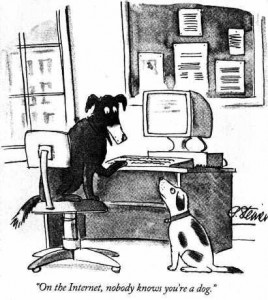
Another feeble failed attempt to develop a mechanism to authenticate the buyer. Or better put, solve the dilemma the New Yorker so aptly described

“On the Internet nobody knows your a dog”.

All this begs the question – how will we secure payments on the Internet?

3D-Secure 2.0, maybe? Or maybe W3C and the FIDO Alliance have the answer in what is called WebAuthN.

To address this question we must begin by defining the problem.

When we think about payments and we think about shopping on the internet it is all about someone or something {read issuer} agreeing that the consumer will make good on the promise to pay and therefore the issuer is willing to guarantee payment towards the merchant. The challenge, how do we confirm it is the legitimate person seeking to pay with their means of payment.

In other spheres of endeavour it’s about granting access to someplace or some website. In the physical world we have a key that we can insert into the lock or a security device {card} we can insert or tap on a reader programmed to recognize our credential and allow us access.

On the Internet, the use of a physical card with physical security features, numbers, letters, and a magnetic stripe was not feasible. Instead, we ended up employing user names, passwords, and payment encryption. Payment encryption, which secures sensitive financial information during online transactions, offers a crucial layer of protection. The user name – a unique identifier, and the password, a secret, support the identification of the person using the browser or connected device, from somewhere out there.

If we could each create and remember complex secrets, these cumbersome things call passwords. And, more importantly, never share them with nefarious individuals seeking to take advantage of our naiveté. All would be at peace in the world of security and convenience. The problem is expecting you and I to remember the myriad of complex passwords and not get tricked into sharing our secrets.

Is there an answer, I believe so and at Money 2020 October 25 we will be discussing this very topic. Wednesday Morning at 8:30 in the Titian room at The Venetian in Las Vegas on Level 2, join us as we discuss Identity is Fundamental: What You Need to Know About Identity & The Future of Money.

In the News as the Vice President of Oberthur Technologies

Oberthur Technology seeks to educate and support the migration to EMV


An Interview with George Peabody of Glenbrook


From a merchant perspective Oberthur offers thoughts for consideration


Healthcare is in need of secure authentication an Interview with Karen Webster


An Article published by Pymnts.com as we consider the last days before the migration


Digital Identity is what we require to secure our world an interview with Karen Webster


W3C and the WebCrypto Working group considering payments and Same Origin Policy


Why EMV and Why Now with Pymtns.com


A Founders of EMV’s view of the US migration to EMV


Understanding EMV in Our Digital Future an interview with Karen Webster


Counting Down to the migration to EMV


The ABCs of EMV


An interview with the Atlanta Constitution


Is recent EMV announcement the catalyst the U.S. needs to catch up?

August 22, 2011

Is recent EMV announcement the catalyst the U.S. needs to catch up?

During this past year, the team at Portals and Rails has published several articles exploring the growing risks in card-based payments and the need to move to a more sophisticated and secure enabling technology. But overhauling a payment system is no easy task, as there are many players that need to collaborate, from the card networks to the bank issuers and merchants. How does the industry organize itself to orchestrate a much-needed transition?

http://portalsandrails.frbatlanta.org/2011/08/lessons-from-mario-brothers-finding-keys-to-fighting-fraud.html

Interesting question for the industry as we go through this transformation to a fully connected world where everything happens between our mobile phone and the merchant, friend, family, phone or cash.


The path for the USA to EMV

http://www.finextra.com/community/fullblog.aspx?blogid=5875

EMV: Let the planning begin


There’s no way around it – EMV transition planning will be complicated. However, while EMV is a complex specification, the good news is that it can grow over time. Thus the key is to implement an infrastructure that lets you start with a simple, single portfolio that can expand and mature with you. Looking forward, the goal is to do it once, do it properly and avoid the pain of re-doing it when it’s time to move into mobile payments

I agree totally with this sentiment. Mobile is here. EMV addresses the requirement to include Dynamic data in a payment transaction to address questions of identity and irritability.

Update 02/22/2012

Having had a chance to sit inside EMVCo working group meeting and being fully aware of those words read every time that reminded us of our confidentiality and sharing of patent and secrets that might jeopardize the future of EMV.

What I saw was the successful release of the EMV contactless specifications and type approval processes capable of testing tap if one remembers the distance has to be 2 cm instead of 10.  Otherwise the protocol and security will last us until 2025.  Plans where underway as I left that where focusing on expanding the standardization of mobile and the development of a next generation or EMV 2.0.  They are talking about 2015 and 2017 for probably dates that these new specifications and processes would be in place to allow widespread adoption so that circa 2030.  If hey are right we have a new and transparent solution that opens and never hinders access to whatever we have the right to access.  what about the next 17 years,

Well, EMV works.  It already includes mobile and contactless.

Visa and MasterCard have said yes.  Amex is OK, discover has had lots of ads for payment people with EMV knowledge and such titles.

The Federal Reserve seems to be on-board and Global Platform, NFC and Mobey forum seem to be OK.

Looks like a plan to me.

NSTIC and EMV should merge

October 03, 2011

Cyberspace trust: Proving you’re not a dog

A very real discomfort underlies the classic joke: “On the Internet, nobody knows you’re a dog.” How can you prove your own identity and confirm the identity of others during virtual interactions? Every time you reach out to a friend on Gchat, post on a classmate’s Facebook wall, or send money to a colleague via PayPal, you are relying on a key assumption: that the person you’re reaching out to behind that Gmail address, Facebook profile, or PayPal screen name is who they say they are. Without this baseline confidence, online interactions and commerce would be paralyzed.

http://portalsandrails.frbatlanta.org/2011/10/cyberspace-trust-proving-youre-not-dog.html

Philip thinks:

  • The next step is to merge the identity sought by everyone and easily relegated to the Banks to manage.  Facebook and GMail offer an option if their KYC can be improved.  With face to face meeting it is possible to truly prove identity, requiring a branch network.
  • Transaction processing is legacy in the developed world while the emerging economies offer an opportunity to build new.  Existing standards and processes need to be respected as they transform to absorb the new information attachments and Internet offers we now need to cope with.
  • The Wallet forms the basic unit to create a trusted network employing smart cards, trusted computing, persistent computing and inteligence to enable the consumer experience.
  • Privacy and integrity of that trust is essential to the system
  • The individual is key
  • Respect rights and obligations


Are the Pundits over thinking the ISIS proposition

Mobile payments is being discussed in the context of “creating” a new “means of payment” or in other words a new “Payment Brand”.  I would suggest  the expense and time it takes to create a new “Payment Brand” is significant not to ignore expensive. 

Just look at PayPal.  How long, on the backs of eBay, did it take to reach the point where they are ready to  enter into a venture with Verifone to become a “means of payment” their buyers can use at the real world stores of their sellers.

Two models for payments exist in the market today and frankly these two models have not changed, since the beginning of any form of commerce. 

The three party model and the four party model. 

Classically banks regulated and trusted to hold our moneys in accounts are fundamental to the act of payment.  They have always been key to developing and operating the payment systems. 

Unless of course we use cash. 

In both models two parties always exist – the Buyer and the Seller, the Payer and the Payee or the consumer/cardholder and the merchant.

In the four party model we add two Banks who support one of these two parties.  There is the bank with the relationship with the consumer/buyer/payer/cardholder, often called the Issuing Bank.  On the other side of the payment there is the bank with the relationship with the merchant/seller/payee, often called the Acquiring Bank.

The three party model, simply means that the Bank of the payer and the Bank of payee are the same.  The movements of funds flows from the buyers account to the sellers, as ledger entries, within a single institution.

American Express and PayPal are perfect examples of non-Banks who operate three party payment systems. 

The central bank is another example of a three party system.  All the banks within a country are clients of the central bank and have accounts at the central bank.

Clearly the three party model is the most efficient.  But, it requires that there is a monopolist who processes payments for all buyers and sellers in order for the system to truly work.  Reality dictates that a monopoly or agreement by all parties to use a single entity for their banking and payment services must exist for such a system to dominate the market.  

Therefore, the payment systems have evolved cooperatively; based on acceptance by the consumer and merchant of a recognized means of payment.  The banks work together to establish a set of rules and procedures they employ to transact payments.  Various four party models i.e. MasterCard and Visa along with checks, electronic fund transfers, dominate the payments landscape. 

Inherent to these models is  a Brand (acceptance mark), a set of rules and a clearing mechanism.  Everything works because there are agreed rules and procedures that govern how the two banks execute payments.  To complete the cycle these two banks ultimatelyexchange real money, typically through a settlement bank or the central bank representing the total value of the payments processed.

To add complexity to the landscape, the Issuer and Acquirer often contract with processors to do the work.  These to entities are identified in the graphic as the Issuing Processor and the Acquiring Processor.

Behind the term mobile payments, some think there is a more efficient method of affecting payments.  They believe inserting a new player into the game will make the whole system more efficient and therefore cheaper.  Or more appropriately they think that their new approach will allow them to earn a portion of the Merchant Discount (fee paid by the Merchant to the Acquirer) or the Interchange (fee paid by the Acquirer to the Issuer). 

The more I think, read and discuss, the more convinced I become that creating a new payment Brand is an expensive exercise and frankly believing we can create something new and more efficient than the existing four party models is irrational. 

So what does the Mobile Phone bring to the payment landscape? 

Clearly ISIS understands.  Mr Abbott states “We plan to create a mobile wallet that ultimately eliminates the need for consumers to carry cash, credit and debit cards, reward cards, coupons, tickets and transit passes.”  Key word “WALLET” by definition “A wallet  is a small, flat case used to carry personal items such as cash, credit cards and identification documents, such as a driver’s license. “  Interesting, a mobile phone is a small, flat object that can carry a digital facsimile of cash, cards, identifications documents … . 

Next we think about NFC “Near Field Communications”, a method of transferring data between the content of the Wallet to the merchant’s Point Of Sale device “POS”.   Tap instead of swipe.  NFC replaces the  read of the magnetic stripe with the transfer of the data from the Mobile Wallet to the merchant’s POS.  To achieve this goal PayPass and the otehr contactless payment cards simply stores what is on the magnetic stripe and passes it via NFC to the POS.  Given that a mobile phone is a computer we can introduce digital certificates and do it much more securely. 

This is exactly what  EMV Europay, MasterCard and Visa defined and employ.  Debit and credit card issuer throughout the world are now employing the  trusted characteristics of a chip card to secure their credit and debit card payments using digital certificates. 

With a Mobile Wallet (remember the SIM is a chip card) a trusted component is available, inside the consumer’s wallet, capable of supporting EMV and assuring the authenticity of the content (Card) of the wallet and the identity of the owner of the wallet.

Bob Egan in a recent Forbes article The ISIS Mobile Wallet: Are Visa, MasterCard and PayPal Under Siege? writes “To me it’s quite clear the ISIS is taking matters into its own hands. I predict we will see ISIS become the issuer behind new carrier partner plastic credit/debit and prepaid cards in addition to mobile wallet capabilities for those cards become resident as applications on mobile phones.” This suggests that Isis is going to compete with Barclaycard.  If this is the case then what does the following statement in the Isis release mean “Barclaycard US, part of Barclays PLC, is expected to be the first issuer on the network, offering multiple mobile payment products to meet the needs of every customer. “ 

So what is Isis planning?  Clearly Pundits are not sure.

EMV is truly becoming the base for secure Card Authentication and Cardholder Verification

INCREASING EMV CARD AND TERMINAL DEPLOYMENTS CONFIRM EMV AS GLOBAL PAYMENT STANDARD
06 October 2010: As of 1 September 2010, over one billion EMV®* cards and 15.4 million EMV terminals were active globally. These are the latest EMV deployment figures reported by EMVCo, the EMV standards body collectively owned by American Express, JCB, MasterCard and Visa.

http://www.emvco.com/download_agreement.aspx?id=561

The Future of Money

I took offence when I looked at the picture included in the article published on Wired.

http://www.wired.com/magazine/2010/02/ff_futureofmoney_move/

The arduous path that he has carved out for a card transaction assumes a lot of unnecessary intermediaries that have included themselves within the picture.

For me the story can be simplified.

Credit card processing involved a minimum of five parties.  The Issuing bank and its technology arm, the acquirer and its network and the scheme (Visa, MasterCard … ).  Everyone else is about the realities of the ISO marketplace and the proliferation of parties offering added value services along the transaction path.


Remember a credit card transaction is simply


Swipe/Tap/Dip/PIN.

Add transaction amount, time, merchant etc.

Ask Acquirer for approval.

Acquirer passed to scheme

Scheme routes to Issuer

Issuer approves and sends back the authorization.

then if necessary sign receipt

That night batches of requests for payment are sent from the acquirer to the Issuer with the Scheme, reconciled and settled.


Then there is ACH.  Yes the technology needs a modernization the functionality must be stream lined and ubiquity must be embedded in the pricing model.

Electronic checks that are facsimiles of hand written checks cleared through the Check 21 system should not be eliminated, they are efficient and provide a great personal audit trail.  handling the paper should be pushed as close to the original transaction as possible so that personal accountability is induced.  The person I handed the check to has the check.  So if there is a problem I have to deal with him.

Otherwise all the necessary transactions are possible and with the move to STP “straight through processing” the ability to assure availability of funds can be assured.

What are most of the other schemes.  First like American Express they are three party solutions with a man in the middle holding funds on account in a pre-paid scenario or capable of submitting as your proxy transactions into the ACH and card systems.

Yes the three party system is the most efficient.  Unfortunately it has one problem, it is not open.

Visa and MasterCard, although viewed as restrictive, are open systems.  They accept; any properly sanctioned bank as a member willing to abide by the rules and maintain sufficient reserved.  For a new system to acquire this status either means they become a bank and meet those incremental regulations or they focus on building critical mass as American Express has proven can be done.

So as this next article concludes, what is can improve and probably is better than something new.

http://www.wired.com/magazine/2010/02/ff_futureofmoney/all/1

The Future of Money: It’s Flexible, Frictionless and (Almost) Free

This is what I have done as the following snapshot indicates:

www.andreae.com/presentations

Critical mass versus ubiquity the future of payments

In a paper recently published by the Federal Reserve they begin to consider what actions the FRB should take to drive the further adoption of P2P electronic payments and the reduction in paper checks.

http://www.bos.frb.org/economic/ppdp/2010/ppdp1001.pdf

Their introduction speaks to the differences in adoption of electronic payments in the USA and Europe.  Intriguingly they include privacy concerns as a key issue.  This being said, having lived in Europe for 15 years, I am not sure the desire for privacy is greater in America.  What can be said is that the moment when the underlining infrastructure was developed defines the ideas and feature sets.  Newer systems learned grew as other economies embraced and proved the viability of innovative ideas.

They go on to discuss the fate of eCash (Mondex, VisaCash) and the need to create ubiquity in order to assure success.    Clearly, as they outline, the major adoption issue in the field of payments is achieving a density of merchants willing to accept a particular means of payment  and simultaneously demonstrating a significant number of consumers willing to employ said means of payment.

Unfortunately for the inventors of neat solutions the reality is that without figuring out how to assure ubiquity the new idea they will not be a success.  If we look at contactless, MasterCard clearly recognised this reality and funded the initial investment in equipment.  Without this investment one wonders if PayPass would have reached the low levels it has.

The interesting thought that emerges from this paper is that the wide spread deployment of mobile phones means that an infrastructure that both merchants and consumers have is in place and if one can find an intuitive means of exploiting this installed base, part of the deployment problem is mitigated.

In my heart, I believe mobile will allow the establishment of new ways of paying,  The next question can today’s infrastructure support P2P payment instructions and will the issuers and acquirers figure out how to make money without cannibalizing existing revenue streams.

What next for Smart Card and Mobile Phone

Why not start implementing EMV in the USA. It is the right thing to do. One global standard.

“Chip and PIN”, EMV … ISO 7614

The New York Times, in the previous post, looks at the issue from the obvious perspective.  The result is as one would expect.  Remember when France first introduced smart cards 1984or mandated then back in 1992 and the acceptance nightmare.

In the past I have written on the idea –

Push PCI/EMV into one coherent electronic and secure smart card reader and PIN Pad.

Mandate all new 1 July 2010; with the understanding that the reality –  every piece of equipment will be replaced in a reasonable period, say 7 to 10 years.

VARs should easily be able to do that.

The incremental ($8/device) on the device side goes down over time, as equipment becomes more affordable.

On the system side, most international providers have a solid EMV implementation they can port over to the US platform over that same 7 year time frame.

At the Network switches, gateways and IPSPs; data formats should be changed sooner, say three years from day one.

Issuers can then decide, when to embrace one  global two factor authentication solution; using contact and contact-less EMV  cards to support card authentication [Factor 1] and card holder verification processes (eg. Chip and PIN) [Factor 2] .

Biometrics were understood when EMV was created.  The mechanisms are in place to introduce an agreed, more secure, biometric verification process [Factor 3].

The NYTimes understands what EMV is

So why not go ahead, do contact ISO7614 and contactless cards ISO14442 for 1.75 a piece.  then merge 15+ cards to a few. Save 11*$.025 = 2.75 per person. or 1.100 Billion less cards as pollutants

Could U.S. consumers spur adoption of EMV in U.S.?

Tracy Kitten

• 01 Oct 2009

As the rest of the world wraps its migration to EMV/chip-and-PIN technology, Americans traveling overseas are running into mag-stripe disadvantages.

This week, travel reporter Michelle Higgins of The New York Times writes that U.S. cardholders traveling abroad are getting turned away by some merchants, since mag-stripe readers are quickly becoming things of the past in every corner of the globe except the United States.

Though EMVCo., which oversees and spearheaded the EMV shift, has said from the beginning that all chip cards and readers would continue to also read mag-stripes, many merchants are reluctant to accept mag-stripes, since they can be held liable if card information is skimmed or compromised. And because magnetic stripes are relatively easy to copy compared with chip-and-PIN technology, accepting mag-stripe transactions potentially opens the door for fraud.

The problem is that most U.S. consumers have not been informed by their financial institutions about potential transaction problems when traveling overseas. Most, in fact, have no idea what EMV or chip-and-PIN technology is.

Twenty-two countries, including most of Europe, Mexico, Brazil and Japan, have adopted EMV technology, according to the Smart Card Alliance. About 50 other countries, including China, India and most of Latin America, are in various stages of migrating over the next two years.

Last year Canada began rolling out chip-and-PIN cards and plans to stop accepting mag-stripe cards at ATMs after 2012 and at POS terminals after 2015.

American Banker Reports

Europe to Eye Mag-Stripe Ban

Cardline Global  |  Friday, June 26, 2009

European banks may consider banning the use of magnetic stripe credit and debit cards, according to Gerard Hartsink, the chairman of the European Payments Council.

Hartsink, who is also a senior executive vice president at ABN Amro in Holland, said that European financial companies will have largely completed the transition to the EMV Integrated Circuit Card Specification by 2011, and the council, which is driving the transition to the Single Euro Payments Area, could then advise its members to stop accepting magnetic stripe cards, which are considered less secure than those that use EMV.

“My feeling is, although it has not yet been decided, the [council] will take a decision in 2011, maybe 2010, to only use chip cards,” he said in comments during a presentation this week at the Contactless Cards and Payments conference in London.

The council has no enforcement power, but if banks in Europe went along with such a decision, it could leave U.S. cardholders in the lurch when they traveled to Europe and tried to use cards for purchases or ATM withdrawals.

“If [Americans] visit Europe, it’s not such a problem; their institution could issue an EMV card,” Hartsink said.

Payments council members will probably debate the issue in 2010 or 2011, he said.

Hartsink is not the only person suggesting a ban on magnetic stripe cards, according to Dave Birch, a director at the U.K. research company Consult Hyperion. In a recent blog post, he cited comments from a financial regulator in Singapore pressing for a “concerted, global effort to phase out magnetic stripe technology entirely.”

The time grows near for the merging of leather and electronics

Recently I came across an article that spoke to an idea that i had back in 1996 when I envisioned a personal device that allowed the consumer to merge their leather wallet, Filofax, mobile phone, walkman and PDA into a single light weight device.

http://www.andreae.com/presentation/Wallet_Pockets/my_dream_Start.htm

The author of this article talks to the need to create a secure mechanism to authenticate, identify and as appropriate verify that it is I.  When we looked to smart cards that was what we where looking to do and the SIM that is inserted into a GSM capable mobile phone is able to offer the security that Kurt Marko seeks.

Has the time come to move forward with my dream?

That was part of the dream that drove the creation of  EMV. 

Personal Portable Security Devices

Are Pocket-Sized, All-In-One Security Devices Ready For Prime Time?

Key Points

• Personal portable security devices integrate cryptographically strong user authentication, such as OTPs (one-time passwords) and public key certificates with ample hardware-encrypted flash storage, all housed in a compact USB device.

• The functional integration enables new usage models for secure mobile computing, such as standalone portable applications, browsers, or complete desktop environments.

• PPSDs are a relatively new and evolving technology that suffers from hardware costs substantially higher than those of point products, such as encrypted storage or OTP tokens, complex deployment processes, and necessary additional management software.

USB thumb drives have become the sneakernet’s backbone, the result of plummeting prices and burgeoning capacities for flash memory. These tiny wonders are spacious enough to store an OS installation with room to spare for user data; however, they are also inherently insecure. Although vendors have addressed this shortcoming with drives incorporating hardware encryption chips, these haven’t yet achieved mass acceptance. Small USB devices have also become a common vehicle for delivering secure, two-factor user authentication.

Wouldn’t it be nice if secure storage and authentication features were combined into a compact Swiss Army knife of security? A relatively new class of products, PPSDs (personal portable security devices) “combine the flash storage of universal serial bus thumb drives with the access control and secure storage capabilities of the smart card,” says Burton Group Senior Analyst Mark Diodati. “PPSDs leverage the USB form factor, use hardware cryptographic processing to provide smart card and one-time password device services, have secure storage capabilities, and reside in a tamper-resistant container.”

The real security magic comes from the synergistic integration of the two sets of capabilities; for example, users cannot access the flash memory without first providing strong authentication. Diodati adds, “The PPSD overcomes two issue— the limited storage capability of smart cards and the relative insecurity of USB flash drives. Larry Hamid, CTO of MXI Security, says the combination allows “a device that serves multiple security functions.”

PPSD Features

Furthering the theme of convergence, PPSDs also incorporate several strong authentication technologies. Like traditional USB tokens, PPSDs embed a certificate-based smart card in hardware; however, they add a software-based OTP (one-time password) generator. Unlike SecurID tokens, most PPSDs don’t sport a display; thus, to generate and view the password, users must plug into a PC’s USB port and run an embedded application. This makes PPSDs problematic for use on public kiosk PCs where the ports are usually disabled. Like USB security tokens or smart cards, PPSDs can hold any number of certificate-based credentials for Windows login or PKI (public key infrastructure).

PPSDs pair their strong authentication features with gigabytes of flash storage. Hardware-based encryption is accomplished via a symmetric algorithm such as AES, and, while standard USB flash drives can be encrypted with software, they are arguably less secure. In addition, PPSDs are tamper-resistant because they use their internal smart card to store encryption keys and an embedded chip to execute the encryption. Some PPSDs also support biometric authentication via an integrated fingerprint reader for added security.

Advantages & Usage Scenarios

Like plain-vanilla flash drives, PPSDs have benefitted from dramatic increases in flash memory density and are available in capacities from 1 to 16GB. Such abundant storage enables some intriguing applications, according to Diodati. He sees PPSDs as an ideal way to protect mobile professionals via solutions such as hosting a complete virtual desktop OS, “hardened” business applications, Web browsers, or SSO (single sign-on) systems.

For example, using software, users can carry a fully customized Windows Desktop environment on a USB stick. Similarly, some let users install and run individual applications directly from a USB drive while leaving no traces behind on the host PC. PPSDs enhance these portable application environments by running them within a much more secure framework.

PPSDs look like the perfect security multitool, so what’s not to like? Unfortunately, according to Diodati, “the functionality of the PPSD comes with a price.” He explains that extensive processes are required to initialize devices for a particular organization, customize and personalize them for users, and bind their security credentials to internal directories. Although vendors provide administrative tools to automate these tasks, Diodati notes these often aren’t the end of the story. “Additionally, a smart card management system is required for most deployments, adding to the cost of the PPSD deployment.”

Cost vs. Alternatives

Aside from the administrative overhead and costs of ancillary software such as a CMS and OTP system, PPSDs themselves aren’t cheap. For instance, 2GB devices run around $150 with 4GB devices pushing $200. Compare that to a 4GB flash drive bundled with software encryption for less than $30, and it’s tough to justify the PPSD’s six-to-one price disadvantage if all one needs is secure storage.

The mobility of today’s workforce opens enterprises up to more security risks, according to Hamid. “You either have to compromise security [or] compromise functionality.” He sees PPSDs as a technology that can make security simpler, more portable, and less burdensome. Hamid believes carrying applications or entire desktop environments on a secure PPSD could emerge as an important new security model for mobile users.

Diodati is equally enthusiastic about the market potential of PPSDs but believes they need further development. “While the PPSD has the opportunity to be a stronger authentication market disruptor, the price must come down.” He’s also concerned about the complexity of PPSD deployment. “The orchestration of smart card management systems, key management/recovery, Active Directory, and PKI will remain a daunting task for most enterprises in the foreseeable future.” Hamid agrees that costs are a problem but promises new product lines “with drastically reduced pricing.”

Although the integration of strong authentication credentials and copious encrypted storage in a key fob-sized device promises to enhance and simplify mobile security while giving new meaning to the notion of a “mobile desktop,” the nascent state of PPSD technology means that it’s more appropriate for evaluation and prototyping than large-scale deployment. As hardware costs continue to plummet and management software matures, PPSDs could revolutionize the mobile security landscape.

by Kurt Marko

Key Features Of PPSDs• Strong authentication via public key certificates or one-time passwords

• Native, hardware-based file encryption

• Portable single sign-on via the ability to carry both a user’s SSO credentials and an on-demand enterprise SSO system

• Ability to securely host a complete portable desktop environment

• Ability to securely carry portable applications, particularly a hardened browser with a restricted operating environment and secure configuration

Source: “Postcards from the Enterprise: The Authentication Experience”; Mark Diodati; Burton Group

America needs to embrace the Future

Back in 1993 I had the opportunity to help in forming the working group who developed and ultimately published the EMV Smart Card Specifications for Credit and Debit Cards.  Since then, as a member of the Europay and Visa Canada executive teams I promoted the virtues of smart cards and the business case for EMV. 

As a consultant, one of the focuses of my practice is EMV.  In both Europe and Canada I counseled executives on the what, how, when, business value and future opportunities of EMV, smartcards. mobile payments and internet payments

One question has always been asked of this American – “when will the USA migrate”.  Up until recently I was stuck, giving bland answers.  I suggested that we would have to wait until after fraud migrated to the USA,  away from EMV protected countries.  I tried to explain to people, committing comparable sums of money, that  the size of the investment required of US Issuers, Acquirers and Merchants is enormous and frankly cannot be justified. 

Why they ask,  simple economics I answered.  I explained that when one looks at the  quality of the fraud management systems in place, the level of on-line authorization and the losses incurred; it simply does not make sense.

Debit is the real reason to Migrate to EMV

In 2007 I was working with “The Exchange”, a Canadian network that supports sharing of ATM services such as deposit, bill pay and account to account transfers.  The focus of my work was to help them to understand the implications of EMV and to work with them to develop their go forward strategy. 

Part of the research led me to talk with the Fiserv, the Brand owner and their strategic partner.  While discussing what the Canadian entity needed to do with the America responsible for the USA Exchange and Accel network; the conversation drifted to when will the USA move to EMV.

What sat front and center inour discussion is the American banks that issue PIN Based Debit Cards have a much stronger rational to migrate to EMV than the credit card and signature based Debit issuers.  In the PIN Based Debit arena the “reputational risk” has and will continue to be the real justificationfor the migrate from magnetic stripe to Chip and PIN.

Why you may ask.  My answer is simple.  The cost to a criminal to install a fascia and PIN hole camera on an ATM, capture the magnetic stripe and PIN; offers these international criminals a very rewarding business case.  They are also funding aggressive operations that embed people into factories that produce magnetic stripe and PIN Pads with the imbedded capability of capturing and transmitting the magnetic stripe and associated PIN to the Mafia

Reputational Risk is the catalyst


So how does this affect “Reputational Risk”? 

1.       When the criminal perpetrates debit card fraud, they focus the attack at ATMs the cardholder would probably visit.  The Issuers’ fraud management systems are finding it hard to differentiate between a valid transaction and a fraudulent transaction, so out pops the cash, 100% fungible no need to fence the goods and cheaper and more profitable than robbing the bank

2.       Weeks later the cardholder notices that there is not as much money in their checking account as they expect and they call the Bank’s call center.  The argument follows – But only people who know your PIN can withdraw funds from your account, who did you tell your PIN to, your ex, your children …

3.       Eventually after a lot of time explaining, crying, shouting and generally getting on each other’s nerves; the Bank’s customer service agent will final accept that the cardholder did everything to protect the PIN and card; so the bank will reluctantly restore the funds to the cardholders account.

4.       Bottom line the cardholder feels that the bank does not care; their systems are not safe and the cardholder is now afraid to use their debit card.  The Bank and its ATM network are now at “Risk”.

No one should be surprised at this form of attack.  I knew and teh media presented the realtities of such attacks back in 1994.  As the size cost of the equipment shrinks and the capabilities of technology expands the incidence simply increase and proportional to the rewards.

To put a point on my analysis; when most countries decide to migrate to EMV it is not the Credit side of the cardholder relationship that seals the deal for the CEO and senior executives.  It is the Debit side that pushes the bankers to say yes we must migrate to EMV.  MasterCard and Visa,  who participant in both credit and debit, want the publicity.  Whereas the debit networks would prefer to not talk about the problem.   End result we are left thinking credit cards drive the migration to EMV.  Compounded by the reality that for credit cards in the USA, there is simply not a business case.

For the US banks to come together to decide that EMV is the right thing to do; there must be a place where the Issuers and Acquirers can come to terms with the cost and agree on an equitable way to fund the investment required.  For the debit card side of the Banks there is not an obvious place to have this discussion.  Most PIN Debit networks are either regional or owned by publicly traded organizations.  There does not appear to be a common forum capable of bringing the executives together to agree and commit.

Migration to EMV is expensive – YET really it is not


Everyone talks about how expensive it would be for America to migrate to EMV. 

Yes if we are to approach the migration with the Big Bang theory it will be ridiculously expensive.  Instead what the powers that be should agree is that all cards and terminals will be EMV by say 2019, ten years.

Let’s acknowledge that most of the major acquirers and processors have already implemented EMV on their international platforms; so the implications are understood and if they where intelligent when upgrading for Canada, England, Europe, Latin America, Middle East and Asia, they should have considerted how to cost effective assure the inclusion of EMV on their American platforms, someday. 

So now they simply have to add it to the list of requirements that will be included in one of the yearly upgrades, or, as part of their technology replacement plans.  Remember we are saying EMV in 10 years. 

Ten years is a long time when we think about technology.  Therefore they have no justification to argue it is punitive to force them to implement EMV.

On the terminal side we must remember that for the merchant there are only intangible benefits to implementing EMV.  Yes, like MasterCard Visa etc, EMV can be positioned as the cost of doing business and included in one of the compliance upgrades. 

Or, if we are intelligent, we say to the ATM operators, merchants, ISOs and acquirers, the next time you upgrade your point of sale system – buy an EMV compliant PIN pad and include EMV as one of the requirement for the systems that drives the device and transmits the approval requests and clearing records to the acquirer. 

Any ATM/POS supplier who sells outside the USA has EMV devices in their catalogue.  All the Value Added Resellers who sell international have support for EMV within their software.  NCR, Wincor-Nixdorf, IBM, EFunds, ACI, S1 … all support EMV.

With this plan in place, over time EMV will progressively be enabled at the point of sale. with minimal cost impact.   Yes the vendors will have to be told to play nice and not exploit the opportunity.  Yes for merchants that attact significant International clientele they should migrate sooner.  Yes, locations that are known to be high risk merchants they should be made to implement EMV sooner. 

This leaves the Issuer with an easy question to answer, when do I add an EMV chip to my card.  Well the answer is easy and it is complex.  On the simple side, when they think there are enough terminals to achieve the fraud saving then do it.  Or, we can add the contactless and mobile payment dimension and start talking about Combi cards, embedding EMV into the handset, considering Multi-application opportunities.  I’ll talk about that another day.

Agree to move and give people enough time so that there is no pain


Bottom line my message to the US market is the question is no longer about who will pay it is simply about how much time should we allow everyone, so that the incremental cost is irrelevant.

 This Blog was driven by reading a recent review from CTST

U.S. getting squeezed by EMV  Wednesday, May 6, 2009 in News

http://www.contactlessnews.com/2009/05/06/u-s-getting-squeezed-my-emv

With Canada and Mexico both going to EMV and most of the rest of the world doing the same it may be a matter of time before U.S. card issuers are forced to go to chip and PIN. EMV in the U.S. was the topic of a panel at the CTST Conference in New Orleans.