The challenge of voice recognition and the need for multiple modalities to the question of authentication

A Good Mimic Can Bypass Voice Recognition Authentication, Research Suggests

The idea of voice many see as one of the more interesting biometric solutions as seen from an ergonomic perspective and something that can readily enhance the call center consumer experience and related security.  The user simply needs to say something into a microphone (telephone) and presto they can be identified or authenticated.    

But is it a safe and secure approach or simply the starting point for the identification and therefore associated with additional authentication processes. 

Personally I am not convinced a voice is a good solution to the challenge of authentication.  Yes, as one element of a multi-factor multimodal approach it is an excellent modality.  But not as the only biometric modality.  My fear emerged from a conversation with a sound engineer.  She told me they could, at the level of a single vowel, splice and change the intonation of a word in a movie sound track.

The above article clearly identifies real world examples of voice biometrics being fooled and concludes by remind us that a multimodal solution is essential. 

Classic Multi-Factor Authentication wants to pair multiple unique and none replicable elements together.

  • Some thing you have
  • Some thing you know
  • Something you are

When I think about multi-factor authentication I wonder what would happen if the object “what you have” can be stolen.  This therefore means the second factor must to assure that only the legitimate user is presenting the object.  If a mime can replicate a voice, after stealing the object, then, this combination of factors can be compromised.

EMV, when implemented as Chip and PIN, matches a unique chip card (what you have) with a PIN (what you know).  Apple Pay is EMV and stores the secrets and executes the cryptographic functions, inside hardware, the Secure Enclave (what you have) and combines this with a sensor to capture the Biometric (what you are).  The electronic passport ICAO use similar chips and carries within it a facial image.  The US PIV & CAC cards uses the same style Chip and are paired it with a fingerprint and sometimes also requires the user to enter their PIN.   

Yet are they truly secure?  We know  Apple X’s, facial recognition, as currently implemented, can be fooled.  We know that Touch ID  was spoofed.  Without liveness testing, most if not all biometrics, will accept a clone or replica of the biometric it employs. 

The challenge is establishing the appropriate benchmarks for the various biometric implementations such that enterprises, governments, merchants and corporations can select and implement a consumer experience that satisfies the needs of security and convenience.

Acronyms like FRR, FAR and PAD become critical to selecting the appropriate implementation of a biometric solution.

  • The False Reject Rate or FRR is all about convenience and not refusing the legitimate user. Perfection is a ratio of 0 in 
  • The False Accept Rate or FAR is all about not approving a transaction or event by an imposter. Perfection is a ratio of 0 in 1
  • The Presentation Attack Detection or PAD is all about addressing the reality that anything can be duplicated; therefore it is essential to make sure the biometric presented in alive and genuine. Perfection is a ratio of 0 in 1.

The challenge is establishing  a balance between the cost and the acceptable FRR, FAR and PAD.

Measuring and establishing the test results of a particular element of a multi-factor solution is not cheap.  EMV, PIV, ICAO software and “Secure enclave” / “Chip Card” / “Secure Element” suppliers spend 100’s of thousands of dollars developing and certifying the functional and security characteristics of the “what you have” element of these solutions.  We know that passwords and PIN can and have been compromised with Phishing attacks and hidden cameras.

When we think about  biometrics there is complexity in the read and match processes.  When the user established their identity and their biometric the reference template is create.  This reference template is then used in the matching process to identify if template resulting from the biometric just presented, is the same.  Unfortunately reality dictates that each presentation of the user’s biometric will generate a unique result.  This unique result will never absolutely match the reference template.  Hence the need to understand and test the sensor and establish its FRR, FAR and PAD.   The more foolproof the match must be, dictates the complexity of the solution and the number of different individual needed during the test process to establish the sensors FRR, FAR and PAD.

Therefore selecting the most appropriate solutions means quantify the risk of the event or transaction and measuring it against the cost and certified characteristics of the authentication mechanisms.

A layered approach that combines two or more factors must also considered including multiple modalities for at least the “what you are modality” is what we must consider.  Using cryptography and hardware to address what you are, Passwords and demographic information to match what you know and layering various elements like location, behavior and some set of biometrics to understand who you are, will offer the highest level of security with the lowest degree of inconvenience.

Bottom Line Multi-Modal & Multi Factor

Authentication of Identification is what we must implement

Always mindful a modality will lose its ability to assure uniqueness

Over time.
We must take care when we speak or sell the power of that which may not be

I always enjoy reading the words David writes.

This particular post creates a moment to reflect.  As we consider the implications of the  Fourth Industrial Revolution, we must remember the  significance many have attributed to Artificial Intelligence.  Those two letters AI are clearly key to the what, why and wherefore of the change ahead.

Clearly machines that work faster, search deeper and are capable of studying vast realms of data are changing the nature of so much.  Simply consider the risks to our security cyber hackers and terrorists wrought on this world or the shenanigans many claim the Russians use to disrupt as they explore and exploit the power of social media.

Moreover as we look afield many industries are being disrupted: movies, books, music, news … to name few.   Outsourcing and robotics is changing the nature of work and the skills necessary to compete and ultimately survive to enjoy the pleasures available in our increasingly digital world.

David makes the point that the intelligence Isaac Asimov and other science fiction envisioned has not yet emerged.  I think he is right.  The message I take aware -we who  market these  solutions should walk forward with care.

People are clearly feeling threatened by the change impacting their towns, families and livelihood.

We must be mindful that complexity breeds confusion.  Confusion drives disillusion.  This then causes people to react, often in nonsensical  ways.

Take On Payments

Federal Reserve Bank of Atlanta

How Intelligent Is Artificial Intelligence?

Posted: Nov 27, 2017 10:51 am

At the recent Money20/20 conference, sessions on artificial intelligence (AI) joined those on friction in regulatory and technological innovation in dominating the agenda. A number of panels highlighted the competitive advantages AI tools offer companies. It didn’t matter if the topic was consumer marketing, fraud prevention, or product development—AI was the buzzword. One speaker noted the social good that could come from such technology, pointing to the work of a Stanford research team trying to identify individuals with a strong likelihood of developing diabetes by running an automated review of photographic images of their eyes. Another panel discussed the privacy and ethical issues around the use of artificial intelligence.

But do any of these applications marketed as AI pass Alan Turing’s 1950s now-famous Turing test defining true artificial intelligence? Turing was regarded as the father of computer science. It was his efforts during World War II that led a cryptographic team to break the Enigma code used by the Germans, as featured in the 2014 movie The Imitation Game. Turing once said, “A computer would deserve to be called intelligent if it could deceive a human into believing that it was human.” An annual competition held since 1991, aims to award a solid 18-karat gold medal and a monetary prize of $100,000 for the first computer whose responses are indistinguishable from a real human’s. To date, no one has received the gold medal, but every year, a bronze medal and smaller cash prize are given to the “most humanlike.”

Incidentally, many vendors seem to use artificial intelligence as a synonym for the terms deep learning and machine learning. Is this usage of AI mostly marketing hype for the neural network technology developed in the mid-1960s, now greatly improved thanks to the substantial increase in computing power? A 2016 Forbes article by Bernard Marr provides a good overview of the different terms and their applications.

My opinion is that none of the tools in the market today meet the threshold of true artificial intelligence based on Turing’s criteria. That isn’t to say the lack of this achievement should diminish the benefits that have already emerged and will continue to be generated in the future. Computing technology certainly has advanced to be able to handle complex mathematical and programmed instructions at a much faster rate than a human.

What are your thoughts?

By David Lott, a payments risk expert in the Retail Payments Risk Forum at the Atlanta Fed

Digital Identity

Words to ponder as we think about the best way to secure our digital persona.

Identifier – A text string we use to uniquely identify ourselves to a relying party, person, government, employer, club or entity we wish to have or need to maintain a relationship with.  This group of entities hereafter will referred to as a replying party. 

Identity – We each are unique and have attributes 

Verification – A process the entity we seek to establish a relationship with uses to determine the truth of the attributes we share. One could argue this is or should be a mutual process.  Many call this identity verification or identity proofing.

Registration – When we take these three words identifier, verification and identification and think about the first time we present ourselves to a relying party in the global digital environment. We typically present ourselves through a user interface to the entity we are interested in establishing a relationship with.  We register and the relying party creates a record of our existence.  They seek to recognize and record our identity.

This process typically requires us to invent or the relying party to present us with a unique identifier and agree to identify ourselves with this unique string, often called a user name, email address, bank account number, social security number, employee id, passport number, drivers license number or payment (card) account number ‘PAN’.  The ultimate goal of registration is for the relying party tonassure themselves we are unique and that the attributes we share are linked to our person. They verify our identity.

Today the challenge is to find an efficient, convenient and none intrusive method of Verification.

Authentication – We exist, we can be recognized and are able to present oneself over and over again to the relying party, using our identifier.  The challenge is how do we prove or assure our identity to the relying party each time. We need to authenticate ourselves.

Identification – Many confuse the dialogue above with this word.  The difference is how we present ourselves or better said how the relying party expects us to present ourselves.

With the wide use of biometrics and  many of the identifier we spoke of earlier, our identifier many not simply be some random string.  A biometric is personal and linked to our body or actions.  This biometric can be converted into an identifier and therefore once accepted as genuine and integrates the act of authentication into recognition of our identity.

Certain identifiers create a level of assurance, because the relying party trusts the attributes it asserts based on who issued that identifier.  They are willing to trust in our identity and associated attributes because of the verification done by the isuing party.  It a passport, an employee id, bank card or a drivers license.  The instrument has characteristic, privileges and attributes linked to the issuing party, not simply attributes associated with the individual.

As we move from a physical world to a digital world.  As people seek to use our identity to present themselves as someone they are not.  As we seek to separate the various relationships we establish.    Requires that we find ways of assuring our privacy while securing our relationships.  All this demands we find more secure methods of authentication that are convenient. 

Thinking about cards

In 1991 I had to learn the difference between million dollar transactions and hundred dollar transactions. As I came to explain, when telling my life story, I had to shift my thinking from 100 transactions at a million to 1,000,000 for a hundred. This transition took me from capital markets to payment cards.

Today, I wonder about the future of the ID-1 based payment card? A piece of plastic 3 3/8 x 2 1/8 with rounded corners.

In another blog I spoke of how this ID-1 object became a token responsible to act as the first factor, something you have. Printed, encoded and embossed characteristics were the security features. Today, with EMV as the global standard for payment CARD security; cryptography and the “secure element” replace those physical security with digitally mastered circuitry embedded inside something capable of protecting those secrets cryptography requires. We digitized the payment card. What we now must do is shift our vocabulary to tokens and credentials.

We need to embrace a new way of speaking we need to think about our “Payment Credentials”.

Today, we now tap our phone to pay, we use our phone to browse the internet, we shop & book tickets with apps and we listen to music & watch movies all from this device we apparently use, thousands of times a day. For those of us who remember computers that filled floors, we now are capable of buying more powerful computers, similar in size to those same cards. Think about the Raspberry Pi, a computer almost as small as a card, not quite! Yet!

The embedded secure element integrated inside our payment cards are being integrated into phones, bracelets, rings and things. The question; will they replace the card we are now comfortable with? Yes – maybe? Will we embrace these objects as the new carriers of our payment credentials? Many hope so.

In oder to think about the probability of cards disappearing, one must begin by think about the number of cards now in circulation. In round numbers we can think about 1.2 billion debit and credit cards, 300 million prepaid cards and 300 million retail branded cards. In round numbers, 1.8 billion payment cards. We next must think about our population and how many people now carry cards – 115 million households and 242 million Americans over the age of 16, according to a recent census. We now has a numerator and a set of denominators.

The question then becomes, how many payment cards does an American want to carry and how many payment credentials will an American end up having.

I would argue a debit card and a credit card is all we need to carry in our leather wallet, purse or pockets. Those other payment credentials can easily be accessed from wallets in the cloud or in our digital objects.

Merchants can integrate payment capabilities and focus on factoring their consumer receivables, behind relationships designed to service, thrill and sell. In an App and API enables economy, cards become a burden as the experience becomes the essential component of our lives.

Money 2020 – 2017 – Las Vegas – Wednesday Digital Identity and Payments

With David Birch We asked the Question.  Identity – Authentication – Identification – Authorization and ultimately verification, where are we.

Simple.  We have the technology.  We have the standards and more are coming.  Authenticate, is done, use FIDO.

Identification with Biometrics is illuminatingly possible.  Even the one I know how to spoof, Voice, with other factors layered in, does the job very well.

The challenge is Privacy and Confidentiality must be inherent while regulatory practices must be incorporated.


Deciphering Digital – Your Phone is Your Wallet

Today Wednesday October 18, 2017. I had the opportunity to provide the closing keynote to the EPCOR Annual Payments conference.  Today, I was reminded of the reality that payments is not only about cards it is the engine that fuels the revenue of a financial institution.  ACH, Wires, Cards, checks, transfers and even cash are revenue earning services; our community banks call payments.

My speach was about the future and focused on the evolution of our phone in this new digital age we all must learn to embrace.

Citizen Bill of Cyber Bill of Rights

Created in December of 2011 as I reflected on the emergence of the Cyber Risk

My identity is mine electronic or otherwise

I will be prudent in its use

I understand if I enter into an agreement that you can prove it was me
Then I am responsible

I will carry with me an object that can be kept safe from intrusion and can easily be remotely destroyed

You, those entities human and other that I enter into a relationship with
Can offer me anything I am willing to opt-in to

Using a defined set of cryptographic relationships
I agree that a digital contract can be signed and agreed and has the full force of the law behind it

You will recognize that I am your human equal and will,
Save for acts of God and Nature,

Endeavor to provide quality and service


All in a Name

IDEMIA

Here in France, we will stick to “ee-day-myah”…

An Englishmen wrote “Eye” “Dem” “e-ha

Others say “eye dim e-ha”

When the new name was launched the following explanation was offered.

As an expression of this innovative strategy, the group has been renamed IDEMIA in reference to powerful terms: Identity, Idea and the Latin word idem, reflecting its mission to guarantee everyone a safer world thanks to its expertise in trusted identities.

Thinking on the first two syllables and reference to Latin, a definition is found.

idem. is a Latin term meaning “the same”. It is commonly abbreviated as id., which is particularly used in legal citations to denote the previously cited source (compare ibid.). It is also used in academic citations to replace the name of a repeated author.

It is interesting to listen to clients, competitors and industry insiders speak of this new name.

It is the Brand that drives recognition. It is the shape and color which establishes the emotion attachment.

IoT 2017 Payments Tuesday Morning

October 10th

Random comments offered as the various speakers speak at the conference at the Hyatt Regency Austin.

  • MasterCard spoke of the opportunity IoT offers in this connected world and how technology can transform physical retailing.

Prof. Gideon Samid, PhD, PE.

  • Speaks of the use of randomness as the key to the security of the future.
  • The challenge of IoT is the processing capabilities of these devices.
  • Digital Money & Contract you cannot separate identity from the value. Cyber economics and the associated cyber security is all about setting up a scheme where for each action there is a payment for service rendered, hence an audit trail is established for each action.
  • What happens to anonymity in this new world where every action is identified and recorded.
  • Anonymity will be dictated by regulation and the political domain. BitMint embraces the controls inherent in the 4th amendment.

IoT payment landscape

  • A brief wander back through the way back machine as we watch time mover forward.
  • Samsung shared a vision of what this new world of IoT looks like.
  • Cars, washing machines and so much more connected and controlled.
  • Samsung is a Token Requestor post identity and development. The. Samsung Pay technologies now in the phone can easily be transferred into almost any device.
  • Gemalto was asked to address the multiplicity of devices emerging in the market place. There are just a plethora or new form factors.
  • The question is all about getting the key set into these devices. The aggregation model as a Token Service Manager is what Gemalto has developed.
  • There are two basic models the pre-personalized and the over the air personalization.
  • There is then the emergence of the new domestic Token Service Providers. G&D speaks of the breadth of security required for these IoT devices.
  • We now need to think about Life Cycle Management especially when considering payment credentials. Key to this conversation relates to upgrading and replacing the device carrying the credential.
  • How will the consumer figure out where all their payment credentials are.
  • How shall the standards evolve to support all of this new and competitive plethora of IoT objects?
  • We must a careful and embrace standardization to support interoperability.
  • Why can’t this market embraced the device and not cloud model to store the payment credentials.
  • We are layering security onto the existing legacy infrastructure. The payment brands are responsible to define what the rules and technology requirements.
  • Tokenization was created as a means of solving for device limitations by pushing the point of compromise into the cloud.
  • MST is a nice transitional technology, NFC is more than likely the future, at least in some peoples view.
  • The point of interaction bottom line the point of acceptance.

Lunch

Tuesday Afternoon

Philip Andreae & Associates is Open for Business

With decades of experience in public speaking, management, payments, information technology, cybersecurity, business development and marketing; Philip Andreae is available to help you and your team develop and implement your products and business strategies.

ISIS the new Mobile Commerce JV … What next

This goes back to november 2010 when the announced ISIS (renamed SoftCard now dead and buried)

Over the last week many of us have read and attempted to understand what are the goals and objectives of Isis and its owners AT&T, Verizon and T-Mobile.

Visa reacted, pundits speak of ISIS becoming a new payment brand/system and Google, Ericson, Apple and RIM all are embracing NFC and speaking to inclusion in the mobile phone.

To include all these links would take more space than appropriate. A simple Google search with key words like ISIS Mobile Commerce etc. will quickly get you to more than you could digest.

In the Isis press release they speak of creating the Mobile Wallet and talk about offering their services to merchants, Banks and carriers. Yet in what capacity? Clearly the relationship between the citizen and merchant today belong to the merchant, carriers and banks. So one wonders if ISIS will interact directly or if the Banks, merchants and Carriers will be the channel to market for the underlining services ISIS offers.
Of significance is Bill Gajda’s, Visa’s head of mobile products, statements which does not identify Isis as a threat or a competitor. He speaks to collaboration. It will be interesting to see what MasterCard will say.
As I thought about what ISIS wants to be, I was drawn to reread a paper produced by GSMA and ECP Global Switch Mobile Association and European Council for Payments. That paper is titled.
Trusted Service Manager Service Management Requirements and Specifications

Doc: EPC 220-08, Version 1.0 January 2010

What occurred to me is that Isis could set itself up as a “Trusted Service Manager” TSM, taking on a trust function supporting Issuers and Mobile Network Operators MNO and why not the merchant; who all all talk about the capabilities of the mobile phone and will want to dematerialize their cards and install their certificates, data and applets within the context of a mobile wallet. ISIS can then derive their revenue from fees assocaited with “Trust” and assuring the identity of the owner of the phone,.

I do not see ISIS becoming a new means of payment. I see them becoming an enabler that helps build the business case to drive the necessary investments merchants and carriers must make to assure the consumer that they can move all their cards into their mobile phone. Mobile Commerce is the key words that leads me to think about coupons, loyalty, rewards, push marketing …

As we all know contactless and NFC are not getting the traction one might have expected. Mobile loyalty, Mobile commerce, services branded as a means of enhancing the customer experience those I do imagine will excite merchants and consuemrs to demand NFC capabiliites. Imagine walking into a store and getting coupons and discounts as you tap and add to your shopping cart. Clearly merchants appreciate that they can drive consumers to buy more it they can excite them.

So what is ISIS truly going to do, compete, collaborate or enable?

NSTIC and EMV should merge

October 03, 2011

Cyberspace trust: Proving you’re not a dog

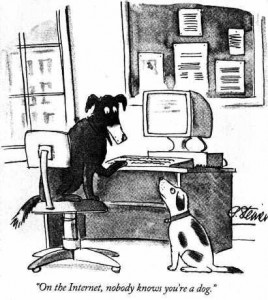
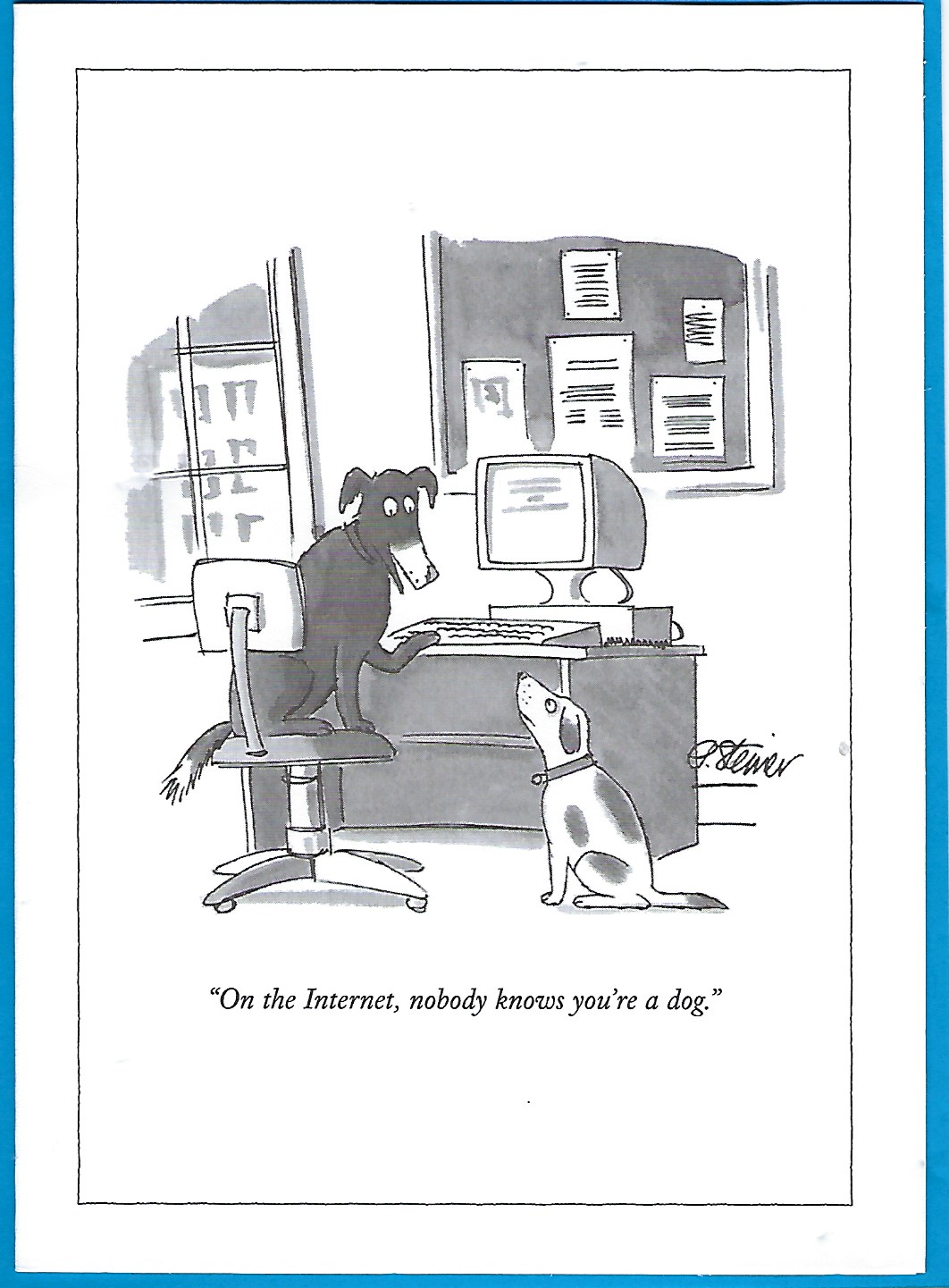
A very real discomfort underlies the classic joke: “On the Internet, nobody knows you’re a dog.” How can you prove your own identity and confirm the identity of others during virtual interactions? Every time you reach out to a friend on Gchat, post on a classmate’s Facebook wall, or send money to a colleague via PayPal, you are relying on a key assumption: that the person you’re reaching out to behind that Gmail address, Facebook profile, or PayPal screen name is who they say they are. Without this baseline confidence, online interactions and commerce would be paralyzed.

http://portalsandrails.frbatlanta.org/2011/10/cyberspace-trust-proving-youre-not-dog.html

Philip thinks:

  • The next step is to merge the identity sought by everyone and easily relegated to the Banks to manage.  Facebook and GMail offer an option if their KYC can be improved.  With face to face meeting it is possible to truly prove identity, requiring a branch network.
  • Transaction processing is legacy in the developed world while the emerging economies offer an opportunity to build new.  Existing standards and processes need to be respected as they transform to absorb the new information attachments and Internet offers we now need to cope with.
  • The Wallet forms the basic unit to create a trusted network employing smart cards, trusted computing, persistent computing and inteligence to enable the consumer experience.
  • Privacy and integrity of that trust is essential to the system
  • The individual is key
  • Respect rights and obligations


EMV is truly becoming the base for secure Card Authentication and Cardholder Verification

INCREASING EMV CARD AND TERMINAL DEPLOYMENTS CONFIRM EMV AS GLOBAL PAYMENT STANDARD
06 October 2010: As of 1 September 2010, over one billion EMV®* cards and 15.4 million EMV terminals were active globally. These are the latest EMV deployment figures reported by EMVCo, the EMV standards body collectively owned by American Express, JCB, MasterCard and Visa.

http://www.emvco.com/download_agreement.aspx?id=561

e-ID – a public utility or a space of trusted third parties

In response to the article published by Consult Hyperion

Conference paper e-ID as a public utility Neil A. McEvoy


Universality

Interesting that as soon as you identify that I should be able to provide my identity to anyone anywhere you state that a national government can offer such a scheme.  That is counter intuitive and fraught with the issue of achieving global standards of identification, given the bureaucracy of most national governments. 

Yes, ICAO was able to agree on a template and specification for the e-passport.  Fortunately they had a template and various agreements and treaties to justify the work.  But when we start out with the basic premise that my identity is how I wish to project myself; we immediately move into a world of nuance with built in mechanisms to embrace and resist change.  That being said Homo sapiens’ have a perchance to employ tools we morph as society and our world evolves.

Picking the right band of stakeholders to assure universality requires that at some point people abandon the idea that there is Profit in defining how we will digitally represent a person’s identity.  Instead because the consumer/citizen wishes to project or required to provide their identity; we leave it to those seeking to receive the information to find the profit in knowing something about me. 

Having been raised in America I am drawn to the words in our declaration of independence that give us the right to life, liberty and the pursuit of happiness.  Behind these words I believe I also have the right to my privacy and do not want to learn that morphing my identity into a digital form puts my identity at risk.  The citizen/consumer must be able to decide when and what information someone is able to scan.

All of this tempers my thinking about who should be engaged in defining the global standard for digital identity.

The two-way street

I could not say it better myself.  Like my business card, a police persons badge or a company id card.  We present these to each other to create trust between various parties and provide a degree of certainty that:

·         I am who I say I am

·         This is how you can locate and communication with me

·         Here is proof that I have the following rights and capabilities

Quick transaction

Very well said the exchange of information about my identity must be as easy as handing you my business card.  Everything after that is about the context of the transaction and will parallel the discussion and negotiations between the parties.

The gadget

My only addition to the supposition that the phone is the right gadget is the reality that we are talking about something that the citizen must be able to carry most anywhere.  So it must be the one object we always carry.  Some would argue this is the mobile phone; I would suggest that we not forget the more primitive device the purse or wallet.  Maybe as we think of identity we must also think of ergonomists and think about merging the phone into the wallet not the wallet into the phone.  Leather is eco-friendly warm and comfortable to the touch.  Metal or plastic tends to be brittle and cold. 

The next thought in respect to the gadget is it becomes the device I trust and will protect at almost any cost.  Should I worry about how trustworthy your device is?  All I want from you is the information you wish to share and any certificates others provide you that allow me to authenticate your rights and capabilities.  My trusted gadget is what I use to share information and certificates and what helps me absorb and as appropriate verify information and certificates others offer to me.

Extensions

Yes my information is mine and what I offer to others is my choice.

Scheme considerations

I am not convinced of the need for a central register.  Yes there is a need for third parties to attest to the citizen’s identity that others can trust and in lies the complexity of introducing a digital solution.  In fact what the citizen needs is a device they trust.  A device we trust, carries the information and certificates that third parties, who the counterparty trusts, capable of exchanging the appropriate digital data electronically.  In order to achieve this goal we must develop and support a cascade of standards, regulations, contracts and relationships that enable global interoperability thus assuring a meaningful means of exchanging our digital identity.

Before we go about defining the techniques that should be employed, I think we must first establish base principles.  Key must be the idea that there is no centralized register.  Instead those parties we as consumers are willing to trust and wish to position themselves as trusted third parties can build registries, recording those individuals they are willing to authenticate.  The citizen may wish to contract with an entity to provide support for the trusted gadget and the various relationships it supports. 

The author’s position on protecting privacy and meeting the needs of law enforcement is laudable yet scary.  I’d rather the protection offered by a distributed environment that still is capable of responding to directed queries from law enforcement and not blanket access to everything I or others have collected about me.

Make my gadget the gate keeper; allow service providers and those parties wanting the security of digital identity the ability through standards to build affordable infrastructure to read, with my permission, data stored in my gadget.  Avoid the complexity of establishing a global resister.  What we need to define is the architecture for a gadget that is capable of carrying and supporting a myriad of digital relationships with their linked need to assure proper identification.  We then need to agree on a common set of information that all sectors share.  Maybe the v-card is the base.

For more information I offer the following background and a concept for consideration.

The Promise of multi-application Smart Cards, refined to consider the device as the media

A bit of research to prove the consumer will understand