
From cash management to cryptographic identity — Philip Andreae has spent four decades at the center of how money moves, how trust is established, and how technology transforms both.
This page is the hub for Philip’s work on payments — spanning the card networks of the 1990s, the EMV standard, mobile wallets, contactless, blockchain, and the emerging identity layer that underpins every transaction. Follow the arc from physical cash to digital credentials, or jump directly to the topic that interests you.
The Payment Landscape
Payments are never just about money. They are about trust — between a buyer and a seller, between an issuer and a network, between a government and its citizens. The architecture of that trust has changed dramatically over the past thirty years, and Philip has been inside it at every stage.
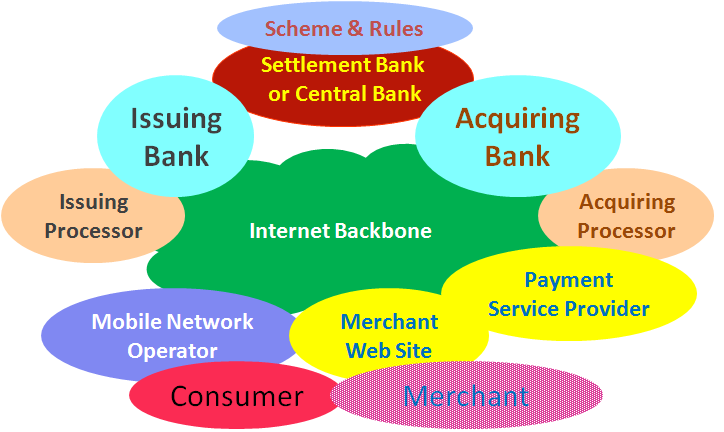
A Look Inside the Payment Landscape — the foundational document Philip produced for British Telecom, mapping every actor in a card transaction and their role.
Payments and Telecommunications — Friend or Foe — Philip’s exploration of the intersection between payment networks and telecoms infrastructure, from the early internet era through mobile.
European Card Payments — The Foundation
Before EMV had a name, the European card payment landscape was being built. Philip was inside Europay International as it was being formed, watching the collision of national schemes, cross-border ambitions, and chip technology. These two documents — written circa 1998 — remain among the most thorough overviews of how European card payments actually worked.
European Card Payments — Part 1 (circa 1998) — The scheme structure, the acquiring and issuing banks, the networks, and how a transaction actually cleared across borders.
European Card Payments — Part 2 (circa 1998) — The technology layer: chip cards, terminals, security, and the emerging interoperability challenge.
EMV — The Standard That Secured a Billion Cards
In November 1993, Philip sat in a conference room at the Hyatt Regency O’Hare and helped convince Europay, MasterCard, and Visa to build one chip card specification instead of three competing ones. The name — EMV — was his proposal: alphabetical order, no hierarchy, no politics encoded in the letters. The specification that followed is now on more than ten billion cards.
EMV: The Room Where Three Became One — Philip’s first-person account of the founding of EMV, the naming war, and the architectural tension between Visa’s online-always model and Europe’s offline-capable chip.
EPCOR Spring 2018 Keynote: EMV — Chip and Choice — Philip’s keynote on EMV’s evolution, the choices it left behind, and what the standard became versus what it was designed to be.
2011: America Finally Embraces Security for Card Payments — Philip’s writing and speaking on the long-delayed US migration to EMV, including his “EMV for the USA 2013: A Founder’s View” presentations.
What is a Smart Card? A Short Overview of the Technology Behind EMV — the foundational technology explained for a general audience.
Mobile Payments — From Concept to Mainstream
Philip proposed the mobile wallet concept in 1996 — a decade before the iPhone, fifteen years before Apple Pay. The journey from that proposal to today’s contactless, NFC, and app-based payments runs through his work at Europay, his CanDo initiative, and his ongoing writing on the mobile payments ecosystem.
My Wallet — Prior Art and the Mobile Wallet Concept (1996–Present) — Philip’s documented prior art on the mobile wallet, from the 1996 Europay proposal through the 2006 device architecture and the CanDo ecosystem expansion.
Mobile Wallet Prior Art: From Europay to My Wallet to CanDo — the detailed prior art record for the mobile wallet concept.
Mobile Financial Services (circa 2009) — an early taxonomy of what mobile payments actually meant: P2P, remittance, mobile banking, contactless POS, and the stakeholder challenge that nearly every implementation underestimated.
Mobile Payments circa 2009 — Philip’s contemporaneous notes on the state of mobile payments as the smartphone era began.
2009: Google Ponders Mobile Payments — Philip’s response to Google’s early mobile payments thinking, and his prediction of where the winning solution would need to land.
CanDo — the initiative that expanded the mobile wallet concept into a full ecosystem play, connecting issuers, merchants, and governments at scale.
Cards Designed By You — The Payment Card Reimagined
Cards Designed By You — The Payment Card — Philip’s concept for personalized, consumer-designed payment cards, exploring what happens when the physical credential becomes a canvas for identity expression.
Blockchain, Crypto, and the Future of Value
Cryptography was always the foundation of secure payments — the chip in an EMV card uses the same mathematical principles as a blockchain. Philip learned cryptography at the hand of David Chaum, whose work on digital cash and blind signatures laid the groundwork for everything that followed. The move from cryptographic payment security to digital assets is a straight line, not a detour.
Crypto — Philip’s reflection on the arc from symmetric cryptography to PKI to digital assets, and what it means that electrons can now carry value the way paper once did.
BLOCKCHAIN Economy — Philip’s exploration of the economic implications of blockchain as a settlement and governance layer.
What is a DAO and How Do We Govern Tomorrow? — moving beyond currency to the question of how decentralized organizations change governance, accountability, and trust.
Identity — The Layer Beneath Every Payment
Every payment is an identity event. Before a transaction can be authorized, someone must answer: Who are you? Do you have the right? Can this be trusted? The evolution from magnetic stripe to chip to biometric to self-sovereign identity runs through Philip’s work across three decades.
Identity — Philip’s hub for the philosophy, technology, and politics of identity — from Prime Ontology to self-sovereign systems to what happens when the power goes out.
FIDO — Fast Identity Online: the authentication standard that replaces passwords with cryptographic proof of presence, and why it matters for payments.
FIDO Overview — Secure Technology Alliance, June 2015 — Philip’s presentation on FIDO at a critical moment in the standard’s adoption.
FIDO — The Case for Better Authentication — the argument for moving the payment industry away from passwords and toward cryptographic identity.
Digital Identity and Authentic Relationships — Philip’s broader reflection on what identity means when it is mediated by technology: not a credential, but a relationship.
Let’s Talk Identity Basics — a clear-language introduction to the identity stack for non-technical audiences.
IoT and the Payments Everywhere World
As payments migrate from cards to phones to objects, the question of who authorizes a transaction becomes dramatically more complex. Philip’s IoT payments writing — from Money 2020 sessions to standalone essays — addresses what happens when the payer is a device, not a person.
A World of Connected Objects Designed to Serve Us — Philip’s framework for IoT as a trust infrastructure challenge, not merely a connectivity one.
A World of Connected Objects — Secure Technology Alliance, October 2017 — Philip’s presentation on IoT security and payments to the Secure Technology Alliance.
The Kennesaw Educational Series
Kennesaw Educational Series — Philip’s lecture series on payments, identity, and security technology, designed to bridge the gap between academic understanding and industry practice.
Where This Work Lives in Philip’s Career
The payments work on this site spans Philip’s roles at Europay International (EMV co-founder), PA&A (payments consulting), Multos International, and his ongoing advisory work. For the full career context:
A Career in Three Phases — Philip’s full career arc, from Wall Street to Europay to the global EMV rollout and beyond.
PA&A — Philip’s consultancy, its work, and its clients across the global payments industry.
PA&A Speaking Engagements — Philip’s keynotes, panels, and presentations at industry conferences on payments, identity, and security.
EMV → · Identity → · FIDO → · PA&A →