Authentication or Identification

Two words Authentication and Identification.

Reading what Wikipedia had to say about authentication leads to an interesting array of discussions across a wide set of sciences and other social segments. The exploration led to a search for a definition of Identification:

  • The act of identifying, or proving to be the same.
  • The state of being identified.
  • A particular instance of identifying something.
  • A document or documents serving as evidence of a person’s identity.

Next exploring what Wikipedia had to say about Authentication leads to a much richer discussion aligned around the idea of assuring the truth of a particular attribute, someone is claiming to be true. Seeking to assure a degree of parallelism to the discussion:

Authentication is

  • something which validates or confirms the authenticity of something
  • computing proof of the identity of a userlogging on to some network

These two words: authentication and identification, some think represent the same act, yet when we bring into the conversation – privacy the two words have very different meanings.

We then have to think about the how and the what we are attempting to do.

In the physical world there are a set of situations and considerations. We will leave those for another article.

When we think about the digital world, this place were our physical presence is not present. We must find solutions that prove we are who we are without necessary needing another to vouch for our identity each time.

As a consumer we want the freedom to visit multiple sites and believe that where we visit and who we interact with is not open to all to know.

As I write, I can hear some say, all our stuff is known so why try to hide. They are correct and then they miss the concern – who knows. Not to get distracted.

Verification, a third word must enter into the discussion. In order for anything associated with only serving or sharing with a clear and identified party one needs to be able to provide Identity.

Trust – the truth of our identity

Such a big word.

This Sunday our minister spoke of Mark 5:20-43 and how we must trust in Jesus.

Her evocative sermon provoked a wider or is it broader question,

“What is Trust”.

First we must ask the classic question what does the Dictionary and Wikipedia say. This then leads us to have to think of the use of the term. Are we using it to describe a legal structure, the nature of a business, a computational concept or the name of a film, song or other human creation?

Given this discussion started as a result of a sermon, the best approach is to consider the social and emotion context of trust. Understand the sociology, psychology, philosophy, economics and systems perspective, may offer clarity to the words “we trust … “. In the first paragraph the Wikipedia authors condensed a lot of thought into a short paragraph. {formatting of my doing}.

Definitions of trust typically refer to a situation characterized by the following aspects:

  • One party is willing to rely on the actions of another party (trustee); the situation is directed to the future.
  • In addition, the abandons control over the actions performed by the trustee.
  • As a consequence, the is uncertain about the outcome of the other’s actions; they can only develop and evaluate expectations.
  • The uncertainty involves the risk of failure or harm to the trustor if the trustee will not behave as desired.

In this flow of thought it is clear this word trust carries with it risk. It assumes we are thinking of tomorrow and there is an expectation the trustee will act in a manner that is consistent with our “the trustors” wishes, hopes and desires.

Vladimir Ilych Lenin expressed this idea with the sentence “Trust is good, control is better”.

In the field I have spent the better part of my life, computers have played a big part. Be it as a tool we programmed to perform a function or task. Or, the systems supporting the products and services we sought to promote. More recently, as we look to this global village we are a member of. We think about the need to establish mechanisms to assure trust between parties. Parties who probably will never meet, in person or even by chance speak to. We must therefore establish acceptable social and psychological mechanism with machines which we inherently are wary of.

Looking to the sociology of trust set of sentences stands out

“It does not exist outside of our vision of the other. This image can be real or imaginary, but it is this one which permits the creation of the Trust.” … “Because of it, trust acts as a reductor of social complexity, allowing for actions that are otherwise too complex to be considered (or even impossible to consider at all); specifically for cooperation.”

All of this leads one to wonder how in a anonymous world can trust be established.

Trust is specifically valuable if the trustee is much more powerful than the trustor, yet the trustor is under social obligation to support the trustee.

In a social context this thought offers a view as to the dominance a position the trustee must have in society. It also frames the responsibility and the obligation established by the trustor in the trustee.
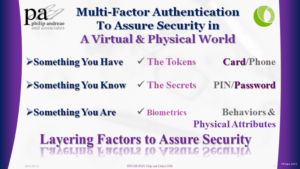
This then leads one think about Multi-Factor Authentication. MFA is emerging as the standard method companies are used to assure one of degree of “trust”. Trust in a claim of the identity of another, be it a customer, employee, citizen or recognized guest.

Is this enough? How can a company be assured of the identity of an individual? How can we, a third party, accept the claims or attributes offers when they are presenting themselves to us. Especially when they present themselves across a global digital highway, prone to the nefarious acts of those who seek to take advantage and profit.

Proof of identity therefore becomes the primary means of establishing trust in an seemingly anonymous space – Cyber Space. This need for proof of identity is the role of the Trustee. These parties who we instinctively have faith in can give us the ability to trust in the claims of identity and the associated attributes representing the characteristics, assets and relationships a person has.

For now I will stop. The next step is to think of and look at words. enrollment, proof, identification,registration, identifier, authentication, rights, privileges, claims, certificates and authority.

What scares me most

Tonight while preparing to listen to the Atlanta Symphony Orchestra play a bit of Beethoven I have a moment to reflect on the Worldview.

Once upon a time one could turn on the news and get a glimpse of what is happening at home and round the world. One could pick up a newspaper and think this will provide me a glimpse of the truth.

Then! In emerged the capabilities of communications and the capacity to write and distribute anything to a vast number of individuals. Otherwise called the Internet.

Yet, what is different? In the past books were burned, history was rewritten and lies were told. The challenge,today we can manipulate what people believe, on a global scale, in realtime. We can spread disinformation and drive the masses to believe anything people with a voice and the power to thrill want to convince them to believe.

Starting in 2016 who would become the American President proved this to be possible. The media demonstrated that they can spin the truth in whatever direction they so desire.

This week the story is about how the DOJ and the FBI obtained warrants from one of the strictest courts in the land. Every 90 days bringing new information, they convinced the FISA court to allow them to continue to investigate the potential actions of our enemy, Russia, or, what was the USSR. What the Russians did was evil and manipulative. I somehow doubt the GOP’s version of the trutb.

Vindicated! Donald thinks he is. Yet, for those who take the minutes to read, one can only wonder what does this incomplete review of the facts actually prove? Nothing!

I wonder why I waste so much of my time listening, reading and worrying. Is there truly a risk? Are we so divided that it matters. Maybe!

Part of the challenge, many think President Trump is doing good. They accept his narcissistic personality and read his tweets with a simply, oh please stop. The rest of us cringe and worry. We consider the risks. We watch our leaders splinter and the divide expand, and we hope for a better day tomorrow.

Fir thise that seek out the truth, we explore and we become aware of the elements that are driving us into the Fourth Industrial Revolution. It causes us to wonder what can we do to bring the masses, those unskilled workers, who have been marginalized by intelligent robots, programmers, engineers and managers out of desolate. We work to reduce the numbers of workers and expand productivity all while ignoring the realities of the human repercussion ahead.

When I started this note, the thinking was about those who do not accept science, believe the world is flat and maybe 9,000 years old. They do not accept, we human kind, are responsible for the wrath of our planet’s climate. They do not appreciate the dangers ahead, as we change the balance of our atmosphere and pollute the lands and oceans that sustain us.

What next?