
Part 6 of 7 in a series continuing The Asymmetry — Seen From Their Side, which asks whether the rules we demand from an adversary are rules we are willing to apply to ourselves and our allies.
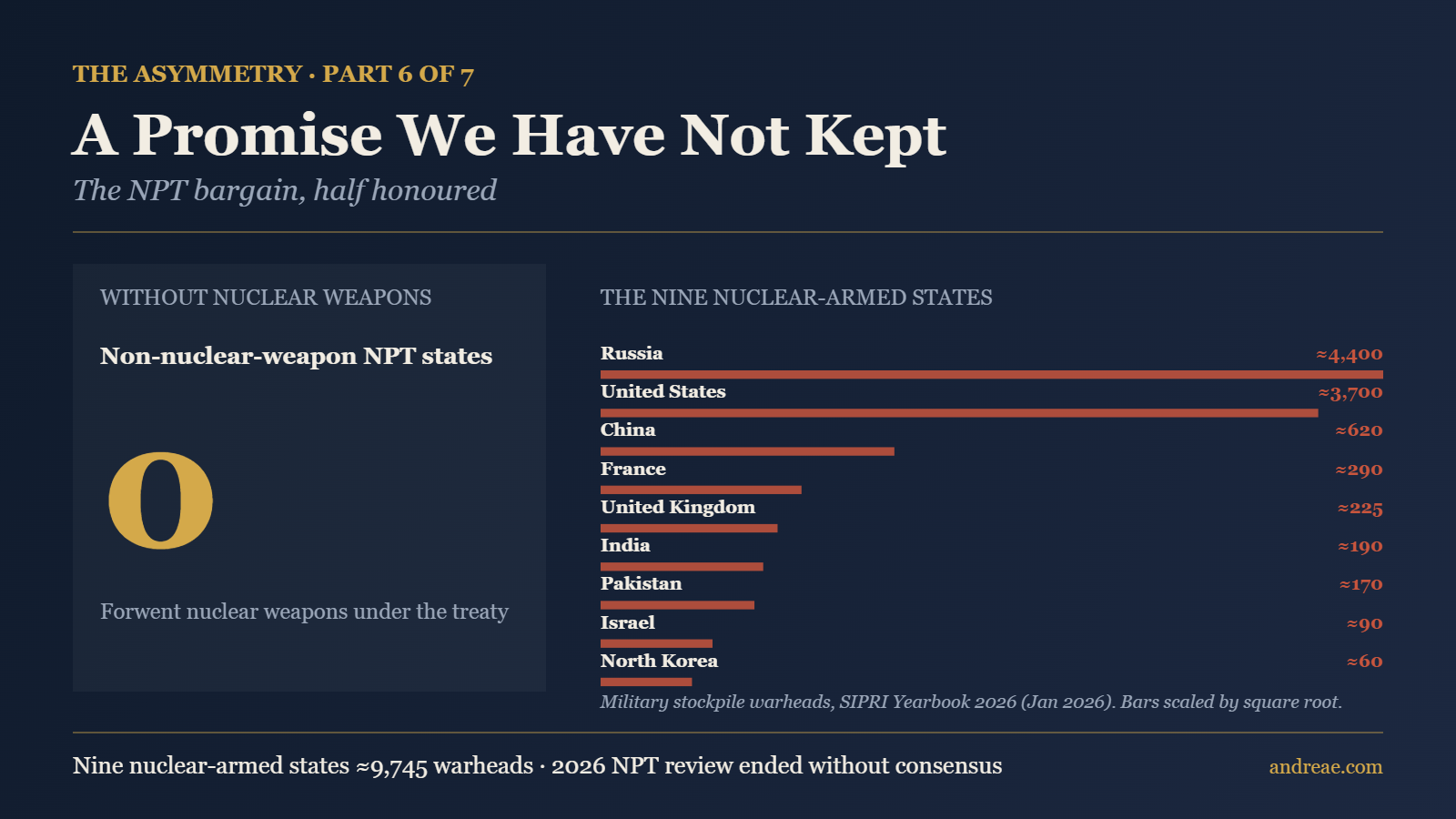
The NPT rests on more than a demand that additional countries forgo nuclear weapons. It also obliges its parties to pursue negotiations on nuclear disarmament. In 1995, the indefinite extension of the treaty was accompanied by a resolution supporting a Middle East zone free of nuclear, chemical and biological weapons and their delivery systems. That objective remains unrealized. The May 2026 NPT Review Conference again ended without consensus. [18][19]
Iran’s treaty violations or unresolved safeguards questions deserve scrutiny. So do Israel’s security concerns. So does the continued possession of nuclear weapons by the most powerful states. Consistency does not mean pretending different cases are identical; it means applying the same principle to each and explaining every exception.
Sources
[18] UNIDIR, 1995 NPT Resolution on the Middle East
[19] United Nations, NPT 2026 Review Conference outcome, May 2026
Full exhibits and source trail: The Asymmetry — Seen From Their Side.
AI collaboration: Andreae.com/aiwork — working method.