
How do we
thrive together?
My more cannot be your less.
Survival for every family.
A satisfying life for everyone.
A living world that can sustain us.
The Golden Rule begins with reciprocal respect, including asking what another person actually needs. The Golden Eye and its five threads help us examine how those intentions affect others in practice. {《 ¿ why not ?》} asks what stands in the way, who can change it, and who bears the cost.
Enter the inquiry ↓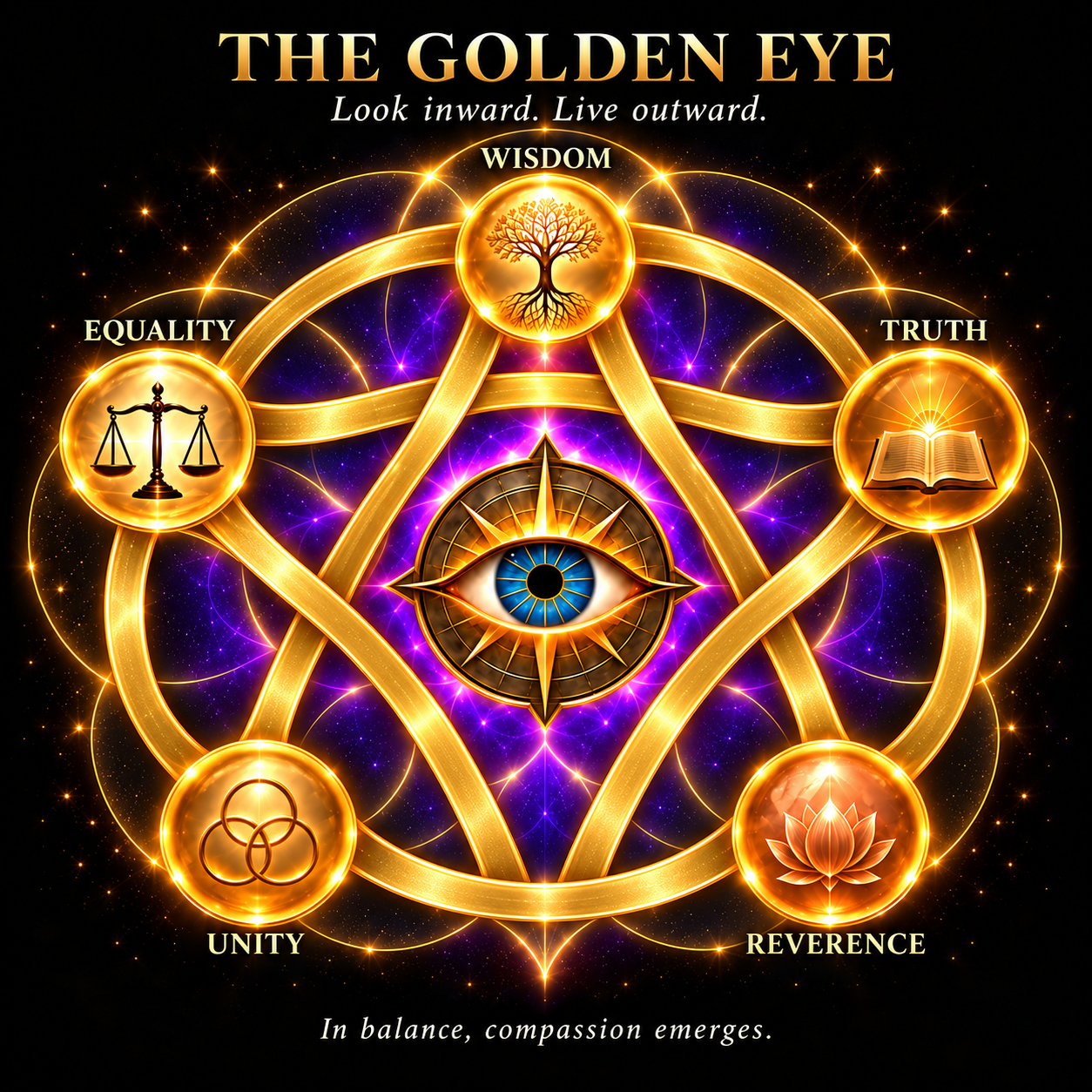
The search
for Utopia
My ancestor Johann Valentin Andreae, in Christianopolis; Thomas More, in Utopia; Tommaso Campanella, in The City of the Sun; and William Morris, in News from Nowhere, each imagined how society might be organized differently.
Their visions differed, but each opened a search we can continue: how might we secure the essentials for survival, care for those in need, and enable a satisfying life for everyone?
Here, that search meets {《 ¿ why not ?》}—the forces that frustrate our aspirations, and the structures we must build to keep a common morality alive.
Dine with your enemy frequently.
Love your neighbors.
Respect all of the human race.
Take care of those in need.
Assure all a satisfying life.
Look inward.
Live outward.
Please. This is what I wish we could all do: live by the reciprocity expressed in the Golden Rule, care for those in need, and build a society in which everyone can pursue a satisfying life. Begin with how we treat one another, then carry that responsibility into the institutions through which we live.
The Golden Eye asks us to look inward and live outward. Five threads help us bring those two directions into balance.
Reverence remembers what came before us: our ancestors, their achievements, their failures, and the living world we inherit. Remembering carries a responsibility to learn, including when an inherited practice caused harm.
Truth asks us to understand what is happening now, including what we would rather overlook. Wisdom draws on that understanding and remembered experience to judge what we should do next.
Equality recognizes our equal human worth. Our circumstances and needs differ; our dignity does not. Unity asks us to act together toward a shared future, leaving room for disagreement and correction.
Together, these threads give shape to the common morality we seek. Their balance requires continual attention: whose voice is missing, whose needs are overlooked, and what are we asking others to bear?
My more cannot be your less.
“My” may mean a person, a family, a business, a tribe, a city, or a nation. “Your” may mean any of those, at any scale. One person’s gain can drain a city’s water; a nation’s prosperity can diminish another people’s future. The boundary around the benefit rarely contains the whole cost.
When balance fails, inequality can emerge in access to water, food, safety, opportunity, or a voice in decisions. Scarcity may begin with geography or circumstance; our choices determine how its burden is shared. The test is whether our more depends on depriving others of the conditions for a satisfying life—including those who come after us.
Our responsibility extends to the other living entities and ecological relationships that sustain that life. We must ask how ownership, work, exchange, and government can support this balance in everyday practice.
Explore satisfaction →{《 ¿ why not ?》}
Why not? is our recurring challenge: what prevents a better outcome, whose authority sustains the obstacle, what could change it, and who pays the price?
Fear, greed, exclusion, competing needs, and concentrated power can pull us away from our aspirations. A durable society must make these pressures visible, limit the harm they can cause, and preserve the means to correct its course.
The Rise to Rule
How does a belief gather followers, become an institution, and acquire power over people who do not share it? The danger deepens when conviction becomes a claim to rule—and the power to enforce obedience. Follow that rise through religion, politics, ownership, and everyday life. At every step, ask who gains authority, who bears its consequences, and whether those subjected to it can question, refuse, or change it.
What prevents the outcome? Who can change it? Who bears the cost?
Land can be divided on a map, but shared waters, human belonging and places held sacred cannot always be allocated like interchangeable goods. The question is not simply who holds title, but whose life, access, identity and future are affected. The Lie examines how inherited stories can shape claims to authority.
Employee ownership and a meaningful employee vote on long-term strategy are among the proposals I am exploring: ways to connect stewardship of the planet, continuity of work, and returns to those who invest. The ownership and voting arrangements remain under development.
Understand what you do before trying to do it better. Without that understanding, redesign produces re-engineered mush. Establish how things work today: what succeeds, what fails, who benefits, and who carries the cost.
Design the present as the past of the future. Once we understand what we have, we can choose what to change now to move toward the future we seek. For example, if tomorrow’s families will need clean water, today’s land use, infrastructure and ownership decisions must protect that supply instead of passing on a depleted watershed. Reverence remembers; Truth examines; Wisdom guides; Equality tests the consequences; Unity helps us act.
Explore the work
Different inquiries.
A shared concern.
The Golden Rule, reciprocal responsibility, and the search for a common morality.
Who we are, how we belong, and how recognition becomes trust and participation.
Power, resources, conflict, and the obligations we carry beyond our borders.
The Caravan is the travelling group in the HESUS / ISSA historical drama, a way to explore encounters among different faiths, peoples and ideas of responsibility.
An inquiry into number, relationships, and the emergence of structure.
Follow the threads
Golden Threads brings the image, the Eye, and the five threads together as a journey.
Temperament is part of {《 ¿ why not ?》}. Explore DNA, temperament, and the people who must live our proposals.
Keep the inquiry open
These pages hold developing as well as established ideas. Through the Swirl, we investigate, challenge, test, and refine. Agreement does not establish truth; proposals must remain answerable to evidence and to those affected.
Read our working method →For my professional background and senior advisory work, begin with About and PA&A.